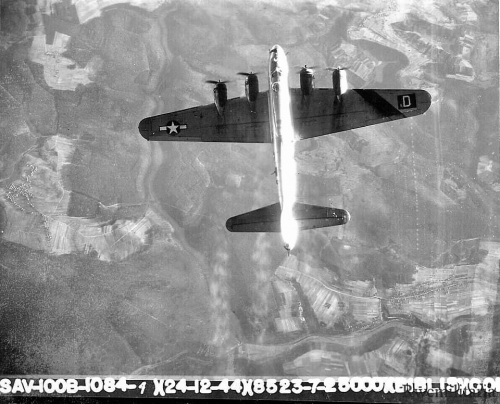
Mission Date: December 24, 1944
BIBLIS, BABENHAUSEN, KAISERLAUTERN
100th BG Mission #: 235
Mission Summary
ON THIS DAY - December 24, 1944
The 8th Air Force had been grounded for five days due to the bad weather covering Europe but by December 24, the weather was clear and the 8th would fly under a ME, maximum effort order. In support of the Battle of the Bulge, the 8th Air Force would fly its largest air operation of the war totaling 2,046 aircraft.
As the 100th’s crews observed for themselves in the crowded briefing room that cold Christmas Eve morning, it was all ‘hands on deck.’ A total of sixty-five crews had checked in with the attendance man at the door.
The airmen were instructed to keep the Luftwaffe out of commission to give the American troops on the ground room to maneuver. Their primary visual targets for the day's mission would be the grass airfields in the Frankfurt area. Intelligence had determined that a large portion of the Luftwaffe's ground support aircraft had been moved up to the airfields in the area.
The 13CBW would be sending six of its groups up to take the fields out of commission. The Biblis field, located seven miles northeast of Worms was to be ‘post-holed’ by the 13CBW’s ‘ A’ and ‘B’ groups. The Zellhausen field, located seven miles SSE of Hanau, was to be ‘post-holed’ by the 13th’s ‘C’, ‘D’, ‘E’ and ‘F’ groups. The post holing would be accomplished by the thirty-eight 100 pound general purpose bombs that each of the 100th's aircrafts would be carrying.
The men, listening intently, were told that if the ships were unable to bomb the primary target visually, they were to move to the secondary target of the railway facilities in the Frankfurt Area: The ‘A’ and ‘B’ groups would target the railway traffic centre at Pforzheim, while the remaining formations would target the railway workshops one mile WSW of Kaiserslautern.
The entire 8th Air Force would be led by the 3rd Division, which would be led by the 4th Combat Wing. The 13CBW would fly second in the Division column, led by the 390BG.
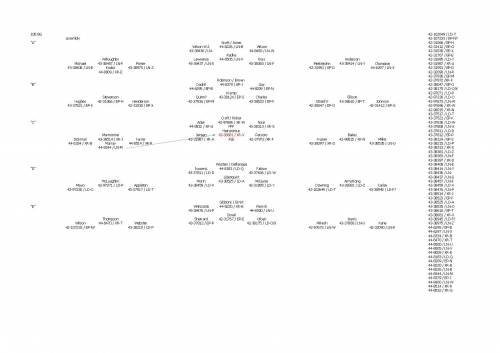
The 100th’s ships would fly in multiple formation configurations — in their own Group formation and in composite formations with other Groups: the 100th's ‘A’, ‘B’ and ‘C’ squadrons would fly as the ‘C’ Group, the 100th’s ‘D’ squadron would fly as the low squadron in a composite formation with the 390BG in the wing’s ‘B’ group, and the 100th’s ‘E’ squadron would fly as the low squadron in a composite formation with the 95BG in the ‘ E’ group.
Neil Scott and Donald Jones would lead the 100BG’s main formation. The squadron flying with the 390BG would be lead by John Gibbons and John Ernst while the squadron flying with the 95BG would be lead by Joseph Ricker and Fred Craft.
The sixty B17s plus five Pathfinder aircraft took off as scheduled. Arriving at buncher 11, the wing assembly was completed at 1048 at 7000 feet. The Division assembly was completed at 1118 at Felixstowe and the formation hit the Belgium coast at 1135, flying over Brussels, where German fighters surprised the Division.
100BG Main Formation ‘A’ Lead Squadron - Bombed Biblis
Art Juhlin in the Donald Jones' lead ship tells us, « Encountered bandits shortly after passing Brussels, but our fighters got them before they could make a pass at us. Saw four bandits spinning down in flames and crash. Also saw a jet propelled job, who stayed out of range and kept shadowing us.

At the lines near Malmedy we went thru a heavy and extremely accurate flak barrage. Saw three B-17s get direct hits and go down flaming. We received hits on our right wing gas tank. Leading the task force we had a little trouble picking up the target due to ground haze and being headed into the sun. Went over the target in squadron formation at 25000 feet and really plastered it…”
The German pilot shadowing the formation was providing altitude and speed information to the cannon gunners down below. On his #9 mission, twenty-one year old bombardier Robert Fitzgerald in with Wilson’s fortress in the wing position off of the Jones' lead ship added, “About 30 miles west of Frankfurt a group of tanks opened up on us with their 88MM. They had our range and hit every plane in our group. A fortress in the group in front of us went down in flames.Our elevator controls were knocked out and we flew the rest of the mission on our trim tabs. We flew around Frankfurt and came in on the bomb run from the East. I watched two groups bomb another airfield and both hit it good. The next group hit a small town. It looked like the town was completely demolished. We hit our target perfectly and some of the bombs hit in the woods along side the airfield which must have had gas storage tanks. There were some large explosions and much fire. After leaving the target we had to fall out of formation because of the elevator control problem. A sitting duck for enemy fighters but we didn’t see any…”
Flying the lead squadron’s high element lead was the Walter Bailey crew. Their engineer, Calvin Dollar remembered the flak barrage and the bitter coldness. “We had a very close call, nearly collided with a plane below us. The temp. was 44 degrees below zero.”
100BG Main Formation ‘B’ High Squadron - Bombed Kaiserslautern
The high squadron was led by John Robinson and Gerald Brown. This squadron bombed the secondary target, the marshaling yards at Kaiserslautern due to the failure of the PFF equipment in the lead aircraft.
Nineteen year-old waist gunner James Smith from the Walter A. Charles crew, flying in the ship ‘Glory Bound’ remembered, ”Our primary target was an airfield but we didn’t hit it. We went over it with our doors opened but we closed them and went on to Kaiserslautern, an important supply center, and hit the marshaling yards. The flak was really accurate but wasn’t so much. They knocked one ship out over the line when we went over. So much of the flak is uncharted now since they’re using railroad cars. Then we hit the target - Xmas Eve. “
100BG Main Formation ’C’ Low Squadron - Bombed Biblis
The low squadron, led by Edward Wooten and Jean DePlanque, also bombed Biblis under the same CAVU conditions with some ground haze.
The Eugene Jensen crew flew #2 position of the low element of low squadron and his bombardier, Richard Ayesh remembered: “Our route in took us directly over the German salient where we encountered heavy accurate flak. ‘Bandits’ were reported in the area. It is very clear, visibility excellent. I saw a B-17 in the group ahead of us get a direct hit and saw him tumble down out of formation. He was breaking up and I could see his wing and tail come off. I didn’t see any chutes. I saw another one fall out of formation and spin down. I followed him down and saw him explode right next to a small town. A single chute came floating down beside the wreckage. Another Fort got a hit and disintegrated…Immediately after E/A were reported in the area, I saw 4 balls of fire in one place and 3 in another which were flaming fighters. I hope they are Jerry fighters. We found our airfield and trained the bombs right across it. Our objective was to hit these fields the Nazis were using to base their fighter support for their push. Flak was everywhere…”
100BG ‘D’ Squadron - Low Squadron flying with the 390BG in a composite - Bombed Babenhausen
The ‘D’ squadron was led by John Gibbons and John Ernst. Flying in the composite formation with the 390BG, they encountered tracking and accurate flak. Although the squadron made a visual bombing on the Babenhausen airfield, their bombs fell short of the target.
It is believed that the Don Liljenquist crew also flew in the ‘D’ Squadron. After his #13 mission, waist gunner, Guy Weaver recorded into his diary, “We flew our ship ‘Miss Conduct.’ Our target was an airfield at Kellenhusen, it’s a field used for there big drive…There was moderate flak over the lines. We saw 2 B-17's go down in flames from flak. Two more went down after they got prop wash and crashed together. I watched them until they hit the ground. No chutes. We got hits in the left and right wings. One hit by the pilot and 3 in the tail. After bombs away we passed by a town and another bomb group bombing a town near Frankfurt it was really knocked out. The whole town was in flame. I was really sweating this one out. Tomorrow is Xmas. Thank God for our safe return.”
100th’s ‘E’ Squadron - Low Squadron flying with the 95BG in a composite - Bombed Biblis
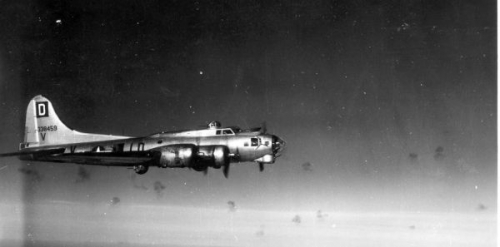
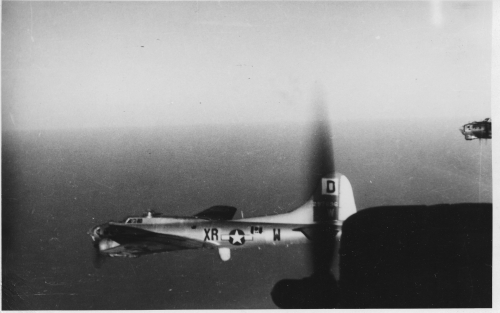
The ‘E ‘ squadron was led by Joseph Ricker and Fred Craft in the PFF ship named ‘Terrible Termite(4)’. Flying with the 95BG, their squadron also bombed the Biblis airfield visually with PFF assistance.
Ricker’s gunner, William Crozier tells us, “Our trip was not so light. We strayed over a heavy flak area before reaching the I. P. We got through it but others are not so fortunate as we. Tong had very close shaves twice. On the bomb run, a piece of flak came through the nose and knocked his flak helmet off. The shattered plexiglass cut his nose slightly. When he was telling us about it over the inter-com another piece came through and hit his flak jacket in his middle and knocked him over backwards. The flak knocked the breath out of him for a few minutes but he recovered and dropped our bombs on and smeared the target.”
Bombardier, Albert Tong was twenty-three years old when he was “showered with plexiglass fragments when flak tore holes in the bombardier's compartment of his Fortress, and twice again was thrown from his position with flak glancing off his flak suit, his flak helmet and ripping off his oxygen mask. When he returned to base, a medical examination showed that Lieutenant Tong was physically fit, although the flak suit he was wearing buried some anti-aircraft fragments, as souvenirs of the experience.”
The 100BG made it through this mission without losing one fortress and only one ship had aborted the mission; Raymond Heironimus had returned early due to his #3 supercharger going out. Some of the squadrons made it back to the base before dark, but many of the ships that had bombed the Biblis target would not circle the field until 1800 hours trying to land that Christmas Eve, hours after the others had returned.
Pilot Gerald Brown, flying lead for the main formation’s high squadron had lost one engine due to flak over the target. Flak had also blown out his left tire and to complicate matters, because of problems with their bomb rack, they were landing with four bombs still on board. Upon landing, their flat tire caused their B-17 to cartwheel into the mud with a wing still on the runway. Radio operator, Bud Vieth recalled, “All of us on the crew jumped out and were joined by others on the ground, all attempting to push our plane out of the way. The planes behind us were diverted to an alternate runway, but shortly another plane had a mishap there and it became necessary to use the runway our B-17 was partially blocking. The next plane to land on our runway struck the wing of our plane and almost tore it off. This at least cleared the runway and the rest of the planes in our group were able to land. WHAT A CHRISTMAS EVE!!”
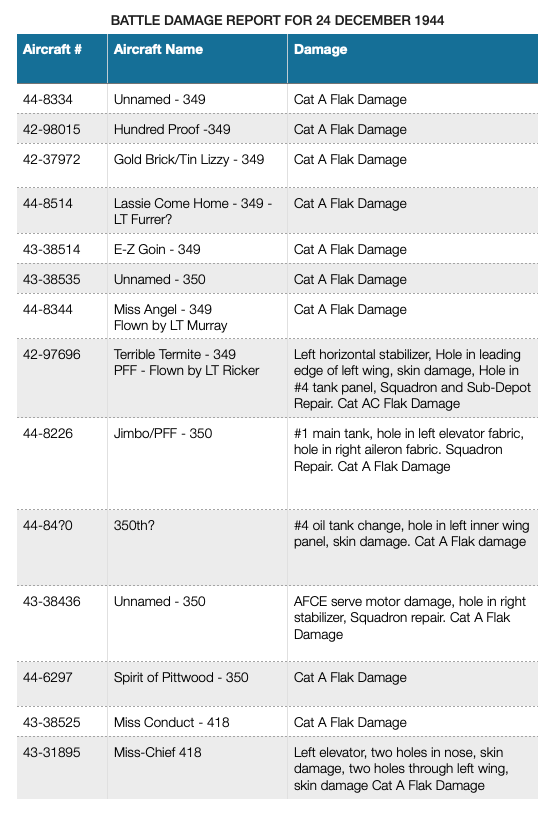
The lead squadron’s ships also returned late and with battle damage. Robert Fitzgerald remembered, “We didn't get back to base until 1800, 8 and one-half hours in the air. We landed with one tire shot out, also had holes in our gas tank and de-icers and auto-pilot shot out. Our original navigator Lou Chappel flying in a lead plane with a flat tire and crashed up on the runway and then had the next plane behind crash into them. A good friend of mine was wounded today. Marvin Berg a bombardier in our barracks. He was not expecting flak from the tanks and was caught by surprise like the rest of us. As soon as he saw flak exploding so close in grabbed his parachute and snapped it onto his chest. Right then a piece of flak went through his hand, hit the metal handle on his parachute rip cord and bent it double. Hitting the metal handle probably saved his life.”
On this first air mission flown in support of the Battle of the Bulge, the 8th Air Force’s bomber casualties included fifteen killed in action, twenty-one wounded and seventy-six missing. In addition, seven P-51 fighter pilots were lost.
Although all of the 100BG’s ships and men came home, the 3rd Division as a whole, lost eight B-17’s. An additional eleven were damaged beyond repair and three hundred and thirty-seven ships returned with battle damage.
Upon their return, the men sadly learned that Brigadier General Frederick Castle, leading the entire mission at the head of the Third Division, had been killed. Flying with the 487th Bomb Group, his plane crashed in Belgium being attacked by German Me-109s over friendly territory.
Christmas Eve at Thorpe Abbotts
That Christmas Eve, those men on base listening to the radio, were shocked to hear along with the rest of the world, that Major Glenn Miller, the famous American bandleader was missing. Miller and his band were scheduled to fly to France to play for the soldiers fighting there. Flying ahead of his band, Miller left Bedfordshire, England for Paris on December 15, taking off in the fog in a small airplane. He never arrived in Paris, disappearing somewhere over the English Channel. Although Miller disappeared on the 15th, the information was withheld for days hoping he would be located. The band was scheduled to broadcast The AAF Christmas Show led by Glenn Miller on Christmas Day at 7 PM or 2 PM war zone time the next day so it was decided to finally announce that Major Miller was missing before the show’s air time.
Many of the ground echelon at Thorpe Abbotts were greatly saddened by the news. Earlier in September 1944, Glenn Miller and his American Allied Expeditionary Force band had played at the base for the entire 13th Wing’s personnel.
A Christmas Eve Service for Protestant airmen was held at 2000 hours along with a Midnight mass for the Catholics. That particular Christmas Eve, there were many reasons for the men to attend one religious service or another: the Group's safe return from the day’s mission, the news from the front and the loss of Glenn Miller, and the death of General Castle. While Christmas carols were sung by the men in their services and sounding over the tannoy system through the evening hours, the mission light glowed red — a mission was on for the next day.
Alerted that they were to fly on Christmas morning, sleep did not come easily that night for the Wood crew and many others. That Christmas Eve, Joseph King and his crew arrived to the 349th Squadron. His copilot, Robert Culp remembered, “They were using flashlights in the Barracks when we arrived as it was very late and they didn't want to wake anyone. 1 guy was standing on a top bunk screwing in a light bulb and everything all of a sudden lite up. He said, "We're flying tomorrow — we can't sleep anyway! “
Bombing Results
Bombing Results: EXCELLENT
Aircraft Lost: 0
Crew Lost: 0
Claims of Enemy Losses (CLS): 0
Aircraft Returned:
Media Articles
Use your thumb to scroll through the results box below.
| Media Item | Type | Page | Volume/Issue | Broadcast Source | Time | Description | File |
|---|---|---|---|---|---|---|---|
| Battle Damage December 24 1944 | 12:00 am |