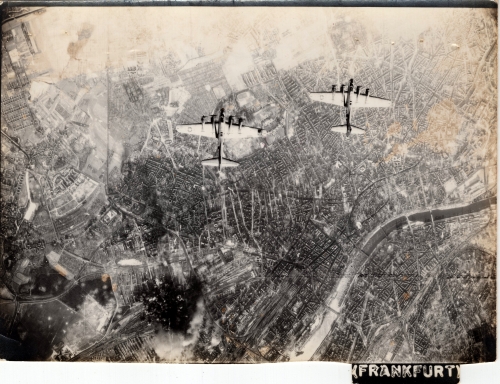
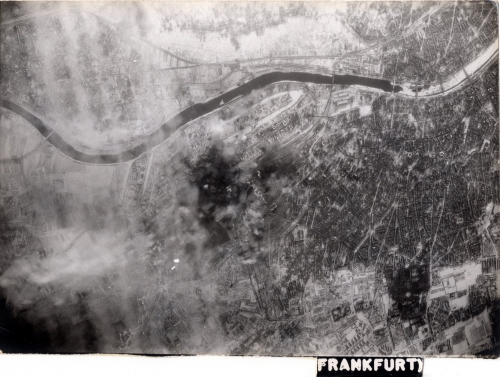
Mission Date: December 29, 1944
FRANKFURT, MY
100th BG Mission #: 239
Mission Summary
ON THIS DAY...December 29, 1944
After being awakened on December 29, the alerted crews headed to breakfast in the bitter cold made worse by the driving rain conditions. It was the 351st’s turn to Stand Down. The lead crews had already been briefed earlier at 0445 for Zietz, located near the dreaded Merseberg. Hearing about any target close to Merseberg, made the boys nervous as hell and thankfully at 0600 hours, the target was changed to Frankfurt.
At the main briefing, all of the airmen in attendance learned that the primary target would be the railway's marshaling yard on the western side of Frankfurt am Main. It was a compact yard with a sorting siding with the capacity to handle 3100 wagons in a twenty-four period. The siding was in the center of their target and the boys were instructed to take it out of commission.
Once again, the 100BG was to lead both the 13CBW and the 3rd Division. Leading the 100th’s formation would be Major John Wallace flying with Gerald Brown.
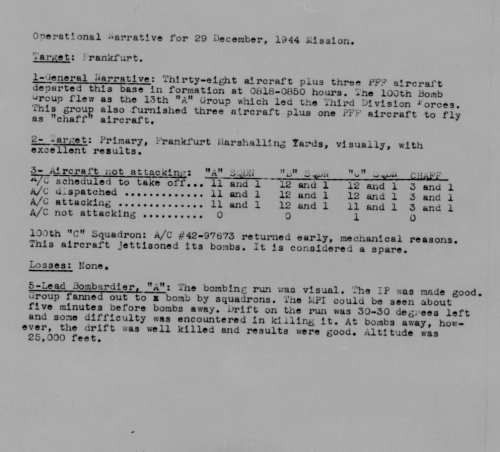
After gathering their equipment and trucked out to their respective hardstands, the young fliers pulled themselves up into their heavy bombers and started to their taxi position. Thirty-five aircraft, three PFF’s and four chaff ships took off between 0818-0850 hours. Aborting the mission before crossing the sortie line, was Francis Mikesh, flying in A/C 673. Reporting one engine out, he landed at another base with no mission credit given to the crew.
The bombers flew in an undercast until they hit the Rhine River where they encountered CAVU conditions. As they neared the IP and their turn onto the dangerous bomb run, the flak coming up from Frankfurt was tracking the formation and extremely heavy, with the lead and low squadrons taking the brunt of the bursts.
Bombardier William Wellings, flying in the high squadron, was sitting in the plexiglass nose when the flak commenced. He tells us, “About 15 bursts at first, all off to the left side of the Lead Sqn. We were flying on the right wing of the High Element in B and it looked as tho we weren’t even going to get scared. Then they really let loose and there was flak everyplace you looked…We turned to the right after B.A. (Bombs Away) but just couldn’t get out of that flak. They started to get a little closer, too, and I heard three of them go off they were so close. Got tossed around a little and picked up a nice gash in the right wing tip but finally pulled away and got back okay. Lost two ships which probably landed in Belgium and had a few wounded.”
Bombardier Robert Fitzgerald, flying his #12 mission and also in the high squadron recorded, “We flew past Frankfurt on the North side and made a 180 degree turn and made a run on the target. We salvoed the 16 bombs and they were right on target. The flak was very heavy over Frankfurt. Four planes from our lead squadron fell out of formation and looked like all were going down but all were able to make it to France or England. We were flying in the high squadron and the two lower squadrons were getting most of the flak…One plane in our squadron took a hit in the engine and went into a dive. The pilot gave the signal to bail out and we counted 4 chutes…”
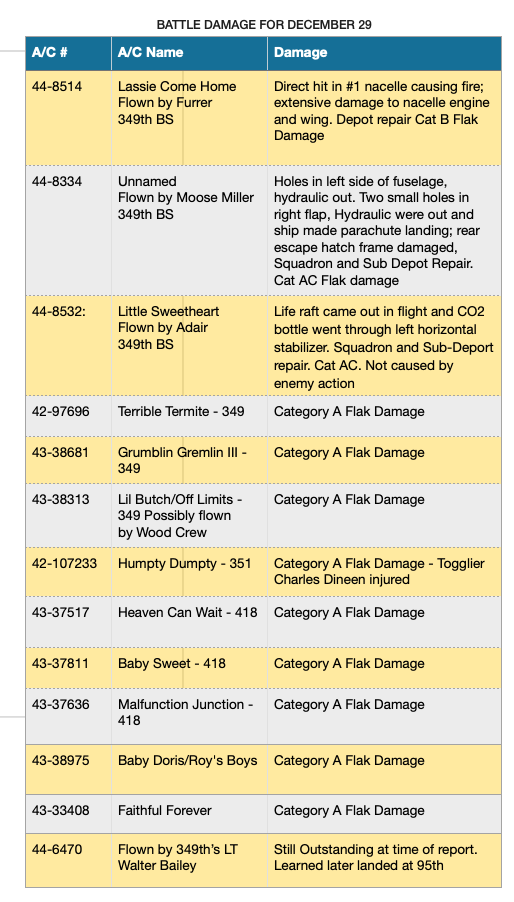
The heavy bombers in the 100th’s low squadron were taking the brunt of the flak due to the headwinds encountered, slowing their aircraft speed through the flak corridor. One of the diving aircraft observed by Fitzgerald was ‘Lassie Come Home’, flown by twenty year-old John K. Furrer and his twenty year-old copilot James Young. On their #29 combat mission, Furrer later remembered, “As we left the IP and entered the bomb run, we encountered extreme headwinds, my navigator reported a ground speed of less than one hundred miles per hours. Needless to say, the enemy flak that we were experiencing was heavy and persistent … The flak struck the left wing area, and immediately flames engulfed the wing and the number one and two engines. The flames expanded well beyond the aircraft tail section.
The force of the impact blew the aircraft upwards and to the right. The aircraft was totally out of control and how we avoided hitting other aircraft in the formation can only be attributed to good luck. Fearing an imminent explosion I issued the ‘Bail Out’ order. Those crew-members in the forward section of the aircraft complied. It was then that I realized my flak suit was entangled with my seat and if I was going to execute a successful evacuation I had to regain control of the aircraft.
I feathered both engines on the left side and after plummeting 14,000 feet I was able to pull the aircraft out of a nearly vertical dive. The maneuver extinguished the fires. Then a voice came over the intercom, ‘What’s going on up there?‘ I realized that during the confusion my microphone had disconnected and those crew-members in the rear of the aircraft had not heard the ‘bail out’ order. Four of the gunners were still aboard. Sgt. Miller came forward and assisted in extricating me from my flak suit. I was having difficulty maintaining altitude and ordered the crew to jettison all loose equipment. We discarded all our guns, ammunition, etc., and headed in a Westerly direction toward England.
All our radios and navigation equipment were inoperative; no maps were available (they had been jettisoned as loose equipment) when a P-51 piloted by Lt. James Evans of Long Beach, California pulled up along side. Messages were passed between Lt Evans and Sgt. Miller by sign language and in this manner we were led safely back to Thorpe Abbotts."
Observing Furrer’s ship were his fellow Squadron pilots, James Adair and Elmer Wesala, flying their #20 mission in the low squadron’s #3 position. During the heavy flak attack, their deflated life raft carried inside the ship released, forcefully throwing a CO2 bottle through the left horizontal stabilizer as it inflated. Adair’s ball turret gunner, James Hendrix recorded, “Life raft came loose and lodged on the stab. It vibrated for a long time…” and Hendrix would later told his daughter, “The crew even tried to shoot it off but the safety stops on the guns wouldn’t let them hit it.”
Flying in bomber 44-6470, another 349th fortress flown by Walter Bailey and crew was in distress. Engineer, Calvin Dollar tells us, “We got hit pretty hard; one piece cut the main oil line on No. 3 engine. It was leaking oil fast and the oil hitting the hot supercharger was smoking and Frost (BTG) thought the engine was on fire…Lt Bailey got hit in the leg just below the knee; the piece that hit him came right through the left rudder pedal. The pilots and navigator’s oxygen was shot out and also the top turret. I helped Lt Bailey out of his seat and down into the navigators compartment so they could give him first aid. Then I got up in the pilots seat and flew there helping the Co-Pilot all the way back…”
The copilot, unknown at this writing, flew as a replacement for their normal copilot, William Merchen, who had been wounded on a previous mission that previous October when Dollar flew the first time as a copilot. On the October 15 mission to Cologne his ship was also hit by heavy flak on the bomb run. And Dollar tells us, “LT Merchen got hit by flak, I heard him say, I’m Hit and leaking like a sieve. I spun my turret around and came out to see what I could do. I helped him out of his seat and lowered him down into the catwalk between the flight deck and the Navigators compartment. Then I crawled up in the blood-covered seat and flew as co-pilot. I flew alone for about 15 minutes while LT Bailey was down checking on the Co-pilot…”
While the pilot was attended to in Bailey’s fortress, the 100BG’s formation continued on through the flak to the target, where it bombed in squadron formation at an altitude of 26,000 feet.
Over the target, Willis ‘Moose’ Miller and his crew were encountering the heavy flak. His tail gunner, Robert Kazee, remembered this mission as his roughest. “Lost one engine as we approached target. Capt. Miller asked if we should drop out of formation but crew wanted to release bombs before leaving formation. After bombs were released we lost 2nd engine on the same side. Other things began to happen — we had to dive plane to put out fire in 2nd engine, and also lost hydraulic power and oxygen system…We were all poised ready to bail out but Capt. Miller said lets wait and see if we can get back home.”
The crews were always in danger during the mission and even the approach to their home base could bring added danger. With the engineer and the copilot flying Bailey’s B-17 over England through poor visibility, Calvin Dollar remembered, “We got back over England and visibility was poor so we landed at the 95th Bomb Group by mistake. We ate there and then a truck from the 100th came and got us and brought us back to our field.”
Miller’s problems, however, continued as he brought his ship in for a landing at Thorpe Abbotts. Kazee tells us, “As we make our final approach the Capt. saw another plane landing in the wrong direction. He was able to ease to the right of the runway and miss the other plane but had difficulty getting enough power to go around again. Somehow it was decided someone was worth saving and we were able to go around and ‘Moose’ made a perfect landing except we had no brakes. The flight engineer Dave Colby and I attached my chest chute to the main strut just forward on the tail gunner door. As the wheels touched down, my chute was pulled and thrown out the smaller door. It opened and slowed the plane enough for the pilot to run off the end of the runway and do hard right rudder and the plane went around once and stopped (ground looped). We were all extremely happy to have made it back but thought we should give the crew of the plane that landed from wrong direction a good going over. As we approached the plane I got sick as a dog because they had a direct hit in the tail and it was some kind of a mess. When we examined our plane I found a baseball size piece of flak stuck in the plane just behind my head area of the plane.”
After eight hours in the air and three and one-half of those hours tethered to oxygen masks, the men were all relieved to be down and out of their bombers. After James Adair had landed and pulled up to his hardstand, his enlisted men jumped out first. Their life raft was still deployed inside the ship and “One of the ground crew was berating them and wanted to know what idiot had deployed the life raft…” Having no level of tolerance left after such a stressful mission, Adair was not going to stand for the dressing down of any his men, especially after what they all had just experienced in the air over Germany. It was reported that, “Adair started in and told the man what had happened and said, ’Don’t ever talk to my crew like that again.’”
With thirteen of the bombers returning with battle damage, the maintenance crews worked through the night to get the B-17s ready for the 100th’s next mission.
Bombing Results
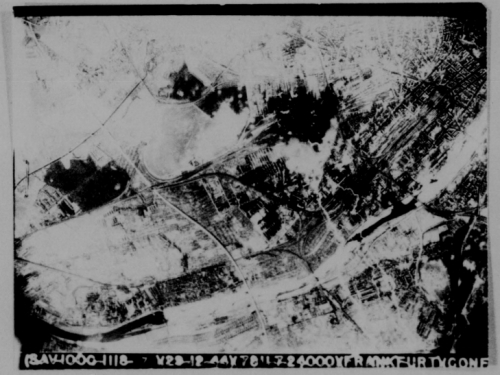
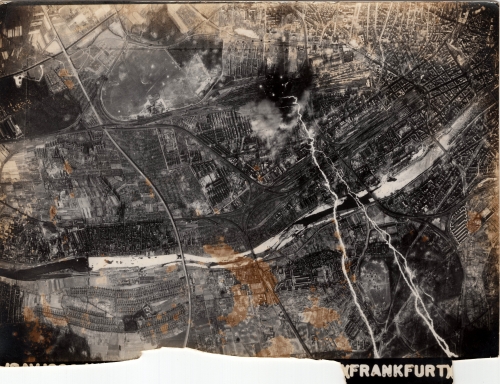
Bombing Results: VERY GOOD
Aircraft Lost: 0
Crew Lost: 1
Claims of Enemy Losses (CLS): 0
Aircraft Returned:
Media Articles
Use your thumb to scroll through the results box below.
| Media Item | Type | Page | Volume/Issue | Broadcast Source | Time | Description | File |
|---|---|---|---|---|---|---|---|
| Battle Damage December 29 1944 | 12:00 am |