Mission Date: December 30, 1944
KASSEL, MY
100th BG Mission #: 240
Mission Summary
ON THIS DAY...DECEMBER 30, 1944
On Saturday, December 30, it was the 418th's turn to stand down. They were able to put in a little more sack time under multiple layers of blankets to keep warm. The other flying crews were awakened at 0430 hours.
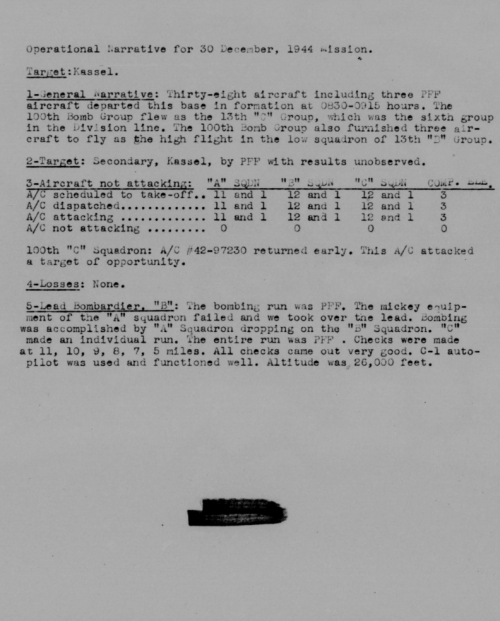
The Officers’ briefing was held at 0530, where the airmen learned that the 3rd Division would lead the entire 8th Air Force to Germany. The 100BG was to fly as the 13CBW's ‘C’ group, sixth in the Division line and led by Elmer Ferbrache and Paul Spurgeon. In addition, the 100th would furnish an element of three planes that would fly as the high flight in the low squadron of the 13th’s ‘B’ group.
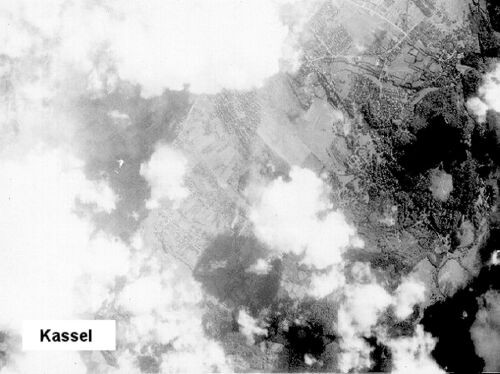
The S-2 Intelligence officer briefed the men on their primary visual target, the Rothenditrold marshaling yard’s main train station in the northern suburb of Kassel. “Strategically, the raids are intended to completely disorganize all traffic and depots, the wagon repair shops, sorting and reception sidings and all signal handling facilities. Tactically, the desire is to bring about the maximum disruption of railway workings.”
Loaded with twelve 500 pound general purpose bombs and after a delay in the original take-off time, the 100BG’s forty-one B-17s plus three Pathfinder aircraft took off between 0830-0915 hours into East Anglia’s heavy fog. William Wellings, recorded, “Weather was p-poor and we all prayed for a red flare but after a one hour delay, we took off at 0900. Flew through weather the whole way.”
Echoing the not so silent sentiments of those awakened again after flying the rough Frankfurt mission, tail gunner, Robert Kazee from Willis Miller’s crew, felt the stress. “After such a mission as the last one, you would think we might have a day off, but no such luck! We got a new plane and target; Kassel.”
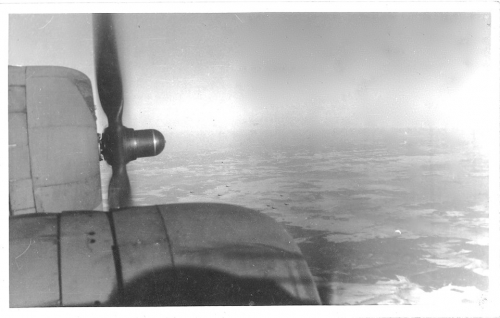
Due to multi-layered clouds, the climb to assembly altitude had forced the pilots to once again fly on instruments. Both the squadron and the group's assemblies were slow and tedious due to the heavy icing experienced in the clouds.
Many of the battle damaged ships from the previous day’s mission to Frankfurt were still under repair, so Squadrons borrowed any aircraft available. Robert Fitzgerald tells us, “Visibility was poor in the clouds and I saw a fortress pass right under us. An awful lot of planes were lost by collisions of planes climbing through the undercast after take off. We flew an old veteran plane named ‘Heaven Can Wait’ a 418th ship. Crews don’t name ships anymore because you keep flying different planes and if you do get your own plane it isn’t until you have about half of your missions flown… “
Flying the diamond position in the low squadron, the Adair crew’s normal aircraft ‘Little Sweetheart’ was still in repairs, so they too flew a 418th Squadron’s aircraft (#42-97230) named ‘Lay or Bust/Fabian’s Flak House’ The ship's #1 engine burned out when the cylinder was blown so Adair aborted the mission and returned early back to base after dropping their bombs on a target of opportunity.
Flying at the high altitudes was unbearably cold for all of the airmen, but especially so for the gunners. Flying as the ball turret gunner on the David Wood crew, even years later, Frank Volk would recall the frigid temperatures. “It was cold. You’re up there traveling 200 mph and the wind chill would break through. Temperatures routinely dropped to 60 degrees below zero. Five layers of clothing, including a heated suit that was similar to an electric blanket, was normal gear on bombing raids that found crews 26,000 feet above enemy targets. For some reason, it never seemed that the heaters worked in my boots. It was all I could do to wiggle my toes. I still feel the effects of that, the frostbite. My feet still tingle in the wintertime. Cold showers upon landing were necessary to return circulation to the numb crew. Tingling toes aren’t the only lingering effects of the sometimes 10 hour missions. I continue to battle feelings of cruising thousands of feet in the air that often shake me from sleep.”
At times, switching aircraft positions amongst squadrons before reaching the target was necessary. Eight minutes before reaching the Initial Point, the lead squadron’s Mickey equipment failed, so the Air Leader radioed the Deputy Lead flying in the high squadron to take over the lead position.
Over the target area, the weather was 10/10 and the crews experienced moderate flak, lower than the formation but with a few accurate bursts. The original lead squadron ended up dropping its bombs on the high squadron's signal at 1306 hours from 26,000 feet while the low squadron, led by John Williams, made an individual squadron run on the target.
Hearing reports over the radio of ‘bandits’ in the area, the 100BG was fortunate and none were encountered. Landing at 1345 hours, the men had flown close to an eight and one-half hours mission, hooked to their oxygen masks for half of that time.
The maintenance crews were thrilled to count in all of their ships returning and the airmen too, felt blessed to return with no battle damage to their aircraft or wounded personnel. However, other Groups in the 3rd Division were not so fortunate as three B-17s and twenty-four airmen had been lost. An additional thirty-seven ships returned with battle damage.
Arriving later that Saturday evening to Thorpe Abbotts for the first time, William Howard and his crew had been assigned to the 349th Squadron as a replacement crew while the alert light glowed alerting the men of another mission.
The Rojohn crew just returned was scheduled to go on flak leave but Rojohn had been scheduled to fly the next mission. His bombardier, William Wellings, noted into his diary that evening, “Found out that our flak leave was postponed until Monday and Rojohn is flying tailend Charlie, but I’m not flying with him. Will probably be dropping practice bombs, I guess. Went up to the party tonite but only stayed five minutes.”
The next day would bring a mission, an Officer’s Tea Dance and a big New Year’s Eve celebration. The fortunate 349th Squadron would have their turn at the squadron stand down and none of them would know just how lucky they all would be.
Bombing Results
Bombing Results: GOOD
Aircraft Lost: 0
Crew Lost: 0
Claims of Enemy Losses (CLS): 0
Aircraft Returned:
Notes
Mission Stories
30 Dec 1944 – Sat – Kassel, Germany
Mission No. 21 of (Adair's) Crew #12
Pilot’s Log (Adair): “Aborted. No. 1 Engine burned out, diamond in Low” Aircraft: unnamed – 48230 XR-A
Flight Duration (Hours): 6:00