Mission Date: December 31, 1944
HAMBURG, OIL REFINERY
100th BG Mission #: 241
Mission Summary
ON THIS DAY...December 31, 1944
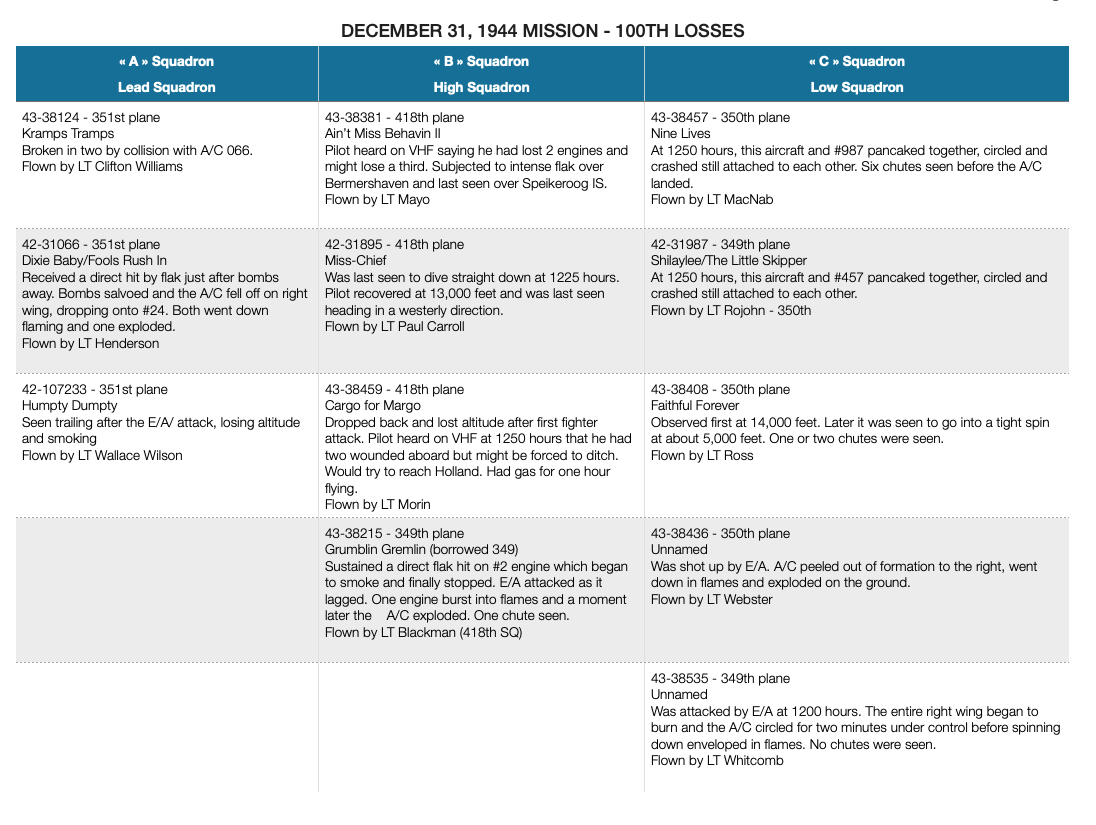
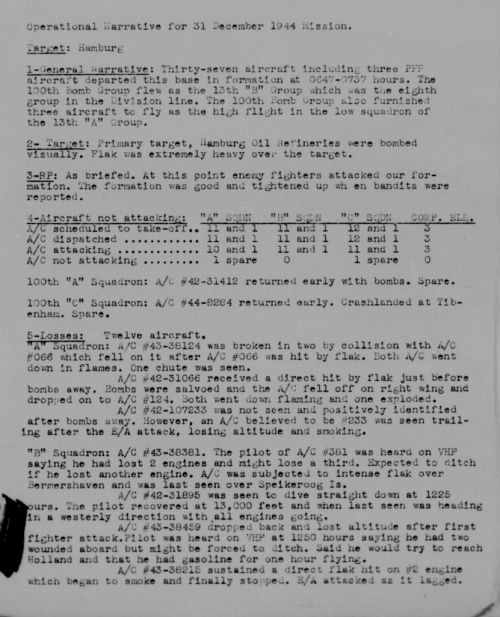
Crews from the 100BG were awakened at 0400 hours on the last day of 1944, for a ME, maximum effort mission. The lucky men of the 349th Squadron were on a stand down. What nobody could know was that this mission would become one of the 8th Air Force’s highest loss missions during the entire war. The 100BG itself would lose thirty-three percent of their aircraft; twelve B-17s to both flak and enemy fighters and most importantly, one hundred and eight airmen.
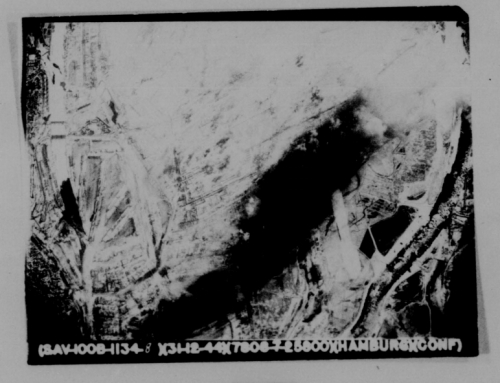
At briefing, the crews learned that the primary visual targets for the 13CBW would be the oil refineries of Deutsche Petroleum A. G. , Deutsche Erdol A. G. and Rhenania-Ossag Mineralolwerke A.G, located in the central dock area of Hamburg. Although previously bombed, the men were briefed that recent surveillance had shown that these oil plants were still operational. Extremely important to the Germans after the loss of their Hungarian refineries, these plants would be heavily defended so the crews were warned to expect heavy flak and to be alert for enemy aircraft. If the target could not be bombed visually, they were to employ the H2X method.
Twenty year-old navigator, William Sterrett on Billy Blackman’s crew was scheduled for his #14 mission and he remembered, “When the map was uncovered in the briefing room we all gave a sigh, knowing Hamburg was a tough target. For whatever reason I believe the entire crew felt this would be our last mission. We would not be flying our regular plane due to an engine problem and were assigned one from another squadron.” They were to fly in the 349th's ‘Grumblin Gremlin.’
The 3rd Division would again lead the 8th Air Force’s bomber stream. Scheduled to fly as the 13CBW’s ‘B’ group, 8th in the Division line, the 100BG would putting up thirty-five of their B-17s plus three Pathfinder ships. Once again, they would also furnish an element of three ships flying in the high flight in the low squadron with the 95BG in the lead group.
Major Charles Martin and Donald Jones were to lead the 100th’s formation. Its high squadron would be led by Major Harry Cruver and Wilson and the low by Edward Wooton and Jean DePlanque.
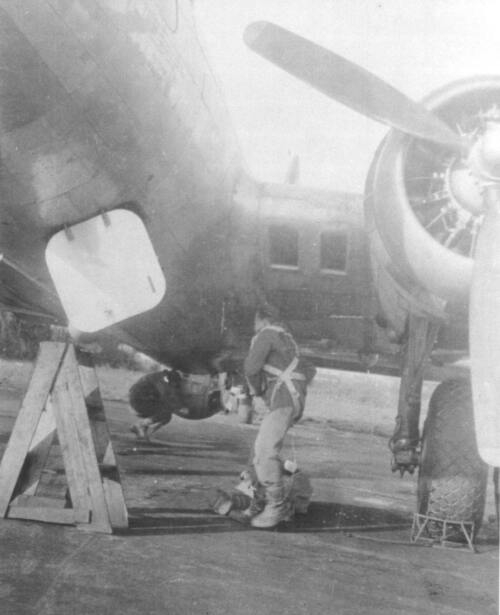
William Sterrett continued his memory. “When we had finished all our checks we all gathered in the tent and waited by the fire until start engine time. It was the usual procedure to kid one another and shoot the bull but everyone was quiet on that morning. We never told the ground crew where we were going, it was against security regulations, but they had a good idea about the target by observing our actions. I am sure they knew we were 'sweating this one out.' They were a swell bunch and would do everything in their power to help us get back.”
The B-17's departed from Thorpe Abbotts, between 0647-0737 hours, again delayed due to the early morning fog. The Group was also flying with spare ships in case there were aborted aircraft, of which there were two. The first was ‘Mason and Dixon’, due to a #1 engine oil leak. The second was named ‘Bachelor’s Heaven’, flown by Carl Baker and copilot Charles Edmondson. They made a forced landing at the Tibenham base soon after take-off when at 300 feet altitude an engine fire started due to a blown cylinder. Attempting to land in snow showers, with poor visibility on a wet runway at an unfamiliar field while carrying an aircraft full of bombs, Baker came in “at an air speed in excess of 150 M.P.H. which caused wing flaps to collapse.”
As the remainder of the formation neared Germany, heavy flak was encountered. Navigator Leon Schwartz of Herman Streich’s crew tells us of the formation’s route in, north of the Frisian Islands. “The weather was clear and cold…Abreast of Heligoland we turned southeast and entered the Koog Elbe estuary near Hamburg. The flak was heavy, as heavy as we had seen at Berlin, but not as intense as Merseberg. It was far more accurate as far as the 100th was concerned. There was a captured B-17 in German markings flying a mile to our left giving our track, speed, and altitude to the flak gunners. In addition to the black bursts at our altitude there were white bursts above us…The flak was getting closer and closer to our plane and I felt several thumps as the plane shuddered. I felt an object strike my flak suit and looked down to see a piece of shrapnel, still hot, on a part of my lap covered by my flak vest. I looked up and saw a good-sized hole in our plexiglass nose between Buhse and me…”
William Leek, flying as Glenn Rojohn’s copilot and flying in the low flight of the low squadron remembered the flak well. “The target and the sky over it were black from miles away. The flak was brutal. We flew through flak clouds and aircraft parts for what seemed like an hour.”
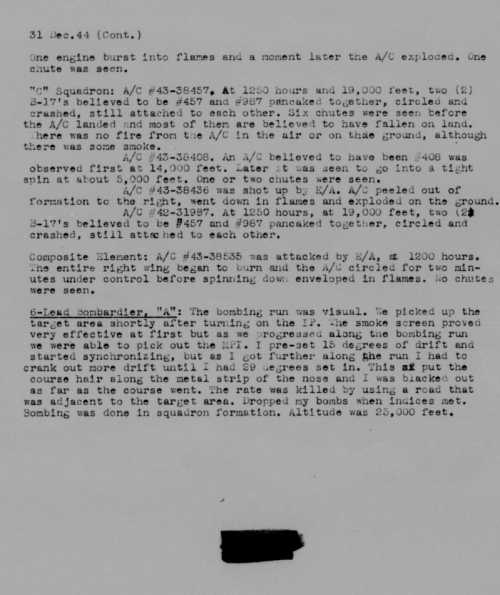
William Sterrett, continued his mission memory. “We could see the target from the I. P. and it took us 10 minutes to get over it…We could see the groups in front of us getting shot at and we knew we would soon be in the middle of the action. No one was saying a word, we were just hoping and praying we would come through without trouble…At 1133 the lead ship dropped his smoke bombs which was the signal for all of the wing ships to drop their bombs…You always felt better as soon as the bombs were gone; the job was done.”
At 1148, the B-17 flown by twenty-three year old pilot, Ralph H. Whitcomb was attacked by German Focke-Wulf 190 fighters. The right wing and inside of the nose caught fire and the ship started down in a spin two minutes later. His navigator Richard Rolle remembered that the “Interphone was shot out. I believe ship blew up since I was either blown out or thrown out by the spin…” Burned from the ship’s fire, Rolle ended up in a German hospital in Rotenburg and from where he learned that his TG, Roch Courreges, BTG Albert Delgado and his WG Clayton Smith were also patients. Five of his crew were killed in action; Pilots Whitcomb and Nicol, TOG George Pults, ROG Arthur Stemen and TTE Clarence Stonesifer were all unable to get out of the ship due to its tight spin and flames. The Crew had just arrived to the 100th that October.
A few minutes after Whitcomb's ship was hit, BTG Stanley Carson, flying with the William “Billy” Blackman crew on their #14 mission, reported oil pouring from their #3 engine and soon told Blackman that their #4 was also leaking. With only two engines running, the ship lagged behind the formation, dropping in altitude and into a perilous situation but twenty-five year old Blackman told his crew, “Stick with it and we could still make it home.”
William Sterret tells us “Bill tried unsuccessfully to call in fighter escort, they had been grounded by the weather over England. There had been ‘bandits’ reported in the area and at that instant Joe (Joseph Pearl TTE) yelled that they were coming in at six o'clock. I looked through the astro dome and saw two FW-190s coming up on our tail. We could see tracers as they passed us, 20 mm shells were also flying around. Now we all realized our chances of getting through were slim.
A 20 mm shell exploded in the cockpit…The ship was on fire and when it started to enter a spin I knew it was time to leave. When I got to the escape hatch Bob (CP Robert Freshour) was lying on the catwalk on his back. Thinking he was hurt I started to help him, but he got up and told me to get out. I put my foot on the door and pushed it out and then jumped. Andy (TOG, Andrew Herbert) was following me and when he got to the door Bob was there and Andy followed him out. Clearing the ship I took off helmet and pulled my rip cord, looking back I saw the ship explode. Bill said he reached behind his head to fire the berry pistol to call for help and 20mm exploded which knocked him out. When he came to he rang the bail out bell and managed to get his chute on. When he got down in the nose the ship blew up. He came to falling through space and pulled his rip cord. The next thing he knew he was on the ground and Krauts were standing around him. They told him another boy had been found with his chute open but he was dead. This was undoubtedly Bob Freshour (Copilot Robert E. Freshour) since he was reported killed and the rest of us POWs or missing in action.” Joseph Pearl (TTE) and Basil Numack (TG) were killed by the enemy fighters. BTG Stanley Carson was unable to get out of the ball turret in time and was also killed. ROG Robert Fortney was later found dead without his chute on.
Twenty-one year old William Mayo and his crew, on their #6 mission, encountered the intense flak thrown up over Bremerhaven at 13,000 feet. Flying in the last aircraft of the low flight in the high squadron, the struggling Mayo and his twenty-four year old copilot Albert Eib fell out of formation, having lost two engines and possibly a third, only to be jumped by fighters at 1225 hours.
Also encountering problems was the fortress flown by twenty-two year old Paul Carroll from Laurens, Iowa and his copilot Harry Winger. On their #4 mission, their B-17 was “seen to dive straight down at 1225 hours. The pilot recovered at 13,000 feet and when last seen at 534N and 0840E was headed in westerly direction with all engines running.” According to their TOG Clifford M. Averett, “We were shot up by flax (sic) over the target and had a fire in the wing. Enemy fighters attacked us and we are pretty sure that two of them were knocked out. At this time we were separated from our outfit. We could not get the fire out so we had to jump.”
At 1230, twenty-one year old Leo D. Ross’s B-17 was also attacked by the stalking German fighters. Flying ‘Faithful Forever’, Ross and his copilot Raigh Mason “dove down, leveled off, then went into a tight spin at 5000 ft. Two chutes were seen. The aircraft crashed at Bartelsdorf.” All of the crew survived and became POWs.
By the time the 100BG’s remaining formation arrived at the Initial Point, no German fighters were observed so Major Cruver called for a squadron bomb run. He later stated, “On this occasion, we had a high velocity tail wind, over 300 miles per hour, so we were able to move relatively rapidly on the bomb run. But no fighters were observed at the I. P. so I instructed the formation to bomb by individual squadron rather than by Group salvo. This was a mistake, because shortly after the I.P. , swarms of FW 190’s and ME 109’s concentrated their attacks directly on the dispersed formations during the bomb run. Unfortunately, the spacing or intervals between the squadrons were excessive and many flights or its (ships) were spread out long distances to provide perfect targets for the incoming fighters. In addition, to the vicious fighter attacks, the anti-aircraft fire was extremely accurate in the absolute clear sky conditions during the bomb run. Many B-17’s lost power in one or more engines due to flak and became additional targets and easy prey for the fighter aircraft as they fell behind.”
‘Cargo for Margo’ flown by John Morin on his #15 mission and copilot Louis Ciriegio, on his #30 mission, was hit during the first wave of fighter attacks. Dropping back and flying at a lower altitude, Morin was heard on the VHR at 1250 hours to say he had a wounded man aboard and may be forced to ditch. Attempting to reach Holland, the ship only had enough gas to last one more hour. Ciriegio from Piqua, Ohio had just transferred to Morin’s crew due to a personality conflict with his original crew’s pilot, William McGuire. According to bombardier Walter Warner, flying in John McLaughlin’s B-17 in the lead low squadron, high group, “Lou wished us Happy New Year as he was going down…” Morin’s ‘Cargo for Margo’ crash landed in a field four kilometers north of Westerhusen. TG Dale Brown was killed and the others would all become POWs.
Also flying in the lead squadron was twenty-five year old Floyd Henderson and his crew. Flying in ‘Fools Rush In,’ their B-17 “received a direct hit by flak. Bombs were salvoed and the aircraft fell off on right wing and dropped on to A/C #124. Both went down flaming and one exploded.” Henderson was flying his #34 mission with only one remaining mission before he finished and could go home.
Henderson’s heavy bomber fell onto ‘Kramps Tramps’, flown by twenty-one year old Clifton Williams and twenty-one year old copilot Kenneth Newkirk, who were on their #25 mission. The ship broke in two and only one chute was observed. Bombardier, Lawrence Ward tells us what was going on inside the ship, “All action began just as the squadron dropped their bombs. I only had time to say, ‘Bombs Away’ when two terrific explosions took place; one under the nose in the chin turret, the other somewhere around the center of the ship. The one under the nose was flak, and pieces of metal seemed to fill the air as they tore thru the plexiglass and aluminum. It was at this moment that I received a hit over the left eye that stunned me…We immediately went into a spin and I remember trying to climb to the escape hatch but I didn’t have strength to overcome the other forces…When I came to I was in the open air and just automatically pulled the ripcord of my parachute…By this time, the bleeding of my wound had stopped — evidently because the blood over my face had frozen. However, hanging by one strap prevented me from having any control over myself and I whirled around and around like a top, making me very sick to my stomach…I made hasty plans as to evading, but when I landed it was within a fenced-in estate on the edge of Hamburg. I was immediately surrounded by soldiers and civilians. They took me to the Luftwaffe base where three others from our squadron were being searched and held. One was my waist gunner (SGT James Murphy) and he is the one who told me the story of our plane. The other explosion I heard (when inside the plane) was another plane colliding with us, slicing our plane in half at the ball turret…”
The B-17 flown by Albert Prestholdt, also took hard hits from the flak and fighters with Prestholdt stating, “During the bomb run we had two engines shot out. #3 Engine was blown completely off by flak and #4 was hit by flak. Saw Lt Hendersons plane collide with LT Williams plane. Both planes went down locked together, what a long way down! We turned off the target right into the fighters. Our aircraft was a sieve from flak and fighters. We came back on the deck with our engine red lined just to keep her in the air. Was afraid we would not make England but did not want to ditch in North Sea at that time of year…”
After the bombs were away, the B-17s made the turn north, right into a devastating headwind, slowing the heavy bombers down to a ground speed of ninety miles an hour giving them the impression that they were standing still.
The lead squadron’s third aircraft lost on the mission was ‘Humpty Dumpty’, flown by twenty-one year old Wallace (Wally) Wilson and copilot Clarence Van Cleave. Taking a direct hit, Wallace was injured and after they got their bombs away, the fortress was trailing, losing altitude and smoking. Navigator, Kenneth Lane described what was going on inside when he stated, “We did not have any problems at all until we got in the bomb run and we took a direct hit…The Pilot, Wally Wilson of Joplin, Missouri had a load of flak in his left calf and it was obvious right from the beginning that we were not going to fly very much longer so we immediately dropped down to 10,000 feet so that I could put a bandage on Wally’s leg and everybody bailed out except Wally and I and our Co-pilot, Roy VanCleave from Memphis, Tennessee. We picked up some ME’s and they made two passes at us but on each occasion, Roy VanCleave was able to dump the nose just at the right moment and avoid getting hit by them. It was obvious that the plane wasn’t a good place to stay for very long, so I put a chute on Wally and pushed him out and then I went out and then Van trimmed up the plane and went out…Anyway, we all bailed out and we all got picked up immediately; they had the old folks watching from the towers.”
The 100BG’s Special Fighter Narrative S-2 Report for this mission would speak to the German fighter tactics used against the bombers. It reported, “As we headed toward our R.P. from the target a dog fight was seen several miles ahead and to our left. Some of our escort fighters were seen headed toward this area where the sky was streaked with con trails. At 1155 hours near 5320N-0930E when E/A first attacked… These E/A - both FW 190 and ME 109’s were in elements of 2’s, 3’d and 4’s but did not appear to have any planned formation…They employed variations of the swooper, roller coaster and triple-threat attacks. Most of them broke off attack 300 yards or more behind our formation by making diving turns to the right and reassembling behind us for another attack. A few were seen to pass through, under and over our formations. A few also pulled ahead for seam attacks from eight to ten o’clock, and there were a few passes by individual E/A from twelve to one o’clock. In general, the attack on our group formation did not appear to be well-coordinated…they were seen to dive on our two straggling A/C in units of 3’s and 4’s and knock them down from point blank range. At 1210 hours near 5330N-0910E our escort fighters closed in and E/A broke in all directions and dived away from the attack.”
Major Cruver wrote in his mission review, “Shortly after the target, I learned that all of the ammunition had been expelled so the returning planes were really ‘sitting ducks’ for the Luftwaffe. The formation of the remaining square D planes became noticeably tighter to constitute a smaller target for the continuing fighter activity. It was at this point in time that the incredible collision occurred between Rojohn and MacNab which caused them to crash land in ‘piggy-back’ fashion…”
Glenn Rojohn vividly remembered that the 100th’s bombers had “encountered wave after wave of German fighters. We just barely got out over the North Sea, and the sky was rumbling around us with exploding flak and German Me-109 fighter planes so close I could see the faces of the young German pilots as they flew by. They are having a field day with our formation. We lost plane after plane.” Rojohn’s TTE Orville Elkin remembered, “The fighters came from every direction, 12 o’clock, 6 o’clock, from the bottom and from the top. Your body becomes cold and numb from fright as you realize that only one-sixteenth of inch of aluminum stands between you and this battery of firepower.”
Aircraft #43-38436, flying in the low squadron had been shot up by the enemy aircraft. Pilot Charles Webster, nicknamed ‘Chief ,’ peeled out of the formation to the right and was viewed by eyewitnesses spinning down in flames and exploding on the ground. In a letter later sent to Webster’s wife, bombardier, Lowell Hendrickson, bailing out and surviving, relayed to Mrs. Webster what had happened during the mission. He wrote her, “The first group (fighters) knocked out our oxygen and one of our engines, then things happened so fast I can hardly remember. Some of the crew had already left the ship. I started back to see if I could help Chief. By the time I had got to where I could see his feet, the ship went into a spin and the nose and a section of the side tore off, throwing me through the side. The next thing I knew I was floating in space; I pulled my rip cord and my chute opened and I was picked up as soon as I hit the ground.”
Webster’s BTG Richard Meehan had been the first one wounded in the attack and had passed out from lack of oxygen. His co-pilot, Virgil Whitt left the deck to provide him oxygen from a portable bottle. “Duke (WG, Sylvester Duke) and Lakin (ROG Grant Lakin) stood in front of Richard to save him as he had no Flak suit on. They got it and were killed right in front of him & he (Meehan) crawled out on his hands and feet over their dead bodies to get to the door. Then it wouldn’t open — it was frozen. He wasn’t able to walk so he made it to the other side of the ship and then bailed out. The sky was so thick with flak that you couldn’t hardly see anything…So when he left (LT Webster) was in the ship still, getting them all out and Whitt was then shot in the leg and Webster was putting his chute on Whitt.” This was the crew’s nightmarish #13 mission and because of the anticipated New Year’s Eve celebration, “Webster had a place all hired for a big party for the crew when they got home that night.” Sadly, Webster, Whitt, Lakin and Duke were all killed in action. The remaining crew members spent the rest of the war as POWs.
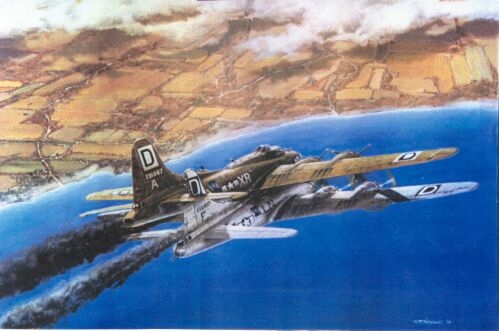
The mayhem of the December 31 mission seemed to never end. After Webster had peeled out of the formation, Rojohn moved his B-17 into the open spot left by Webster’s departing fortress. At the same time, William Macnab moved his B-17 upward into the same space. The top turret guns on Macnab's ship pierced into the bottom of Rojohn’s plane, binding them like 'breeding dragonflies' and killing the pilot, William MacNab and his copilot Nelson Vaughan.
A fellow squadron pilot, Ethan Porter, observing that the two B-17s were about to collide, valiantly tried to warn both MacNab and Rojohn when in horror, Porter “immediately shouted a warning via radio, the two fortresses collided and locked together, continued flying piggy-back over the sea.”
Still inside his ball turret when the MacNab B-17 locked into the Rojohn aircraft on top, was gunner, Edward Woodall. He tells us, “I knew we were in trouble from the violent shaking of the aircraft, no power to operate the turret, loss of intercom, and seeing falling pieces of metal. My turret was stalled with the guns up at 9 o’clock. This is where countless time drills covering emergency procedures from the turret paid off, as I automatically reached for the hand crank, disengaged the clutch and proceeded to crank the turret and guns to the down position so I could open the door and climb into the waist of the airplane. I could see that another aircraft was locked onto our aircraft and his ball turret jammed down inside our aircraft.” And BTG Joseph L. Russo was trapped in his turret while Rojohn’s crew tried frantically to free him. Copilot, Leek could hear Russo recite his Hail Mary’s over the intercom and remembered feeling helpless, “I could not help him and I felt that I was somehow invading his right to be alone.” According to Glenn Rojohn, “Our engines were still running and so were three on the bottom ship.” Fearing the spread of the fire from the fourth engine on the lower bomber, Rojohn rang his bailout bell.
B-17 pilots needed powerful strength in their hands, arms and upper body and Rojohn and Leek had to pull back on their controls with all of their might to keep the plane from diving. As they started to drop fast, navigator Robert Washington remembered crawling to the pilots compartment before bailing out stating, “I saw the two of them holding the wheels against their stomachs and their feet propped against the instrument panel.”
Several crewmen in both planes bailed out over the North Sea but drowned in the icy water. As the pilots turned the linked heavy bombers back towards land, several others bailed out. Rojohn descended to 10,000 feet where he crossed back into enemy territory, landing near Wilhelmshaven. As the two aircrafts landed linked together, Rojohn’s B-17 ship positioned on top slid off and then MacNabs B-17 exploded.
While the mayhem continued in the air, Gerald Kane from Wiser, Nebraska received word through the interphone that his ROG, twenty-one year old William Graham, had been killed and two additional gunners were injured. He remembered, “One of the injured boys was having trouble breathing so I left the rest of the planes in the formation and gave it full throttle. We arrived back in England before anybody. We were flying red flares which meant we had injured on board so the ground crew had ambulances and fire trucks waiting for us. I didn’t know it but I had one tire shot out. I landed the plane by the grace of God and managed to keep it from looping….It looked pretty hopeless for a while. After seeing all the planes on fire and the mid-air collision I didn’t think I would be coming home.” Graham, a professional baseball player from West Virginia had only been in the war for six weeks.
By 1400 hours that afternoon, only twenty-seven out of the 100BG’s forty-one B-17s taking-off that morning had returned back to the base. New Year’s Eve 1944 would not be a night celebrated at Thorpe Abbotts. By the time the flying crews had returned to their huts after Interrogation, the lost men’s belongings had already been packed up and many of the airmen slept would sleep next to an empty cot. Leon Schwartz, not scheduled to fly the mission, was returning back from a leave. He remembered, “On our arrival we heard all the bad news and soon saw the empty cots of comrades who had failed to return — four out of the sixteen inhabitants of our barracks; my buddy Dick King, his pilot Floyd Henderson, Ken Kane, a jolly Irishman from Boston whose cot was next to mine — he was the navigator of the Wallace Wilson crew. Lt Sidney Brewin,(BOM) another barracks mate of ours, had not flown that day…He was inconsolable over the loss of his fellow crewmembers.”
Twelve of the 100th’s ships, each carrying a nine man crew were missing. Nineteen additional ships returned with extensive damage from flak or fighters. Major Cruver, the devastated air leader for this mission wrote, “On landing, General Partridge flew in to Thorpe Abbotts with a P-47 and attended the mission critique; as I entered the building, I can vividly recall how two or three group personnel were at the entrance, crying in an unabashed manner, due to twelve planes which did not return and the 111 airmen who were killed or became prisoners of war.”
In fact, the last day of 1944 was the worst mission of the war for the 3rd Air Division with a tallied twenty-seven B-17s and 282 airmen lost on one single day.
William Wellings remembered that he had the date of 12/31 circled on his calendar diary with the note ‘my luckiest day.’ Normally flying with the Rojohn crew, Wellings was not scheduled to fly the Hamburg mission. The following day, Wellings’ diary entry would reflect the emptiness and guilt of those left at base. “The Group went to Hamburg yesterday and got hit by fighters and terrific flak. I didn’t do anything at all except take a bath and catch pneumonia. Was playing solitaire when Browning came in and said that Ross and Rojohn was missing. Tore up to Interrogation to find out about it right away. Baker had crashed on T.O. this A.M. so Rojohn wasn’t flying tail end but took over #5 in C sqdn…We lost twelve ships altogether from the group — five of them from the 350th. One of them, 418th, called this morning and they were in Holland. Went all the way from the target on one engine. Afraid that’s all that will get back tho. The barracks were sure empty last night. We cleaned up all the boy’s stuff and kept all the candy, etc. I also have Koechel’s battle jacket. Had a terrible cough last night and hardly slept at all. Guys in the next barracks were drunk all night and that didn’t help any. I’m not going on flak-leave now but Gibbons said he would send me on pass in a few days. Horenfan, our tail gunner, just walked into the barracks! He was grounded because of a frostbitten ear yesterday. Frite’s togglier was flying in my place yesterday and they also had a waist gunner from his crew, too. ROUGH! Ross screamed over the V.H.F. that he had two engines and was being attacked by three FW-190’s and that’s the last that was heard…”
LEAD SQUADRON CREWS LOST: 351ST SQUADRON
Clifton Williams: KIA: Williams, Newkirk, Williams R, McGinley, Peiteys, Carpenter POW: Douglas, Ward, Murphy
Floyd Henderson Crew: KIA: Henderson, King, Kovach, Robinson, Shepard, Horcasitas POW: Smigo, Murphy, Sauls
Wallace Wilson Crew: POW: Wilson, Van Cleave, Kane, Gaye, Nash, Gibeon, Monte, Fellmeth, Eckmeyer
HIGH "B" SQUADRON CREWS LOST: 418TH SQUADRON
Wiliam Mayo Crew: KIA: Mayo, Eib, Cohen, Radich,Hayes, Corum, Dickenson, Stell, Hudgens
Paul Carroll Crew: POW: Carroll, Winger, Klare, Averett, Westman, Olsen, Isola, Ross, Bracken
John Morin Crew: KIA: Brown POW: Morin, Ciriegio, Letourneau, Nawoj, Hanley, Kouloutpanis, Wright, Berry
Billy Blackman Crew: KIA: Freshour, Fortney, Pearl, Numack, Pace, Carson POW: Blackman, Pace, Sterrett
LOW SQUADRON "C" CREWS LOST: 350TH SQUADRON
William Macnab Crew: KIA: Macnab, Vaughn, Ethridge, Rench, Seyfried POW: Berkowitz, Comer, Chadwick, Woodall
Glenn Rojohn Crew: KIA: Russo, Little, Chase POW: Rojohn, Leek, Washington, Shirley, Neuhaus, Elkin
Leo Ross Crew: POW: Ross, Mason, Burruss, Koechel, Andersen, Angelotus, Affleck, Johnson, Wynne
Charles Webster Crew: KIA: Webster, Whitt, Lakin, Duke POW: Little, Henrickson, Burkhart, Meehan, Anthony
Ralph Whitcomb Crew: KIA: Whitcomb, Nichol, Pults, Stemen, Stonesifer POW: Rolle, Delgado, Courreges, Smith
Bombing Results
Bombing Results: POOR
Aircraft Lost: 12
Crew Lost: 111
Claims of Enemy Losses (CLS): 23
Aircraft Returned:
Media Articles
Use your thumb to scroll through the results box below.
| Media Item | Type | Page | Volume/Issue | Broadcast Source | Time | Description | File |
|---|---|---|---|---|---|---|---|
| December 31 1944 losses | 12:00 am | ||||||
| Battle Damage December 31 1944 | 12:00 am | ||||||
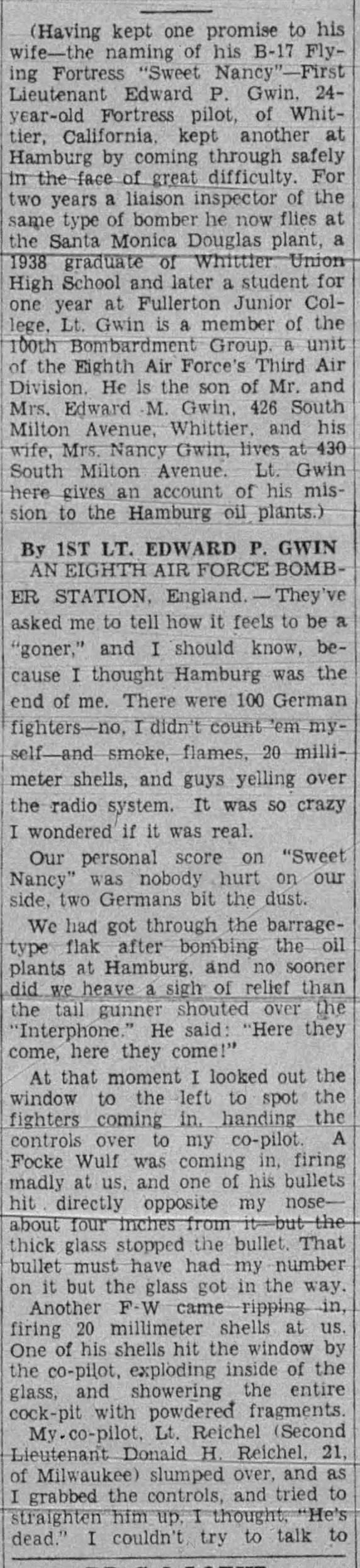
| Don Reichel, Ed Gwin writes of Hamburg Dec 31 1944 part 1 | 12:00 am | ||||||
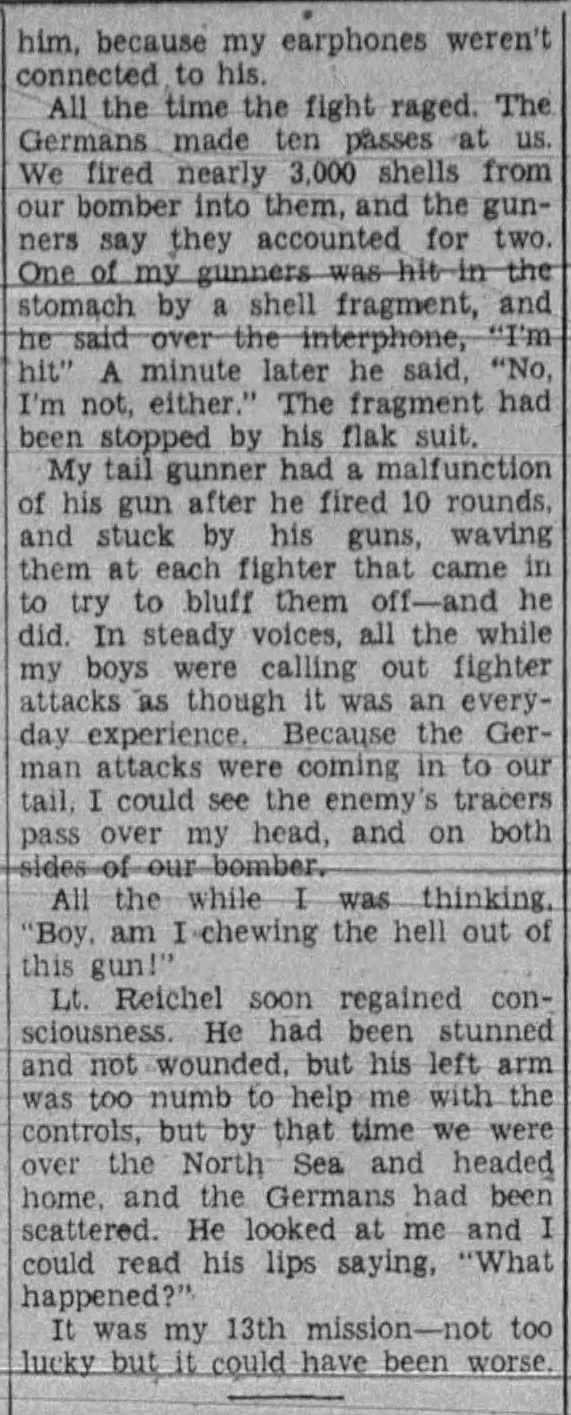
| Don Reichel, Ed Gwin writes of Hamburg mission part 2 | 12:00 am |