Mission Date: January 5, 1945
FRANKFURT, MY
100th BG Mission #: 244
Mission Summary
ON THIS DAY...JANUARY 5, 1945
In the early Friday morning of January 5, as the air crews were being awakened in their respective huts for the day’s mission, the runway was being cleared of its “mantle of snow.”
What the boys didn’t know as they trudged to breakfast was that aspects of the mission planning coupled with atrocious weather conditions would impact the success of this mission greatly, causing a high number of mission aborts and missing aircraft. In fact, twenty-five B-17s in the 13CBW would either miss the take-off entirely or abort the mission early: eight from the 95BG, eight from the 100BG and seven from the 390BG with an additional two of the 3490th’s B-17s failing to take off. In addition, thirty-two of the wing's total aircrafts scheduled to fly the mission did not return to their base: ten were outstanding from the 95BG, six from the 100BG and sixteen outstanding from the 390th.
At the 0500 briefing, the thirty-eight crews in attendance, bundled in fur-lined jackets to shield themselves from the bitter cold, learned that their primary visual target for the day would be the Frankfurt marshaling yards just east of Frankfurt’s main rail station, again bombing the railroads taking supplies to the German front lines. The target bordered built-up areas of the city on all sides except to the North. The secondary target would be the same as the primary, employing the H2X method of bombing if visibility was an issue.
The 3rd Air Division’s column of B-17s would be led by the 45CBW with the 13CBW flying second in the Division line. In the 13th’s formation, the 95BG would be flying as the lead group, the 100th as its high group and the 390th flying as the low group.
The Hundredth's formation was scheduled to be led by Lt Colonel Samuel Barr and Donald Jones with the deputy lead team of John Gibbons and John Williams in the high squadron. The low squadron would be led by Major Hank Lyster, flying with eleven of the 418th’s crews.
Thirty-five B-17s, three Pathfinder ships and two additional spares took off from Thorpe Abbotts between 0725-0804 hours. Once again, due to the low clouds and inclement weather over the base, the take-off and formation were difficult, requiring the pilots to again utilize instruments for the climb into assembly position.
The on-time 100BG was unable to meet with the late 95BG. Making contact with the 95BG, Lt Colonel Barr would fly the 100BG’s formation abreast of the lead group until the two formations became separated again due to the cirrus clouds. Arriving ahead of the 95th’s formation over the Channel, the 100BG made a 270 degree turn in order to lose some time, allowing the 95th to take its lead position as originally planned.
As the formation of B-17s crossed into enemy lines, the German flak guns opened up. Robert E. Fitzgerald recalled the route in. “(We) left England south of London. We flew far south into France then turned east and crossed the lines where twice we were fired on by flak guns and one ship was knocked out of the low squadron and headed back for emergency landing in France.”
Unfortunately, that first ship to abort was the low squadron’s lead ship, flown by David Lyster, Commander of the 350th Squadron. He tells us that, “flak knocked out one engine, damaged another and we had a big bird full of holes. Deputy lead took over and we headed back to England. We reached the coast but realized we would not make it based on the loss of altitude. Our emergency field for the day was at Liege but we ended up at an emergency RAF base in Brussels. We made it to the end of the runway, cut our engines and got out. All of a sudden, the base commander comes up and said, ‘I command you Sir to move that Aircraft.’ I tried to explain to him that if I moved the aircraft off the mesh steel runway the B-17 would ‘sink to the hub in mud.’ Still he persisted so I climbed back into the plane, started her up, and moved her off the runway. Sure enough, she sank right to the hub. We stayed there the night and was transported the next day back to Thorpe Abbotts. Our 349th B-17 returned a few weeks later, still full of holes.”
Meanwhile, the weather enroute to the target was reported to be 8/10 to 10/10, with high clouds at 23,000 feet made worse by the dense, persistent contrails which made formation flying difficult for the pilots.
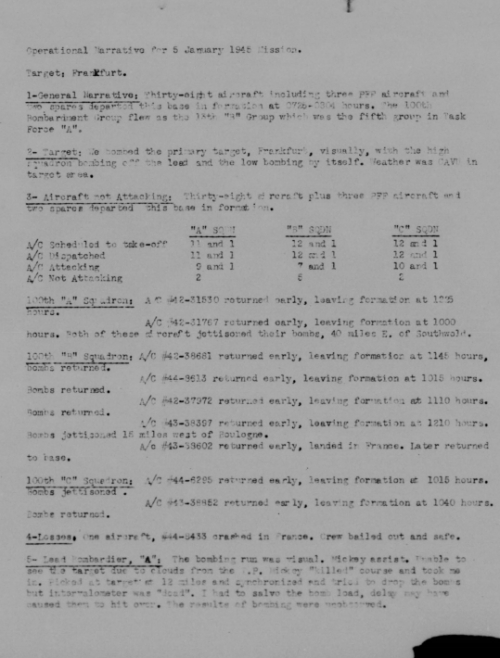
The radio channel had already been reported ‘clutched’ due to individual situations being reported by the number of aborting B-17s, which had started at 1000 hours, forty miles east of Southwold when a fortress from the lead squadron, ‘Our Gal Sal,’ flown by Ronald Dovel returned early, jettisoning its bombs before returning.
Fifteen minutes later at 1015 hours, two additional B-17s left the formation; 44-8613 of the high squadron, flown by twenty-three year old Jack Gay, returned home with its bombs. The fortress, 44-6295 ‘White Cargo’ of the low squadron, flown by Sidney Johnson, aborted early, jettisoning bombs before returning to base.
At 1040, B-17 43-38852, ‘Humpty Dumpty’ from the low squadron, left the formation. Its pilot returned early to Thorpe Abotts with all of his bombs aboard.
At 1110 hours, A/C 42-37972, ‘Gold Brick’ from the high squadron and fifth ship from the Group, flown by David Wood and Tony Pecyk, left the formation due to engine problems and a burned out exhaust stack. Their bombs were jettisoned in the channel.
Thirty minutes later at 1145, yet another B-17 from the high squadron, 42-38681, ‘Grumblin Gremlin III’, flown by Willis Miller left the formation with its bombs returned.
By 1210 hours, another B-17 from the high squadron, ‘Scrooges Stooges’, left the formation. Flown by Ronald Lebo, the ship returned early but not before the bombs were jettisoned fifteen miles west of Boulogne.
There were now a total of nine heavy bombers out of the 100th’s formation and not proceeding to the target; five aircraft not attacking from the high squadron, two from the low and two from the lead.
For the bombers still remaining in the Group’s formation, it was now CAVU at the target, perfect weather for the German anti-aircraft guns to see the bombers coming their way. The target area at Frankfurt was observed at fifty-five miles out and positively identified at forty-five miles so naturally the flak gunners blasted away.
The formation reached the target around 1313 hours with each squadron peeling off and making individual runs on the marshaling yards. For the 349th flying in the high squadron, their lead ship’s air speed indicator was out, so the high formed up with the lead squadron for the attack while the 100th’s low squadron proceeded in to the target by itself. Bombardier Robert Fitzgerald recorded, “We dropped our bombs and 2 clusters of incendiaries over the target at 1334 about one third of the bombs hit the target with the balance falling into town…”
After bombs were away and the 100BG reformed at the rally point, the formation encountered a severe wind change, slowing the speed of the heavy bombers considerably.
In addition, the formation encountered a storm over the English Channel, adding to the additional danger of running out of gas. In fact, radio communication was reported to be difficult due to the number of individual aircraft calling in about low levels of fuel. Flying against the severe wind had added considerable time to the mission’s hours, causing the airmen to be up in the air for close to ten hours and flying on oxygen for twice as long as other missions.
Fitzgerald continued, “We had a SE wind flying to Frankfurt and on the way home the wind changed to NW at times our ground speed was only 50 MPH. We were on oxygen for 6 and one half hours…There was a storm over the channel so rather than try to climb over it we went under it. All but 12 of our planes said they didn’t have enough gas to get home so they landed in France and Belgium. We flew just over the waves in the channel and had to gain altitude to clear the cliffs of Dover. We landed at 1720 with only 50 gallons of gas left. We were in the air for 10 hours compared to 5 and one half hours the last time we went to Frankfurt showing what kind of factor the wind can be. No planes were lost but we had the people at the base worried when only 12 of 36 planes landed.”
A high number of the departed B-17s had already returned early and at the formation’s expected time of return, those standing lookout at the tower were anxious as they awaited the remainder of their fortresses to return. Hearts began to sink as they counted the ships in as they flew over the base for landing…1, 2, 3, 4, 5, 6, 7, 8, 9, 10, 11,12…Oh, my God, where were the rest?
The 100th’s ground executives would later learn that six of their B-17s had landed in France although when the 100th’s mission report went up to wing headquarters that evening, six bombers were still unaccounted for and marked as ‘outstanding.’
Landing Elsewhere
James R. Rasmussen, navigator on Robert Wilkes crew flying his very first combat mission in aircraft 602, remembered that they ran out of both oxygen and gas on this mission. After the bombs were away they were down to five oxygen bottles on board, passing the bottles around until they were able to descend to a lower altitude. Robert Wilkes, assessed that there was not enough gas to get back to Thorpe Abbotts, so he told Rasmussen to find a place to land. Rasmussen found an American fighter base located at Messinger, France. Unable to raise the base and report in after safely landed, the crew spent six days in France. Rasmussen said that when they finally returned to Thorpe Abbotts, his squadron, thinking that the crew was missing in action, had the enlisted men’s bedding rolled up and their personal belongings boxed up. The officer’s belongings were just about ready to be boxed and sent back to their loved ones in the States.
Another 349th crew flying in the low squadron, in ‘Kleen Sweep,’ had just crossed the channel before their gas gave out. They landed at the RAF Station in Woodrige to refuel.
With nightly raids to England made by Luftwaffe, it was important to continually identify your aircraft as a friendly aircraft if you flew over friendly territory in the dark. The Walter Charles crew flying aircraft 047, had also landed at Loon Athis, France to refuel and they experienced problems when returning to Thorpe Abbotts that night. Waist gunner, James Smith remembered, “Somebody started throwing cal.50’s at us when we came across France after dark.”
Thomas Anderson flying in A/C 433, had also landed in France. After safely back in his nissen hut at Thorpe Abbotts, his radio operator, Glenn Smiley recorded into his diary, “We ran out of gas so we had to land in France near Leon at a B-26 & P51 base. Came back after dark had to really work that radio ragged. Identify at coast. Call Division and later we got lost over England so got a series of bearings - ADMs hit the base right on the nose got in about 7:45 raided mess hall. …Sure was a long tiresome day 3:15 in the morning until 10 at night. Rough was 31st mission.”
Unfortunately, the Fred O. Parrish crew, flying their last mission before their tour of duty ended, ran out of gas between 10,000-15,000 feet altitude. Parrish rang the bailout bell, and the entire crew bailed out. Fred, as pilot, was the last man to jump which he did when the aircraft was at 5,000 feet. The B-17 crashed. All of the crew survived but Parrish was seriously wounded from the low level bail out, remaining in the 65th General Hospital for some time.
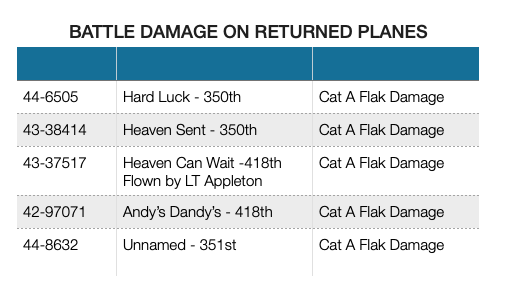
When the battle damage report was sent up to wing headquarters, there were four B-17s still outstanding and only five were reported as returning with battle damage.
In the mission review, the wing felt that the mission’s planners had made some tactical errors and its critique included the following highlights:
Estimated airborne time - 10 hours and 30 minutes
Estimated Oxygen Time - 6 hours and 3 minutes
Landing after dark
Return route was too indirect in friendly territory
The weather aircraft took off 47 minutes after he should have reported the weather from altitude
Deputy Wing Leader was not listed as being qualified
Weather did not require extreme southern route followed, or high altitude assembly planned.
Crews flying this mission: Wilkes, Adair, Williams, Lebo, Marmorine, Wood, Miller. Thrasher, Baker, Champion, Porter, Wilson W, Parrish, Charles, Dovel, Gay, Hughes, Willoughby, Sherrard, Johnson, Carley, Jones, Kane, McGuire, Ivosevic
Bombing Results
Bombing Results: GOOD
Aircraft Lost: 0
Crew Lost: 0
Claims of Enemy Losses (CLS): 0
Aircraft Returned:
Media Articles
Use your thumb to scroll through the results box below.
| Media Item | Type | Page | Volume/Issue | Broadcast Source | Time | Description | File |
|---|---|---|---|---|---|---|---|
| Battle Damage January 5 1945 | 12:00 am |
Photos
Frankfurt Mission
Frankfurt Mission Report (100th BG Archives)