Mission Date: January 6, 1945
GERMERSHEIM, AF & ANNWEILER, CITY
100th BG Mission #: 245
Mission Summary
ON THIS DAY...JANUARY 6, 1945
Twenty-three ships, plus two Pathfinder aircraft, were readied in the early morning hours by the ground crews after working through another freezing night. All through the night and into the early morning, directives had been coming in from Division HQ to the 13CBW HQ, which would pass the orders on to the individual Groups.
Some of the 100th’s aircraft had still not returned from the Frankfurt mission until very late the previous night while the whereabouts of others were still unknown. Consequently, the 100BG was only able to put up two squadrons. As was the practice, the crews that had aborted the previous day’s mission would be scheduled to go the next mission, including the Willis Miller and Dave Wood crews. Tail Gunner Robert Kazee on Miller’s crew, was awakened for what would be his #32 mission. Recording how he felt during that January coldness, he recorded into his journal, “by this time the warmest place on the base was the mess hall. We would go to bed cold, sleep cold, and get up frozen, but #35 was getting nearer so we were ready to roll.”
At the 0445 briefing, the unveiled primary target was shown as the marshaling yards near Germersheim. The secondary target, to be bombed either visually or by H2X would be the marshaling yard near Ludwigshaven. Annweiler would be a target of opportunity.
The mission's orders originally called for the 93CBW to lead the 3rd Division, but the wing was scrubbed from the mission, leaving the 13CBW as the Division’s lead wing.
The 100BG would lead the wing with its two squadrons forming the ‘A ‘ group, a composite group made up of the 100BG flying the lead and high squadrons and the 95BG flying the low. The wing’s ‘B’ group would be flown by the 390BG, also in a composite formation with a second squadron supplied by the 95BG.
Loaded up with twelve 500 pound bombs and 2600 gallons of gas, the 100BG’s bombers departed Thorpe Abbotts between 0800-0830 hours. They were led by Lt Colonel Frederick Price and Donald Jones, flying in the Pathfinder named ‘The Brass Hat.’
The 13CBW assembled at splasher 7 one minute late, although the 100th’s formation experienced difficulties when the wing’s ‘B’ group, led by the 390BG, cut in front of their formation from the left. In order to avoid breaking up its formation, the 100BG maneuvered out of the way, losing three minutes at the English coast.
The weather was 10/10 over most of the route in to the target. Prior to reaching the Initial Point, the 100th’s own lead ship under Price and Jones aborted due to a broken piston on their #4 engine and the lead was turned over to Major Lyster who was flying command in the high squadron with David Raiford. The remaining lead squadron “s” d along the route to allow their new lead ship to come ahead and take over the wing. The low squadron then took over the high position in the group’s formation.
The second abortion from the lead flight was Wilbert Ivosevic flying in the fortress named ‘Baby Sweet.’ Losing his #3 engine due to too much over-boost, he turned back twenty minutes from the target and jettisoned his bombs in the channel west of Dunkirk.
As the formation neared the IP, the 390BG’s lead pilot in the “B” group “misunderstood the Lead Navigator’s heading,” taking the entire formation right over the flak installations at Stuttgart. The flak was intense and the lead ship of the “B” Group was soon forced to abort due to the battle damage received.
The flak barrage experienced over Stuttgart scattered the 390th’s formation with its B-17s coming ahead of the 100th’s formation. By the time the 390th got back into its proper formation, the 13CBW was beyond its briefed turning point onto the bomb run, leading to confusion as to whether to attack the primary target or go on to the secondary. The 100BG’s leader followed the 390BG in its turn to attack the primary.
Germersheim was covered in 10/10 clouds so the 390th altered course to the target of last resort target, finding that target also covered. “It was apparent that the 390 Group would seek out a target of opportunity on the route out so the 100 Group Leader left the Group ahead and bombed Annweiler, intercepting the briefed course home. They came home ahead of the 390th rather than follow the 390th Leader around.”
Robert Fitzgerald, flying bombardier on Wilson’s ship, provides us with his own commentary about the problems encountered when changing targets. “Our primary target was under clouds so we flew looking for another target. We finally spotted a rail yard at Annweiler we flew on east and made a 180 degree turn to our bomb run. As we turned the anti-aircraft guns opened up on us at Stuttgart. They were very accurate. Our plane was hit three times but held together. The togglier from crew 46 in our barracks was wounded by flak. …The last ship in the lead squadron was hit and lost 2 engines so our squadron took over the lead for him. Bombs were away at 1234 most of them hit to the left of the target but we still had many bombs on the target.”
Ultimately, at 1243, eighteen heavy bombers from the 100BG’s two squadrons bombed Annweiler, although with poor results. One B-17 bombed with the 95BG, one aircraft bombed a different target of opportunity near Rosenfell and yet another B-17 bombed elsewhere.
After seven and one-half hours of a confusing route to the target, the airmen arrived back to Thorpe Abbotts at 1500 hours, thankful to get through another mission flown in heavy flak.
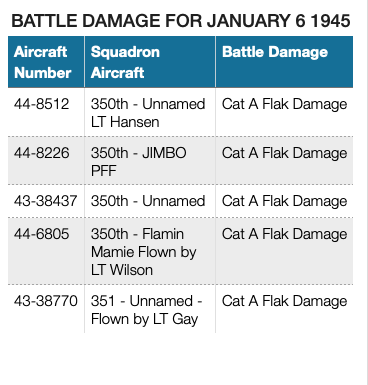
All but one of the 100th’s aircraft returned with five of those returning requiring squadron maintenance due to the flak damage received. It was aircraft Andy’s Dandy’s, flown by John McLaughlin and Winston Hargrave that was reported missing in action. Over the German airfield at Germersheim, McLaughlin was hit by flak, which sliced into his #4 engine, causing “a steady stream of fuel to leak away.” Fortunately, he was able to make a successful emergency landing at field A-92 near Brussels.
That evening, the mission light glowed red and the crews were alerted for their next mission. After checking his squadron board, Tony Pecyk saw that the Wood crew would fly the next day. That evening, from a writing table in the Aero Club, Tony wrote a letter to his dear friends back home. Not writing for some time, he wrote them, “During the holidays we worked like mad. The darn huns decided to cause a little trouble and did. We all got up every day at 0300 and sweated the weather. If it permitted, we took off. It certainly helped the situation when we dropped the bombs. I write to a friend who is at the front and he claims it’s a wonderful sight to see our planes overhead. It certainly is grand to hear statements such as that. Sometimes we wonder about the help we give, but when we hear praise, we stop our wondering. It’s comforting…”
Crews flying this mission: Miller, Wood, Lebo, Lyster, Wilson, Champion, Dawson, Hansen, Porter, Raiford, Wilson W, Dovel, Sherrard, Gay, Charles, Johnson, Willoughby, Ivosevic, McLaughlin, Kane, Jones
Bombing Results
Bombing Results: POOR
Aircraft Lost: 0
Crew Lost: 0
Claims of Enemy Losses (CLS): 0
Aircraft Returned:
Media Articles
Use your thumb to scroll through the results box below.
| Media Item | Type | Page | Volume/Issue | Broadcast Source | Time | Description | File |
|---|---|---|---|---|---|---|---|
| Battle damage January 6 1945 | 12:00 am |