Mission Date: January 7, 1945
COLOGNE, AUTO BRIDGE, LIMBURG (T.O)
100th BG Mission #: 246
Mission Summary
ON THIS DAY...JANUARY 7, 1945
Crews were awakened for an 0430 briefing. After signing in with the attendance man, the airmen took note of the reduced number of men sitting in the briefing room. Orders would call for only two squadrons to be put up from the 100BG.
As the briefing commenced, the target for the mission was unveiled. Today, it would be Cologne, Germany’s third largest city and home to its medieval twin-spired cathedral dating back to 1248. More specifically, the 100BG’s bombs would target the autobahn bridge over the Rhine at Rodenkirchen, an important link connecting the autobahn between Cologne and Aachen. Their secondary target would be at the North end of the Kalk-Nord marshaling yards, located east and across the Rhine River from Cologne.
Cologne was one of Germany’s most heavily bombed cities due to its strategic importance as the home for Germany’s Military Area Command Headquarters and its 211th Infantry Regiment and 26th Artillery Regiment. Its medieval cathedral, unintentionally hit fourteen times during the war, had never collapsed. Due to its historical significance as well as the use of its twin spires as a navigational landmark for the bombers, the Allies did not want to intentionally destroy the cathedral.
As they were briefed, the men were reminded by the S-2 Intelligence Officer to expect heavy flak from the gunners below as well as attacks from German fighters.
For this mission, the 3rd Division would be flying two wings; the 45CBW as the lead wing and the 13CBW.
Forming a composite ‘A’ group in the 13CBW, one squadron from the 390BG would lead with the two squadrons from the 100BG flying as the formation's high and low squadrons.
The high squadron would be lead by Major Robert “Rosie” Rosenthal and Gerald Brown while John Robinson and Donald Jones would lead the low.
Reviewing the formation sheet in front of them, Lieutenants Wood, Pecyk and Scheipers saw that they were scheduled to fly in the high squadron.
With each B-17 loaded with six 1,000 pound bombs, the 100BG’s twenty-four B-17s and two PFF ships took-off between 0730-0753 hours in thirty-second intervals.
The fortresses formed up with the 390BG, completing the ‘A’ group formation and proceeded to buncher 12, where it fell into position behind the 45CBW. The ‘A’ group ”s“d across the Channel to kill some time and gain the proper interval behind the groups ahead, crossing the continental coast at 1027 hours.
With solid 10/10 coverage as the formation neared the target, it was difficult to keep contact with the squadrons. In fact, at the pre-IP, the low squadron would lose contact with the group, flying on instruments until it broke out of the clouds on the bomb run.
The fortresses in the high squadron experienced heavy flak including four rockets but ultimately were successful in accomplishing their mission. According to the high squadron’s lead bombardier, William Titley, “The bombing run was PFF. The Mickey Operator brought us in on the entire run until I clutched in at the 11 mile point. Mickey equipment did not seem to function too well although the five mile was good. Bombs were dropped in squadron formation. Altitude was 25,500 feet.” The bombs were away at 1142 with all thirteen of the squadron’s ships attacking the secondary target — the marshaling yards at Cologne.
Due to difficulty with the MicroH beacons, the 100th’s low squadron made a request to the leader to make a run on a target of opportunity. With no response forthcoming, the low squadron's leader took his squadron to bomb Limburg on their own where at 1142, the thirteen ships attacked from a 26,000 feet altitude. After bombs were away, it fell in behind an unidentified group all the way back to Thorpe Abbotts.
James Adair and his crew were flying in the low squadron, in their regular ship named ‘Little Sweetheart.’ In his very short diary entry, Adair recorded, “Drove over primary, hit Limburg.” Adair kept a four-leaf clover in his wallet during his tour of duty. On this particular mission to Cologne, his luck held as incredibly Adair’s copilot, twenty-one year old, Elmer G. Wesala from Calumet, Michigan, had forgotten his parachute harness and was ‘sweating out’ the entire mission, hoping that there would be no need for a bail out order. The blond, blue-eyed Elmer had been given the nickname ‘Curly,’ due to his curly hair, a nickname that he did not like. According to the crew’s top turret engineer, Conley Culpepper, “Wesala didn’t like it much when Brucker (Bombardier) called him ‘Curly’ so naturally, Brucker usually called him ‘Curly.’”
As the 100th's low squadron was tacked on behind another group, the 390th’s lead squadron and the 100th's high squadron followed their regular return route, deviating slightly over France when they ran into cloud banks.
Recrossing the Continental coast at 1401 hours, the 100th’s high squadron peeled off from the 390th before reaching England’s coast, arriving back to Thorpe Abbotts at 1435 that afternoon. The boys had been on an eight hour mission with over half of that time tethered to their oxygen masks.
As the men filtered back to their huts that evening after interrogation and chow, many of them made their mission entries into their diaries. Waist gunner, James Smith was relieved to have made it home safely. He recorded, “Today they scared us plenty when they briefed us for Cologne. We bombed it PFF, and the flak wasn’t bad at all. We sweat fighters every day now.”
The ‘Moose’ Miller crew, also flying in the high squadron, was on their #33 mission and was so close to finishing their tour. Scheduled to go on a five day pass the next day, their TG Robert Kazee recorded into his diary that night, “Seven hours, target Cologne, secondary Limburg. We hit Cologne - weather bad, meager flak. Pass January 8 thru January 12 to London. Hoping we could make 2 more.”
Crews flying this mission: Adair, Miller, Lebo, Wood, Champion, Dawson, Lawrence, Porter, Anderson, Hansen, Brown, Charles, Dodrill, Dovel, Gwin, Stevenson, Hughes, Willoughby, Sherrard, Appleton, Jones, Kane, Mikesh
Bombing Results
Bombing Results:
Aircraft Lost: 0
Crew Lost: 0
Claims of Enemy Losses (CLS): 0
Aircraft Returned:
Photos
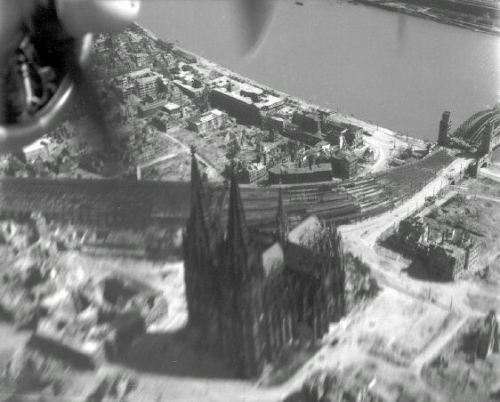
Cologne Cathedral
Cologne Cathedral (Paul Valentine collection)