Mission Date: January 10, 1945
COLOGNE, RAILWAY BRIDGE, DUISBURG
100th BG Mission #: 247
Mission Summary
ON THIS DAY...JANUARY 10, 1945
The thirty-eight crews that were to fly on Wednesday the 10th, were awakened that cold morning to two more inches of snow falling, on top of the two inches already on the ground.
At the briefing, the men learned that they would again be going back to Cologne. Their targets would be the same as on the January 7 mission, the autobahn bridge over the Rhine River at Rodenkirchen near Cologne for the primary target with the railway transshipment shed in the Kalk-Nord marshalling yard, east and across the Rhine River from Cologne as their secondary. Again, the boys were briefed to expect heavy flak from the reported four hundred German anti-aircraft guns in the area.
The Division column would be led by the 93CBW, followed by the 13th, 45th and 4th wings.
Not flying any composite group formations, the 13CBW’s formation would consist of the 95BG flying as the lead group, the 100BG in the high and the 390BG in the low. For the Hundredth, their formation would consist of three squadrons: the lead with ten aircraft would be led by Major Charles Martin and Paul Spurgeon, the high with twelve ships by Major Harry Cruver and John Ernst, and the low with twelve ships led by Edward Wooten and David Raiford.
The B-17s were loaded with six 1,000 lb. bombs, making take-off in the morning darkness on the icy and snowy runways even more dangerous.
Thirty-seven of the planned for thirty-eight ships took off, between the hours of 0800-0853. The snowy runways that morning caused problems for a few of the ships. One of the 418th's ships, ship # 673, flown by Francis H. Mikesh was stuck in the snow, unable to take off. Another 351st aircraft, 42-38047, ‘Fever Beaver,’ scheduled to fly in the low squadron was late to take-off. Unable to catch the formation once airborne, it returned early back to Thorpe Abbotts.
Other Groups in the East Anglia area were also having take-off and formation issues due to the snowy runways and the 10/10 overcast conditions. The 390BG, flying as the 13CBW’s low group, had five aircraft stuck in the snow, unable to take off.
William Carleton, the Hundredth’s engineering officer remembered the that day in January as the day a B-17 crashed into the bomb dump on base. He wrote, “On the 10th, we heard the telltale noise of runaway engines again and took cover. It was about nine o’clock in the morning and we had a low ceiling and our planes were on a mission. Suddenly, out of the sky loomed a B-17 in a dive of about 45 degrees angle. The sentry at our bomb dump heard it and ran from his post only seconds before it crashed into the dump. It had on board two 2,000 pounds which exploded with « a hell of a roar » throwing debris all the way across the field. Unfortunately, this concussion set off other bombs, and we had a pyrotechnic display for the next two days. The field was closed, and although we were able to get our planes back in, we were off operations for a day or two.” The crashing B-17, A/C 44-8181 from the 452BG, was flying out of Deopham Green, Norfolk. Its pilot, Harry Arant, had fortunately bailed out prior to the crash.
Richard Benz, who maintained, installed and repaired radar counter measures in the 100th’s B-17s, remembered that explosion well. “We began to hear small explosions and smoke and realizing that this might be coming from the bomb dump we piled into the jeep and headed across the perimeter and all the runways for the opposite corner of the field. On the way a large explosion took place, evidently from a bomb in the plane. A half mile away it was like a brick wall hit you in the back of the head. I am sure glad I was never on the receiving end of a bomb delivery. It must have been absolute terror! I spent the rest of the day in town waiting for the base to disappear.”
Meanwhile for the crews out on the mission, the 95BG as wing leader, had arrived to the assembly point two minutes early but was unable to locate see the 100BG or the 390th's formations due to the heavy contrails in the air. Despite the contrails however, the 100BG eventually was able to form up with its wing without incident.
At 1215 hours, flying over Bonn, the Germans opened up their flak guns on the formations with most of the 100BG’s bombers taking direct hits. Flying through the exploding flak, the 100th’s lead squadron started to make its visual run on the target but two minutes before bombs were away, the lead aircraft’s bombsight was struck by flak so “the Lead dropped wheels to indicate abortion and left formation, dropping bombs after leveling off.”
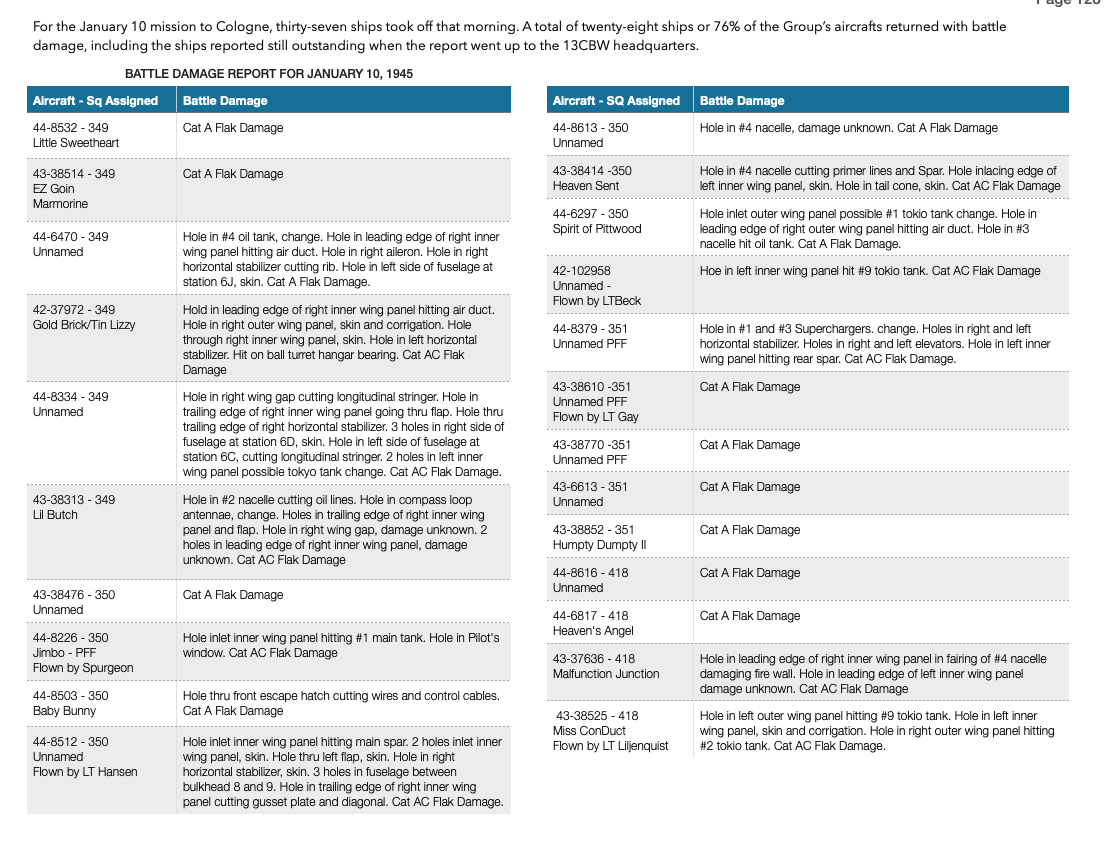
The flak bursts damaged a number of the B-17s. According to twenty-three year old navigator, Billy Bittle, flying his #1 combat mission on George Fowler’s crew,“The Group ahead of us got off course and we went in south of Cologne at Bonn. Flak started about five minutes out of Bonn, which is in the Ruhr Valley, better known as Flak Valley. We followed the Rhine River on to Cologne and flak was bursting all around us. We were flying straight and level at 27,000 feet for almost thirty minutes. Our nose was shot out and the wind was cold as hell. No one was hurt in our crew, but planes were going down everywhere. The lead plane got a direct burst of flak in his bomb bays and couldn’t release his bombs. The leader was hit pretty bad and had to abort. Richard Beck, 3 B aborted at the same time. Flak through escape hatch in nose up to pilot’s compartment, knocked off panel lights, cut Fowler’s (pilot) electric cord to heated suit, and left bruise on his left leg. Everyone had close shaves by flak, but we didn’t realize it because it was our first mission.”
Aircraft 44-6811, an unnamed aircraft had aborted the mission, returning early due to its #1 and #4 engines running rough. On this mission, the 100BG would have minimal mission aborts in comparison to the wing's other two Groups which had nine pilots from the 95BG and five from the 390BG abort the mission early.
Twenty-nine year old pilot Arthur R. Calder and his crew, also flying their very first combat mission, were flying in the B-17 named ‘Milk Run Mabel,’ in the #5 position of the lead squadron. Calder reported that he was hit on the nose of his ship about two minutes before target time. His navigator reported bad damage when twenty-seconds later, a second burst shot away the control cables in the waist. A third burst struck the left wing at the inboard aileron hinge, “setting the wing afire stopping aileron control and setting fire to outboard tanks.” Still focused on accomplishing the mission, they were able to get bombs away, after which they received another flak burst that caused the ship to roll out of formation to the right. Calder stated, “Approximately ten minutes after the wing was set afire, the ball gunner (Carl Donnell) called me and reported that the fire was getting worse. We did not wish to bail out over Germany…and at this time I called the navigator and asked for estimated position. He was unable to give me a gee fix as the first burst through the nose had knocked out the gee box…on looking at the wing I could see that the flame was beginning to come out in large bursts, so I called the crew on the phone and told them to bail out. The bombardier salvoed the bomb bay doors and hit the bail-out bell…The last man left the ship at approximately 12,000 feet…20 to 30 seconds after leaving the ship, the wing either blew up or came off as the ship went into a deep spiral and crashed approximately 5 kilometers from the town of Gestel in Belgium. We were unable to visit the ship later due to the fact that the Prince Albert Canal was between us and the ship, and there were no bridges in the vicinity. The ship burned on crashing.”
John Stack, Calder’s twenty year old copilot from Lansing, MI remembered, “Calder hit the alarm-bell for ‘abandon ship.’ Frankly I was scared to bail out that close to our bombs dropping and couldn’t see any flame yet. I suggested that we try to get to friendly territory. We all stayed until the fire bloomed out all along the wing way past the tail….I was wrong. We should have bailed sooner. But we were lucky… At this point we bailed out (about 20,000 feet)…. The Crew’s TG, nineteen year old Leon E. Briggs from Tahlequah, Oklahoma added, “Well, we all got out quick. Somebody said over the inter phone, ‘See you all in Brussels.’ And I hoped to hell he was right. We were all safely out, even the pilot, when the plane blew up, and pieces of the wing fell down around us.”
The rest of the Hundredth’s bombs were away at 1224 and the Group made their turn to the rally point and their route out.
As the formation returned to the safety of England, the winter storm from earlier that morning was still hanging around, keeping the ships circling at the coast waiting for an opening to land. When the formation finally came in at 1579 hours, red flares, indicating wounded aboard, were shot from the high squadron’s lead ship flown by John P. Ernst. His copilot, twenty-two year old James Olmsted, flying as formation officer had been wounded by exploding flak.
A command pilot would often sit in the copilot’s seat and the copilot would sit in the tail of the airplane as the formation officer, an uncomfortable and tight position where the trained pilot would provide feedback on the squadron’s formation flying during the mission. During the rough flak encountered on the bomb run, flak had pierced into the tail of Ernst’s aircraft, passing through copilot James Olmsted’s hand and into his left temple when he instinctively put his hands up to protect his face. This was Olmsted’s twenty-fifth mission. After landing, Olmsted was taken to the 65th General Hospital with such severe wounds encountered from the flak that he never returned to combat.
As the 100th’s fortresses came in over the field for landing, the men at the tower made their count - five of their B-17s had not returned; Beck, Dodrill, Raiford, Kane and Calder’s ships were still outstanding. Fortunately, four of the pilots would later report in as safe with John Dodrill’s fortress left as the only ship and crew never returning.
John J. Dodrill and his crew, flying in the B-17 named ‘All American Girl,' were starting their #12 mission when they took off that fateful morning. After bombs were away, Dodrill was reported last seen at 1228 hours, heading to Belgium, flying alone with his bomb bay doors still open. The Hundredth would later learn that the ‘All American Girl’ crashed near Gladbach, Germany, where Dodrill and his entire crew ultimately perished. From Puente, California, John Dodrill at nineteen years old, had been the “youngest pilot flying a B-17 Flying Fortress in the entire Eighth Air Forces Third Bombardment Division.”
Richard Beck and crew had also been flying their #1 combat mission when Beck pulled out of the formation. “About half a minute before they hit target no 4. was hit and it wouldn’t feather. Ten minutes later no.2 wouldn’t feather because of flak in the gears. They dropped their bombs and got out of there. The ship was full of holes, two engines wind milling, no 2 caught fire but went out. No 1. was causing problems, no compass, no trim tabs, no artificial horizon, out of range of the G box, bomb bay doors wouldn’t close ball turret cables partially cut… They were getting ready to land in a field in France when they lost it in the fog. They then got a tower at P-51 in Melville where they landed. They had the left and tail wheels flat and managed to stay on the strip at only a 20 degree angle. They counted the holes in the ship and there were 225, they figured the ship wouldn’t fly again…None of the crew was injured.” The Group however, would not hear that Beck and his crew had safely landed in France until the next day.
Although another lead ship flown by David Raiford had been reported last seen at 1230 hours, the crew would later return safely to base as would Gerald F. Kane and his crew. Kane, flying A/C 43-38992, had made an emergency landing in Belgium after his B-17 became damaged from the flak.
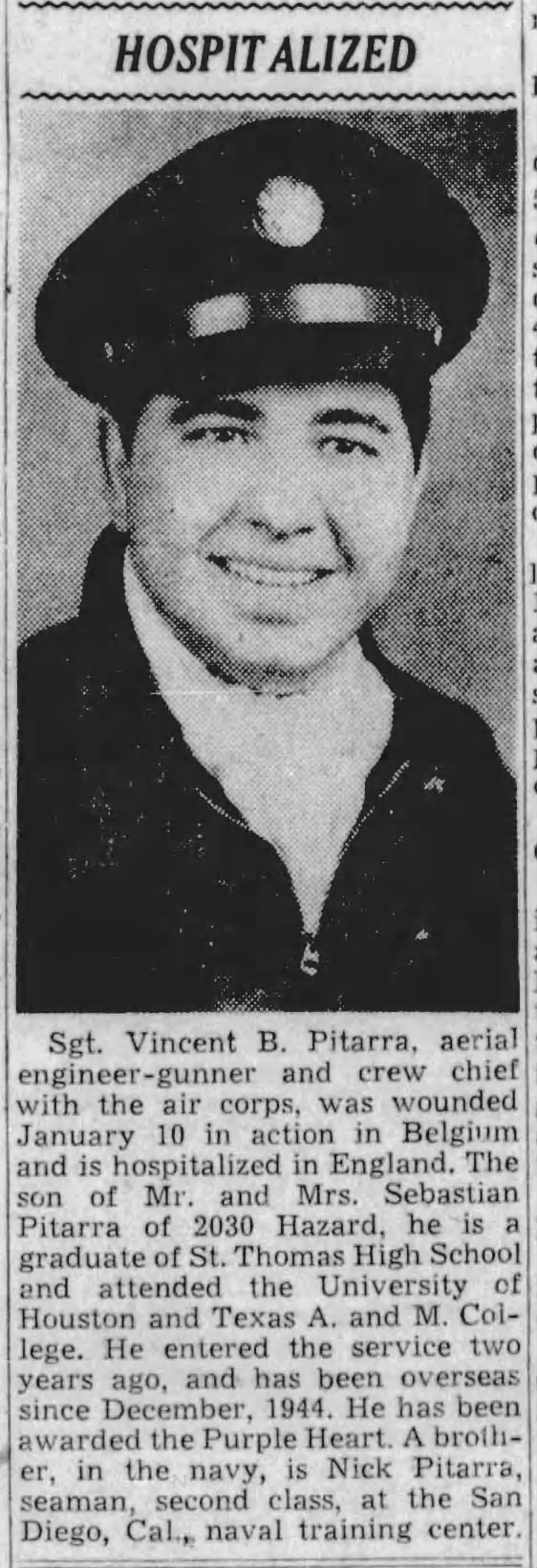
When Arthur Calder’s crew had bailed out, they hit the ground near Meerhout, Belgium. His copilot, John W. Stack remembered, “Waist gunner Whipple hid out for two weeks, thinking he was in Germany. When found, he was delirious and had trench foot. He refused to fly again and was given a job as a squadron clerk. The engineer, Pitarra, broke his ankle and never flew again. I flew one ‘abort’ and one ‘scrub’ with Calder and then got off the crew to become a spare copilot.” Little did Stack realize how fortuitous his decision to get off the Calder crew would become.
Bombing Results
Bombing Results: FAIR
Aircraft Lost: 1
Crew Lost: 9
Claims of Enemy Losses (CLS): 0
Aircraft Returned:
Media Articles
Use your thumb to scroll through the results box below.
| Media Item | Type | Page | Volume/Issue | Broadcast Source | Time | Description | File |
|---|---|---|---|---|---|---|---|
| Battle damage January 10 1945 Cologne | 12:00 am | ||||||
| Vincent Pitarra wounded on January 10 1945 mission | The Houston Chronicle March 25 1945 | 12:00 am |
Photos
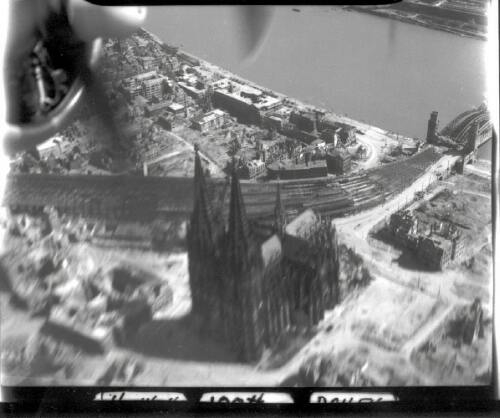
Cologne
The Cologne Cathedral "Continental Express" tour of Germany after the War.