Mission Date: January 14, 1945
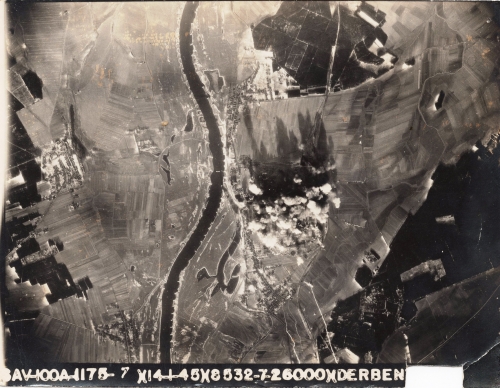
DERBEN, OIL STORAGE
100th BG Mission #: 249
Mission Summary
ON THIS DAY...JANUARY 14, 1945
At the 0445 main briefing, the Primary target was unveiled to the thirty-eight crews flying — it would be the underground oil storage tanks located immediately north of a small village named Derben, fourteen miles SSE of Stendal. Stendal was located seventy-eight miles west of Berlin and was the site of a Luftwaffe airfield. The boys knew that this would be a rough mission — one where they could again encounter heavy flak and German fighters who would be defending their much needed oil reserves.
The 95th Bomb Group would fly Lead as the 13CBW, with the 100BG flying as the High formation and the 390th as the Low. The Air Leader for the 100th’s formation would be Major Lyster in the Command seat, flying with Raiford.
The B-17s took off from Thorpe Abbotts between 0732-0815 hours. The first pilot to abort the mission early was the 418th's LT Paul E. Deweerdt. He was flying in the ship named 'Dixie’s Delight' when he left the formation at 0800 hours, just after take-off over the base at only one hundred feet altitude. Next, it would be the 349th’s Raymond L. Heironimus, flying in the Lead squadron in a ship named 'Grumblin Gremlin III'. He aborted at 1102 hours at 12000 feet. They would not be the only ones that day. In fact, a total of ten ships from the 13th Wing would ultimately abort early: two from the 95th, two from the 100th and six ships from the 390th.
Due to clear skies, flak gave the boys some trouble over Brunsbuttlekoog, where it was reported "tracking and accurate'". Tail Gunner, Joe Urice on his #2 mission remembered, “…As flak bursts tracked closer toward us, the 100th bomber stream veered slightly to the right and the German AA ceased firing at the 100th…this was a clear day and that trailing Group was nearer than usual and very visible. The German 88 AA batteries were able to zero them as to elevation and four B-17s went down immediately. My startled reaction was that in no way could a big powerful B-17 be blown down the quickly, but it happened.”
Not sure of where the bomber stream would attack, German defenses would send up smoke screens meant to hide the targets below. William Wellings now on his #12 mission, flew in the ship 'Heaven Sent' with Michael’s Crew. He remembered, « It was visual all the way and we sure had them guessing this time because every town had its smoke screen going. Just got into Enemy territory for 5 minutes when they started shooting at us. Wicked-looking stuff too. Bursts as red as hell! Only got about 20 bursts but five of them were right on the low. Just started to reach for my flak suit when one blew right in front of us. I jumped a mile and a piece of flak came through the nose and splattered my arm with plexiglass. Don’t know how the flak itself missed me. It came through right where I usually have my feet, too. I stopped doing pilotage right then. We were only a few miles north of Hamburg then and heading right for Big « B » and we were sweating!”
Fortunately, the bombers’ P-51 fighter escorts were on time and ready. The 349th’s pilot, Eugene Jensen, leading the Low element in the Lead squadron recorded, “As we turned and headed for our IP at Berlin we could see many contrails ahead and we knew the Jerry fighters were waiting for us. Our 16 fighters formed in front of us… »
Between 1234 and 1310, the German “bandits” were on the attack but most of the P-51 fighter 'escorts' were able to break up the enemy formation. LT Wellings adds, “We were all pretty jittery expecting fighters and natch I was looking in the wrong place when they did hit us...There were so damn many planes mixing it up that when they started towards us I was afraid to shoot for fear I’d hit a 51. They made a half-assed pass at us for about 1 minute and the 20 mm looked like flash bulbs exploding out there. Then they cut between the Lead and us and the whole damn mess went thru and I still didn’t dare shoot. They got around to 0600 then and tried again but still couldn’t get us so they turned and bounced the 390th, right in back of us and shot down 6 of their low Sqdn. There were dogfights all over the sky by this time and everybody was nervous as hell...Went within 10 miles of Berlin and then turned right and made a run on the Target. It was still visual and Bombs Away ok. No flak at all. We smashed hell out of it too and so did the 95th in front of us. Had fighters in the area for next 20 minutes but didn’t get hit. »
Ultimately, the 100th's ships in the Lead squadron made it through one attack by a single FW 190 while the High squadron took the brunt of the attacks made by fourteen FW 190s and two ME 109’s. The Low Squadron survived their attack by a single ME-109. Most of the German fighters passed through the 95th and 100th’s formations and focused on the 390th, which was flying ten miles behind the 100th. The 390th was not so lucky, ultimately losing a total of eight bombers and crews that day.
With enemy fighters in the area, the 100th stayed in Group formation to drop their bombs rather than risk the individual squadron bomb runs. The Hundredth's formation came into the target very close behind the 95th, dealing with problems from the 95th’s prop wash as they bombed. Bombs were away at 1304 hours with reportedly excellent results in hitting the target but the storage tanks had been emptied of their oil.
Crews had hoped to be assigned to a 'milk run' for their last scheduled mission, but for the 349th’s « Moose » Miller Crew, this would not be the case. Tail Gunner, Bob Kazee, remembered his #35 and final mission well. « …Our hopes for an easy mission flew by quickly as we approached the target we were jumped on by about 50 FW-190s. Our P-51s escort took out after them and we saw quite a dog fight…There was no flak but I guess the fighters knew it was our last mission and this was their way of saying good-bye… as we passed over the coast and headed toward England we all gave a big sigh of relief because by completing 35 missions we would be inducted into the « Lucky Bastards Club » and soon be on our way to the good ole U.S.A. Another funny thing happened when we finished our last mission. I was called in and offered a permanent rank in the army as Mast SGT with a battlefield commission to 1st Lieutenant if I would stay in England for another tour of duty. I couldn't stop laughing. My only remark was « I want on the first available flight or boat going back home. »
All ships returned safely to base. The official Engineering report would reflect eight of the 100th’s ships returning with battle damage. The mission light at Thorpe Abbotts indicated a mission on for the next day.
Crews* known to be flying this day:
349th: Miller, Jensen, Wood, Wilkes, Thrasher
350th: Meiklejohn, Streich, Fowler, Spurgeon, Michael, Porter, Ellis
351st: Dovel, Johnson, Kodas, Wofford, Ernst and
418th: Carley, Liljenquist, Mikesh
At the 0445 main briefing, the Primary target was unveiled to the thirty-eight crews flying — it would be the underground oil storage tanks located immediately north of a small village named Derben, fourteen miles SSE of Stendal. Stendal was located seventy-eight miles west of Berlin and was the site of a Luftwaffe airfield. The boys knew that this would be a rough mission — one where they could again encounter heavy flak and German fighters who would be defending their much needed oil reserves.
The 95th Bomb Group would fly Lead as the 13CBW, with the 100BG flying as the High formation and the 390th as the Low. The Air Leader for the 100th’s formation would be Major Lyster in the Command seat, flying with Raiford.
The B-17s took off from Thorpe Abbotts between 0732-0815 hours. The first pilot to abort the mission early was the 418th's LT Paul E. Deweerdt. He was flying in the ship named 'Dixie’s Delight' when he left the formation at 0800 hours, just after take-off over the base at only one hundred feet altitude. Next, it would be the 349th’s Raymond L. Heironimus, flying in the Lead squadron in a ship named 'Grumblin Gremlin III'. He aborted at 1102 hours at 12000 feet. They would not be the only ones that day. In fact, a total of ten ships from the 13th Wing would ultimately abort early: two from the 95th, two from the 100th and six ships from the 390th.
Due to clear skies, flak gave the boys some trouble over Brunsbuttlekoog, where it was reported "tracking and accurate'". Tail Gunner, Joe Urice on his #2 mission remembered, “…As flak bursts tracked closer toward us, the 100th bomber stream veered slightly to the right and the German AA ceased firing at the 100th…this was a clear day and that trailing Group was nearer than usual and very visible. The German 88 AA batteries were able to zero them as to elevation and four B-17s went down immediately. My startled reaction was that in no way could a big powerful B-17 be blown down the quickly, but it happened.”
Not sure of where the bomber stream would attack, German defenses would send up smoke screens meant to hide the targets below. William Wellings now on his #12 mission, flew in the ship 'Heaven Sent' with Michael’s Crew. He remembered, « It was visual all the way and we sure had them guessing this time because every town had its smoke screen going. Just got into Enemy territory for 5 minutes when they started shooting at us. Wicked-looking stuff too. Bursts as red as hell! Only got about 20 bursts but five of them were right on the low. Just started to reach for my flak suit when one blew right in front of us. I jumped a mile and a piece of flak came through the nose and splattered my arm with plexiglass. Don’t know how the flak itself missed me. It came through right where I usually have my feet, too. I stopped doing pilotage right then. We were only a few miles north of Hamburg then and heading right for Big « B » and we were sweating!”
Fortunately, the bombers’ P-51 fighter escorts were on time and ready. The 349th’s pilot, Eugene Jensen, leading the Low element in the Lead squadron recorded, “As we turned and headed for our IP at Berlin we could see many contrails ahead and we knew the Jerry fighters were waiting for us. Our 16 fighters formed in front of us… »
Between 1234 and 1310, the German “bandits” were on the attack but most of the P-51 fighter 'escorts' were able to break up the enemy formation. LT Wellings adds, “We were all pretty jittery expecting fighters and natch I was looking in the wrong place when they did hit us...There were so damn many planes mixing it up that when they started towards us I was afraid to shoot for fear I’d hit a 51. They made a half-assed pass at us for about 1 minute and the 20 mm looked like flash bulbs exploding out there. Then they cut between the Lead and us and the whole damn mess went thru and I still didn’t dare shoot. They got around to 0600 then and tried again but still couldn’t get us so they turned and bounced the 390th, right in back of us and shot down 6 of their low Sqdn. There were dogfights all over the sky by this time and everybody was nervous as hell...Went within 10 miles of Berlin and then turned right and made a run on the Target. It was still visual and Bombs Away ok. No flak at all. We smashed hell out of it too and so did the 95th in front of us. Had fighters in the area for next 20 minutes but didn’t get hit. »
Ultimately, the 100th's ships in the Lead squadron made it through one attack by a single FW 190 while the High squadron took the brunt of the attacks made by fourteen FW 190s and two ME 109’s. The Low Squadron survived their attack by a single ME-109. Most of the German fighters passed through the 95th and 100th’s formations and focused on the 390th, which was flying ten miles behind the 100th. The 390th was not so lucky, ultimately losing a total of eight bombers and crews that day.
With enemy fighters in the area, the 100th stayed in Group formation to drop their bombs rather than risk the individual squadron bomb runs. The Hundredth's formation came into the target very close behind the 95th, dealing with problems from the 95th’s prop wash as they bombed. Bombs were away at 1304 hours with reportedly excellent results in hitting the target but the storage tanks had been emptied of their oil.
Crews had hoped to be assigned to a 'milk run' for their last scheduled mission, but for the 349th’s « Moose » Miller Crew, this would not be the case. Tail Gunner, Bob Kazee, remembered his #35 and final mission well. « …Our hopes for an easy mission flew by quickly as we approached the target we were jumped on by about 50 FW-190s. Our P-51s escort took out after them and we saw quite a dog fight…There was no flak but I guess the fighters knew it was our last mission and this was their way of saying good-bye… as we passed over the coast and headed toward England we all gave a big sigh of relief because by completing 35 missions we would be inducted into the « Lucky Bastards Club » and soon be on our way to the good ole U.S.A. Another funny thing happened when we finished our last mission. I was called in and offered a permanent rank in the army as Mast SGT with a battlefield commission to 1st Lieutenant if I would stay in England for another tour of duty. I couldn't stop laughing. My only remark was « I want on the first available flight or boat going back home. »
All ships returned safely to base. The official Engineering report would reflect eight of the 100th’s ships returning with battle damage. The mission light at Thorpe Abbotts indicated a mission on for the next day.
Crews* known to be flying this day:
349th: Miller, Jensen, Wood, Wilkes, Thrasher
350th: Meiklejohn, Streich, Fowler, Spurgeon, Michael, Porter, Ellis
351st: Dovel, Johnson, Kodas, Wofford, Ernst and
418th: Carley, Liljenquist, Mikesh
Bombing Results
Bombing Results: EXCELLENT
Aircraft Lost: 0
Crew Lost: 0
Claims of Enemy Losses (CLS): 6
Aircraft Returned:
Media Articles
Use your thumb to scroll through the results box below.
| Media Item | Type | Page | Volume/Issue | Broadcast Source | Time | Description | File |
|---|---|---|---|---|---|---|---|
| Battle damage January 14 1945 | 12:00 am | ||||||
| Gene Bankston describes Derben mission | Holdenville Daily News Feb 5 1945 | 12:00 am |


Photos
Douglas Eden Derben
Derben Jan 14,1945 100 "A" Group Strike Photo from Capt Douglas Eden, Photo Courtesy of Beth Eden-McGuire