Mission Date: January 17, 1945
HAMBURG, OIL REFINERY
100th BG Mission #: 250
Mission Summary
ON THIS DAY...JANUARY 17, 1945
On Wednesday, January 17 at 0330 hours, the 349th’s crews scheduled that day were awakened by Sergeant Miner calling out their names as he shined his flashlight into their faces. Wood…Pecyk…Scheipers… Wilkes…Baugher…Rasmussen…on it went as he moved into the enlisted men’s quarters…until all of the air crews flying that day were told of the 0430 briefing. January 17 was the birthday of Wilkes’ navigator, James Rasmussen and the crew would have to fly without them as he had woken up “sick with a fever and was put in the hospital for the remainder of the day while the rest of the crew flew.”
The awakened forty-one crews went through their morning routines before checking in with the attendance man at the briefing room door. Orders called for thirty-eight crews but the Hundredth would put up a few extra aircraft as spares to take the place of aborting aircraft.
When the crews heard that the primary target for the mission would be the Albrecht and Rhenania synthetic oil refineries located in the central dock area of Hamburg, you could hear a pin drop. Everyone knew what had happened to the 100BG the previous December 31 at Hamburg. Navigator Leon Schwartz tells us, “The briefing room was hushed on the morning of January 17th as we were being informed that the 100th was returning to Hamburg to bomb the oil refinery missed on December 31, 1944, the third bloodiest day in the 100th’s storied history.”
The 3rd Division would lead the entire 8th Air Force’s column of aircraft. The 100BG would be flying in the 13th’s ‘B’ group and would be led by Major Robert Rosenthal, flying in a Pathfinder ship with twenty-seven year old Paul L. Spurgeon from Oklahoma City. The 100th’s high squadron would be lead by Charles Robinson and John P. Ernst with the low lead by John P. Gibbons and Jack V. DePlanque.
The 100th’s heavy bombers departed the base between 0810-0838 hours, each B-17 loaded down with twelve 500 lb. bombs. The first pilot to abort early was Warren Marmorine, flying aircraft 43-38514, named ‘E-Z Goin.’ Starting his #33 mission with his crew that morning, Marmorine turned back at 0930 hours with a turbo out, bringing his bombs back to base. Taking off late, in aircraft #608, was twenty-one year old Edward O. Talmage, Jr. Unable to catch the formation, Talmage turned back to the base at 1113 hours. Both of these 349th pilots were scheduled to fly in the low squadron and were marked as spare aircraft on the 100th’s Operational Narrative.
At 1051 hours, a B-17 from the high squadron, 43-8414 named ‘Heaven Sent’ and flown by Joseph Michael, also left the formation, returning early due to an oil leak in his #1 engine. Flying as Michael’s bombardier that day, William Wellings recorded into his diary upon heir early return to base, “My heated suit went out and I almost froze but luckily we aborted about 52N and 02E because #1 was tossing oil all over the place. Feathered it finally, and dropped bombs in the Channel. Landed about 1215 and loafed around in the barracks rest of day.”
The weather was 1/10 to 2/10’s scattered low clouds over North Germany and the target area was reported as clear except for a slight ground haze. Good weather for the bombers to make a visual bombing run but also making it easier for the flak gunners and enemy fighters to see the bombers heading toward the target.
All of the boys were jumpy. At briefing, they had been told to expect flak from the many anti-aircraft guns protecting the German refineries in Hamburg and as they neared the target, they each were having their own private thoughts about what could happen to them over the bomb run. ‘Please God, don’t let it be another December 31.’
Dave Wood’s gunners did not have to be reminded to keep alert. Sergeants Volk, Williamson, Rozmenoski, Vaughn, Campbell and Valenza had all been nervous about German fighters ever since their take-off. Thankfully, the P-51 escorts were “very much on the job…Rendezvous times were made and good close support was given throughout the time that we were over enemy territory.”
Fears over the anticipated flak were quickly replaced by the real thing as the formation neared the target. The flak was intense, barrage, and tracking for three minutes — considered an eternity when you are flying in a tin can, loaded down with 6000 pounds of explosives at 25,000 feet in the air.
The 100th’s lead bombardier, Ralph R. Searle, reported, “the bombing run was visual all the way. Mickey helped with course to catch in point. Made one slight evasive action to gain better position behind group ahead. Altitude was 26,000 feet.”
The bombs were dropped successfully at 1156 hours. As the Group turned from the target, “three large explosions were seen in the black smoke that covered the area where our bombs hit. A large number of fires were seen in the target area.”
Waist gunner Guy R. Weaver on Don Lilenquist’s crew, remembered, “Flak was heavy and pretty accurate. Target was visual. We hit it pretty good. I only hope we don’t have to go back again. After bombs away No. 3 engine started throwing oil. We had to feather it. We dropped out of formation. We came back alone. We sure had good fighter protection. We made it ok. Thank God for our safe return.”
According to what the air crews were told in the briefing that morning, the route home was to be flak free but the formation ran into three more rounds of flak. As they turned away from the bomb run flying along the Elbe River, many of the pilots had to take evasive action from the additional flak thrown up. The second round of unexpected flak had bursts that were concentrated just ahead of their formation, lasting for five very long minutes as the boys flew into its path. The third and last flak barrage encountered lasted for an additional three minutes - three minutes that set the men on their very last nerves.
After seven and one-half hours of flying time, five of which were on oxygen, the 100th’s fortresses landed at 1530 hours. Those standing at the tower watching for the Group’s return breathed a sigh of relief as they counted all but one aircraft coming in over the base. This would NOT be a repeat of the last Hamburg mission but everyone was still concerned about the missing ‘Heaven Can Wait,’ flown by William Appleton and still outstanding.
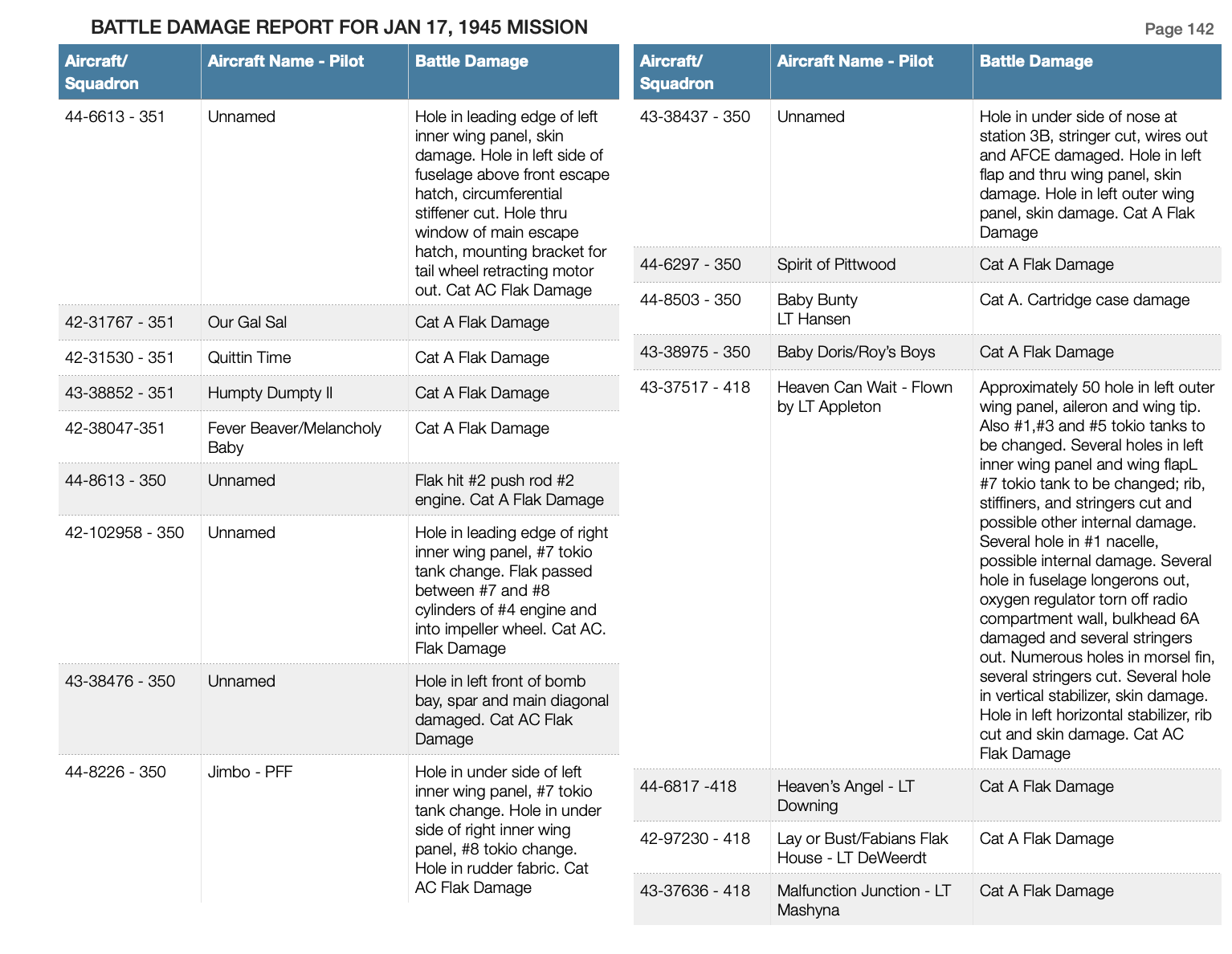
Later however, Appleton would report in safe. His B-17 had run into difficulty when flying over the Kiel Canal, formerly known as the Kaiser-Wilhelm-Kanal - a canal that links the North Sea to the Baltic Sea. There, Appleton “ran into a second barrage over the Prince Wilheim Canal, where the oxygen supply was knocked out to the tail and ball turret positions, adding to the problems caused by the loss of ‘fourteen feet off the Port wind and the inboard engine.’ Three minutes later, the nose was shattered and the compass damaged by .50 calibre bullets. As the engineer sat and pumped fuel by hand to the outboard starboard engine, the pilots brought the plane home, to reach the English coast in over Lowestoft, to land at 15.15 with no brakes, no hydraulics, with half the rudder stabilizer gone and with a flat left tire.” Although Appleton returned his heavy bomber with major battle damage, no serious injuries were reported. Navigator, Leroy W. Duncan, recalled “Nobody was hurt, except Togglier (Harry Sutherland), who had received a burn on bum from a piece of flak caught in his flying suit…”
Out of the nine 418th crews flying, five returned with battle damage. Out of the total forty-one B-17s, seventeen returned with battle damage resulting from three separate rounds of heavy flak encountered, keeping the men on the ground crews and in the sub-depot busy through the night.
The men of the 100BG considered themselves fortunate when they would later learn that the 3rd Division had lost a total of eight aircraft and crews.
As night closed in on the base, some of the airmen in the 418th squadron were still jumpy - nothing to do with enemy fighters or being flaked up but rather over a reported new sighting of the squadron ghost. Thomas Williams, not yet marked operational, recorded that night into his diary, “so we got up again this morning - come to find out one of the fellows saw the ghost again last night. That ghost is getting to be quite a fellow — wow - I hope he keeps clear of me & my shadow.”
During the night, as the ground crews worked outside on their damaged B-17s, high winds blew in another snowstorm and the 100BG prepared for yet another weather stand down.
Bombing Results
Bombing Results: GOOD
Aircraft Lost: 0
Crew Lost: 0
Claims of Enemy Losses (CLS): 0
Aircraft Returned:
Media Articles
Use your thumb to scroll through the results box below.
| Media Item | Type | Page | Volume/Issue | Broadcast Source | Time | Description | File |
|---|---|---|---|---|---|---|---|
| Battle Damage January 17 1945 | 12:00 am |