Mission Date: January 28, 1945
DUISBURG, BRIDGE
100th BG Mission #: 253
Mission Summary
ON THIS DAY...JANUARY 28, 1945
On Sunday, January 28, the crews headed to the flyers mess hall, trudging through three more inches of new snow, on top of the multiple inches that were already there. At the general briefing, the boys learned that they would be flying their mission to Duisburg with a Primary target of the Duisburg-Rheinhausen double track railway bridge, a five span bridge of iron and steel across the Rhine. The Group's Secondary target would be the main train station at the North end of the rail yards in Duisburg.
The 100th would fly as the 13th Wing’s ‘A’ group with the 390th flying as the ‘B’ and the 95th as the Wing’s ‘C’. Leading the 100th's formation would be Major Neal Scott, flying as the Command pilot alongside David Raiford of the 350th, who had started flying as a Lead pilot earlier in January. The High ‘B’ squadron would be led by Captains Robinson and Brown, and the Low ‘C’ by Captain Spurgeon and LT Sharemet. The airmen were briefed to expect heavy flak from the reported three hundred German guns in the area.
Once again, Mother Nature complicated the day’s mission by putting East Anglia into another heavy snowstorm that started as the boys were taxiing into positions for take-off. With each B-17 loaded up with six 1000 lb. bombs, the pilots brought their B-17s to a complete stop when the snow flurries prohibited the pilots from seeing the planes directly in front of them. The takeoff was delayed for thirty minutes and the boys finally took off between 0910-0954 hours. Flying his #20 mission, Bombardier, LT Robert E. Fitzgerald flying on the 350th’s LT William Wilson’s ship named ‘The Little Rebel’ remembered, « The plane was covered by ice and snow and we cleared the ground at the end of the runway and cleared the trees by about 10 feet…. »
The 100th’s Lead and Low squadrons attacked the Primary target while the High squadron attacked the marshaling yards from an altitude of 25500 feet when their lead Bombardier couldn’t pick up the Primary target due to poor visibility from fog and haze in the target area.
Over the bomb run to the target, flak was reported as “moderate to intense, barrage and tracking” and the ships flying in the Lead formation were reportedly taking the brunt of it. LT Fitzgerald remembers, “Our first flak was on the bomb run. I watched as a plane in the group in front of us was hit and burst into flames and went into a tight spin and exploded on the ground. I saw no chutes..The flak over the target was very accurate. One of our forts had over 200 holes in it. As usual we were lucky and had only two holes in our brand new plane…”
Some of the crews flying their #1 combat mission would also remember problems encountered from flak. Waist Gunner, S/SGT Harvey K. Wingard, flying with the Donald Dewey Crew on their #1 remembered, “…Got 18 holes in our plane. Two holes in the nose the rest in the wings. Bombardier had a very close call, his sighting window was shattered by flak. Smoke from flak was very thick, we thought our plane was on fire…” The 349th’s LT Lyman Fillingame on his #1 combat mission recorded, “A six hour mission with 3 hours on oxygen. Visual - light but accurate flak, six holes in ship — cracked left windshield and had to change right wing.”
Flying in the aircraft named Grumblin Gremlin III, was the 349th’s Edward O. Talmage Crew. Their Copilot LT Walter E. Karutz remembered, “The worst mission was Jan 28 to Duisburg. We took off in a snowstorm but did manage to assemble on top. The flak was heavy and accurate over the target and we received heavy battle damage. We feathered #3 over the target and #2 was only able to put out partial power for the remainder of the flight.”
Flying in the Low squadron was the 350th’s crew lead by Charles W. Wilson, a Texan from Fort Worth. His Navigator, LT Billy M. Bittle remembered, « …Wilson, who always wore cowboy boots, could smell flak, and always had Arnold Wimer (Bombardier) direct him so that a plane was directly under ours for the flak, and for no apparent reason, would veer our Squadron (in tight formation) fighter right or left, and we were grateful when the flak exploded where our plane would have been had we not changed course. Robert Kennedy, our ball turret gunner, especially appreciated Wilson’s E.S.P.
Anyway, our Squadron hit the railroad bridge over the River Rhine just as a train was passing over, and we got both the train and the bridge. Our battle damage was slight, but we got a burst of flak just under the nose and our oxygen was shot out and went through the astrodome. I was sitting on the navigator’s table - the flak came through the other side. We had to hit the deck… » Their Engineer and Top Turret Gunner, SGT James M. McCullough, added « …nothing till target and then had our ass shot off — lots of holes - Co-Pilot and Bombardiers oxygen shot out - Kennedy (Ball Turret Gunner) saw 24 bombs hit the target — blew hell out of things — good raid… »
In the 418th’s LT Thomas Carley ship, their Top Turret Engineer, S/SGT Thomas F. Winkle was hit in the arm with flak. It was so cold on the ship that it was reported, “Grease on first-aid scissors froze today and they wouldn’t work to cut away wounded mans clothing…”
After bombs away, S/SGT Elmer Hooper, Tail Gunner on the Batterman Crew reported “ Broke off in three ship elements after bombs away to evade flak. Field was closed in with snow storm so we had to circle around sweating out landing. I was in the tail - boy what a cloud of snow.”
The boys landed however without any incidents. On the 28th, the 100th had caught a break — there was no loss of life or lost aircraft although nineteen of their B-17s returned with flak damage and almost half of those flak damaged aircraft were more severe, heading into the Sub-Depot department for repairs.
Bombing Results
Bombing Results: VERY GOOD
Aircraft Lost: 0
Crew Lost: 0
Claims of Enemy Losses (CLS): 0
Aircraft Returned:
Photos
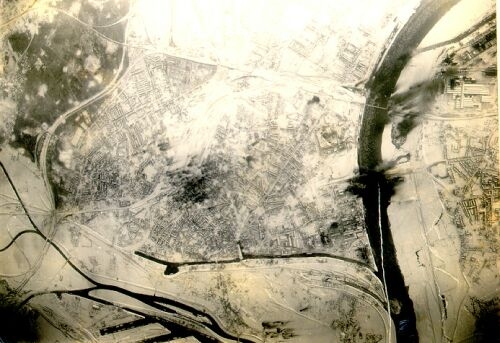
Strike Photo - Duisburg Germany
Strike Photo - Duisburg Germany Photo identified by Winfried Wollschlaegen.