Mission Date: February 3, 1945
BERLIN, CITY
100th BG Mission #: 255
Mission Summary
ON THIS DAY...FEBRUARY 3, 1945
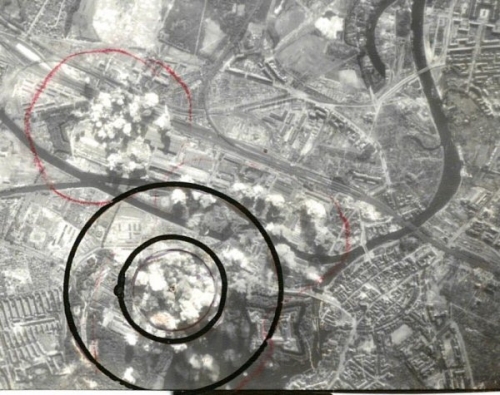
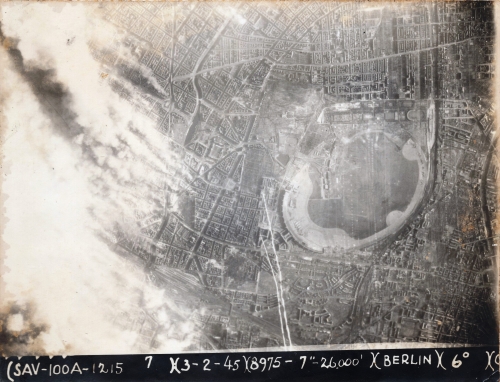
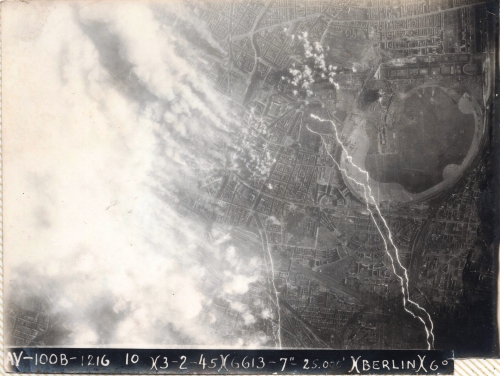
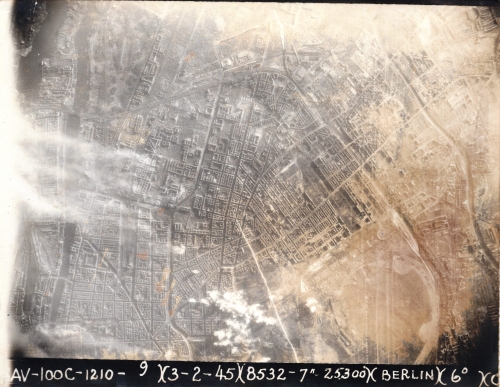
Thirty-eight Crews were in attendance when low, loud whistles were let out by the men when they were told that they would be going to Berlin. With the goal of “disorganizing all communication and transportation within the city,” their target would be the Templehof marshaling yards. Allied Intelligence had reported that the Germany’s 6th Panzer Army was moving through Berlin on its way to the Russian front, which was now only thirty-five miles to the East.
The 13th Wing would lead the 3rd Division and it would be the 100th BG that would lead the entire 3rd Division’s column of five hundred and thirty-six ships. Although a Group’s Commander would normally lead, twenty-seven year old Major Robert Rosenthal was approved by the General to fly as the Command Pilot with the 351st’s Captain John Ernst's Lead crew. This would be Major Rosenthal’s #52 mission.
The 100th’s ships took off between 0715-0745 hours in CAVU conditions, forming up with no incidents. Taking almost two hours to form the division’s column, the 100th’s formation left the English Coast at 0920 hours, flying behind the 1st Division.
The 1st Division’s B-17s were first over the heavily defended Berlin. Flying in the 100th’s High squadron, Bombardier, LT Robert E. Fitzgerald, tells us, « … On the bomb run we could see Berlin covered by smoke screen and smoke and flames from the 1st Division. The sky in front of us was full of flak and we could see two bombers going down in flames. The guns quit shooting as the last group of the 1st Division left the target. The gunners had ten minutes of rest and time to take careful aim at us. »
By 1115 hours, the 100th’s formation had reached the Initial Point of the bomb run when all hell broke loose from ground rockets and the “accurate and tracking” exploding flak.
A ground rocket hit the 100th’s Rosenthal and Ernst's Command ship first. Dropping its bombs over their target, the pilots peeled away from the formation. Official records tell us, "Fire producing a dense white smoke was seen to break out in the fuselage and bomb bay, including the cockpit. The bomb bay doors were closed and then reopened. Pilot opened his window and peeled gently off to the right, directing the deputy leader to take over the lead on VHF. The aircraft headed NE and flew level for a few moments while six members of the crew bailed out. Three men appeared to have come from tail or waist while the other three came from bomb bay. There was a small explosion in #3 engine nacelle and the A/C headed down, burning and beginning to spin. When last seen, at 15,000 feet, observers believed that the entire crew had an excellent chance to bail out."
At the same time, LT Jack Gay's B17, also flying in the Lead squadron, was hit by an 88 mm shell, ripping through his #3 main wing tank , opening the top of his wing and sending gallons of gasoline into its fuselage and the path of the ships flying behind it. Keeping on course and in formation, LT Gay’s bombs were released over the target and then, it too dropped out of formation.
With the Group formation collapsing under the disintegration of the Lead squadron, the High and Low squadrons released their bombs individually.
At bombs away from the High, the 350th’s LT Orville H. Cotner’s ship, “…received a direct hit by flak, believed to have been a ground rocket, on the right wing…Right wing folded up against fuselage and the A/C flipped over on its back. The wing gasoline tank exploded and the entire A/C began to burn and then exploded. One man was seen to bail out, reported to be the tail gunner, and his chute opened.” Although a chute was seen, all men were believed to have been killed when the plane crashed in Hobrecht Street in Berlin. This was their #1 mission and also the twenty-sixth birthday for their Navigator, LT Elmer H. Rundy.
Also flying their #1 mission was the 350th’s Waldo J. Oldham Crew. Their Waist Gunner, SGT Tom Ramsey, vividly remembered the intensity of the flak and the explosion of Cotner’s ship. “As we flew through the intense flak, there was a lot of pilot and crew exchanges over the interphones. I learned that we had lost an engine over the target. During this time, LT Cotner’s ship exploded in a great ball of orange flame…When the explosion occurred I instinctively dropped down behind the armor plate that covered the area below the waist position. After we flew through the debris I stood up and discovered that my ammo rack, positioned at eye level and to the right had taken a direct flak hit. I would surely have been killed had I been standing at my station. At the same time, Chapel encountered flak hitting the ball turret and he hurriedly extracted himself from that position. The turret subsequently took a major hit that would most likely have killed him had he remained there. Tooley left the upper turret to transfer fuel and upon returning, found that his station had been damaged as well. I don’t recall what happened to Kalberloh’s tail position, but he acted his station during the bomb run, with all of this going on we still managed to drop our bombs. Considering all that happened I’m certain some greater powers was looking over us….Wally reported a prop windmilling on another engine but I thought that we lost that one and a third after we had left the target zone. We immediately joined another Group after leaving the target zone but Tooley protested that we could’t keep up with only two or three engines functioning…”
The 350th’s Richard Beck Crew, on their #5 mission, also ran out of luck. At nineteen years old, Beck’s Bombardier, LT Robert Carpenter from Cedar Rapids, Iowa, remembers, " … I was closing the bomb bay doors when we were hit. We began falling out of formation immediately, I was dazed momentarily and then put on my parachute, I was out of communication with the rest of the ship. By the time I had my chute on we were spinning so bad I couldn't climb to the escape hatch. The last I remember is that I was being thrown all over the nose then went blank. When I came to I was floating in the sky along with Snow the navigator. We figured the plane exploded, the nose was blown off and the wind pulled us free." LT Carpenter and Navigator LT Dale B. Snow landed outside of the city of Berlin and were captured. The rest of the crew perished.
At 1129 hours, just before the turn at the Rally Point, Oldham’s bomber, still struggling to keep up with its formation was again hit by flak. With its #3 engine burning and losing altitude, all crew members bailed while the ship spun down and crashed. First to bail out, SGT Tom E. Ramsey, Waist Gunner leaves us his perspective upon bailing out. “…Spinning like a ball upon exiting the plane and the chute opening without a severe jerk….Approaching the ground, all I could see was dense forest, so I had no choice but to fall through the canopy. I crossed my legs and brought my arms across my face, as I had learned through training. I went through a large pine or fir tree and hit the ground with a thud. I was uninjured and the chute came through with me. Fortunately, I still had my GI boots with me, which I had slung around my neck before bailing out.” All of the Oldham crew members would become Prisoners of War, although their BOM, LT Howard R. Leach would evade capture for ten days and SGTS Kalberloh and Ramsey would evade capture for five. Their Navigator, LT Ross Purdy later told Oldham that when captured, he and other captured airmen were paraded through the bombed out areas in Berlin and lined up against a wall to be shot. “Fortunately, in the nick of time, a Luftwaffe officer appeared and took them into custody.”
After an eight hour mission, the 100th’s formation returned back to the base at 1545 hours, with five ships missing including their Command ship. Twenty-five out of the remaining thirty-three ships landing did so with battle damage. Flares indicating wounded on board, landed with first priority. On LT Ronald Dovel’s ship which was returning with a hole in their right outer wing panel and damage to its #1 tokio tank, Dovel’s Tail Gunner, twenty-four year old Edward G. Hunter had been injured when he was hit by flak, remaining in the hospital for several months.
Plenty of those returning were "flaked up." SGT Wingard remembered, "We were lucky. One Crew that had taken their overseas training with us blew up right ahead of us before bombs away. Our Pilot cracked on this mission. Picked up 20 holes...radio man and ball turret gunner were missed only by inches..."
The Group would eventually learn what had happened in the Ernst's Lead ship as Major Rosenthal, LT Stropp, SGTS Webber and Windisch would return to Thorpe Abbotts after landing in Russian lines while other crew members were not so fortunate. Debating where to bail out, some of the crew had bailed out over Germany, while others waited to cross into Russian lines. Bailing out over Germany, Captain Ernst had severely cut his leg on the jagged bomb bay door, requiring surgery without anesthesia the night he was captured. He would later return back to the States as part of an early prisoner exchange. The Lead Navigator, LT Stewart Gillison had insisted on staying with the Bombardier, twenty-three year-old LT Eugene Lockhart, who had been wounded in the head by flak. Trying to stem Lockhart's bleeding with his handkerchief, Gillison refused to bail out so that the mortally wounded Lockhart would not die alone. Eventually bailing out, Gillison evaded capture for three months, never becoming a POW.
After deciding to try for England rather than Sweden, LT Jack L. Gay’s ship struggled to make it back. As Gay flew over the North Sea, everything that was loose was thrown out of the plane and they “flew from one rescue ship to the next.” As he neared the English shore, two English fighter planes flew out to guide LT Gay back where “…they lead him to their small landing field. The crew were in ditching position in the radio cabin. Jack came in too high so he put it in a steep dive and pulled out at the last minute hitting the ground hard. With the crew back in the radio room, they all thought that they had ditched into the North Sea. Once the wheels touched down, Jack raised the tail up to put all the force of the wings on the tires as he locked the brakes… » They were safe.
Bombing Results
Bombing Results: GOOD
Aircraft Lost: 4
Crew Lost: 36
Claims of Enemy Losses (CLS): 0
Aircraft Returned: