Mission Date: February 24, 1945
BREMEN, RAIL BRIDGE
100th BG Mission #: 266
Mission Summary
ON THIS DAY...FEBRUARY 24,1945
Lead crews were awakened at 0215 for their pre-briefing, main briefing at 0415. Today, thirty-eight crews were scheduled to fly to Bremen, nicknamed “Little B,” with the target of a railroad bridge across the Rhine as their Primary visual and Secondary H2X target. The boys were briefed for three hundred flak guns at the target.
Interestingly, the 13th Wing would fly the 95th and 100th Groups together between a split 93rd Wing. The 100th would fly as its ‘B’ group, with the 95th leading. The 390th would fly last in the Division column behind the ‘C’ group from the 93rd Wing, and with a bridge over the Rhine at Wesel as their Primary target.
Leading the 100th’s formation would be Major Martin and Blanding, with LT Stack flying as the Group’s formation officer. The High would be lead by Albrecht and Murray and the Low by Stivers and Champion.
With take-off delayed by two hours awaiting weather information, some of the boys caught up on their sleep in the ground crew’s tents or outside their ships while they waited. Only thirty-seven ships finally took off in a low haze between 0740-0810 hours, loaded up with six thousand pounds of bombs and two thousand seven hundred eighty gallons of high octane gasoline. Failing to take off would be the 349th’s LT Charles Sanford, experiencing problems with his #3 engine in ship 841.
With Group assembly higher than normal, the wing assembly took place at 19000 feet due to 7/10 cloud coverage in the area. The route in to the target was as briefed and before reaching enemy lines, two of the 100th’s pilots had abandoned the mission early: LT Stanton Lawrence from the 350th and LT Arthur Calder from the 418th, both experiencing engine problems and returning their bombs to base.
With an 8/10 overcast on the bomb run, a flare had been reportedly expected from the Lead. When none was forthcoming, the Low Lead interpreted that as an attack in group formation rather than by squadron. Bombardier, William Wellings from the ‘C’ Lead crew recorded, “Nate had put it right on course and I had a darn good drift from Andris and the hairs stayed right on it. Took a level and had about 3/4 of a minute left when the Hi Sqdn crossed over on top of us and we pulled out to the right and the gyro toppled and we were running a collision course with another unknown sqdn and by the time the Command Pilot gave the ship back I had about 3 seconds to go. There was a helluva lot of flak but not too accurate on us…” The Primary target was bombed by all squadrons with most missing the target.
Although the official operational summary stated that flak was “light and inaccurate,” the boys encountered what they thought to be heavy flak. Flying in the Lead squadron, Dick Ayesh in the 349th Jensen crew wrote, “Wild bomb run with a rat race for the target. We made a steep right turn and avoided the flak in the city park. The flak was very heavy barrage but I didn’t see anyone go down. Talmage finished.” Also flying in the Lead Squadron was 349th Lyman Fillingame, whose notes tell us, “Large flak barrage but we turned just in the edge of it and only a couple of holes.” And Tail Gunner Thomas Booze, on the Morasco crew felt it was the “roughest yet.”
The route home was uneventful, although there would be another inaccurate flak encounter and the High squadron would become separated from the rest of the Group, joining the 95th on the route back. After flying a seven and one-half hour mission, four of those on oxygen, eighteen ships returned to Thorpe Abbotts with battle damage from flak - no airmen lost or injured.
Bombing Results
Bombing Results: POOR
Aircraft Lost: 0
Crew Lost: 0
Claims of Enemy Losses (CLS): 0
Aircraft Returned:
Photos
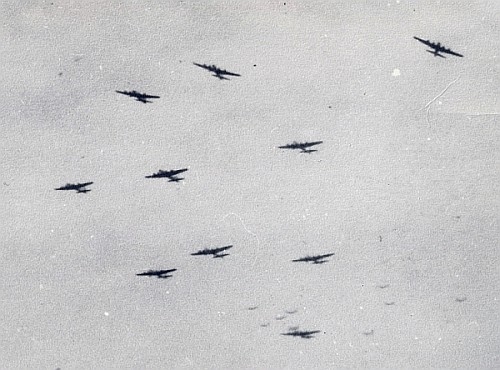
Bremen Mission, February 24, 1945
100th aircraft returning to Thorpe Abbotts after the Bremen Mission, February 24, 1945. Photo courtesy of Lee Jacobs