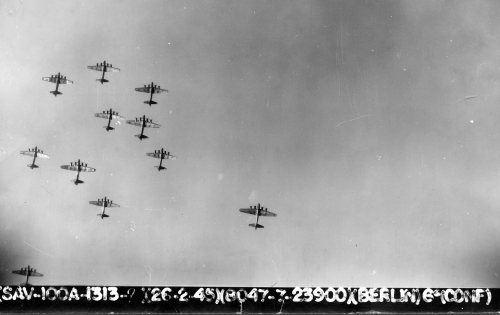
Mission Date: February 26, 1945
BERLIN, CITY
100th BG Mission #: 268
Mission Summary
ON THIS DAY...FEBRUARY 26,1945
At the 0430 briefing, moans and whistles were heard from the forty-two crews in attendance when the target was revealed as the German capital of Berlin, or “Big B.” That day, the entire 8th Air Force would be attacking Berlin’s three main railway stations with the 3rd Division targeting the Alexanderplatz railway station in the center of the City, as both its Primary and Secondary targets and within two miles of the German Air Ministry building.
Leading the 13th Combat Wing would be the 390th in a composite ‘B’ group made up of twenty-four ships from the 95th and six from the 100th, supplying an element in both the ‘B’ High and Low squadrons. The 100th would fly a full formation as the Wing’s ‘C’ group.
The Hundredth’s formation would be lead by Cruver and Blanding with the High lead by an unknown Command pilot flying with Ellis and the Low by Staples and Champion.
As the boys prepared for takeoff, some of the veteran fliers’ thoughts turned to the last Berlin mission on February 3, while for the unbaptized, thoughts were similar to those expressed by Tail Gunner Donald Becker who wrote, “Today was the day we’d trained for ever since I wanted to fly — to bomb Hitler’s Heaven Berlin. It has the heaviest flak defenses and more fighters than any other target in Germany so it’s easy to understand the agonized sounds from the crews on sight of the target at briefing — and everyone including our crew was scared beyond words even before we started — yes we were pretty worried before take-off but still resolved.”
Between 0816-0819, the first six ships to form up with the 95th took off with the remaining continuing in order of position until 0844 hours. The assemblies were uneventful and the Wing’s formation merged into an “extremely compact” Divisional stream. After the sortie line had been crossed but before reaching the IP, pilot Eugene Jensen, flying the 100th’s lead in an element flying with the 95th, aborted the mission due to a #3 turbo failure.
As the formations neared Berlin, anxiety increased in the city as German radio warned its listeners of the approaching bomber stream, reported to stretch for one hundred fifty miles. While inside the B-17s, the crews' anxieties increased as their thoughts ran to the four hundred briefed for anti-aircraft guns aiming at them from below. With flak suits on, the formation closed in on the target and reality commenced. Donald Becker in Bernard Painter’s ship, continued his mission description, « After take-off I felt very alone back in my tail position even with a thousand planes behind & all around us — so terribly alone & full of thoughts that this was the last - I can’t ever explain the emptiness I felt - After the longest haul we ever made (up over the Zuider Zee) we neared the target & we were tight & afraid as drumheads — then we were in the middle of it all the sky peppered with flak & smoke — pitching & rolling planes — one right behind us blew up in a cloud of flame & dirty black smoke — a direct hit — we continued on & the suspense was terrible — the flak got nearer & closer & I crawled with an itching body expecting steel to rip thru me any second — then the bomb doors were open & bombs were away!! »
Fortunately, shepherded by hundreds of P-51s, enemy fighters were not an issue and the 10/10 cloud coverage with tops up to 14,000 feet helped keep the flak “meager and inaccurate.” Flying in the Low’s lead ship with Ivan Champion, Bombardier William Wellings tells us, “Were briefed for 10/10 cover and it was, thank God! Flak wasn’t bad at all and we kept pretty well out of what there was. Tore down the bomb run at 335 mpg G.S. and the checks came in so fast I couldn’t get half of them…” Attacking Berlin in squadron formation, bombs were away at 1221 from an altitude of 27,000 feet.
With the route out reported as uneventful, the boys were returning back to Thorpe Abbotts in the dark, after an eight and one-half hour flight, safely and with only six flak damaged bombers. Due to the hour of the Group’s return, pilot Harold Sherrard remembered, “It was a night recovery at Thorpe Abbotts. British night missions were airborne and someone called out bandits over the radio and all aircraft turned off all running and formation lights. I started an immediate climb to higher altitude and waited for things to settle down before making approach to Thorpe Abbotts.”
The mission light glowed green that evening signifying a Stand Down for the next day and the crews relaxed a little more.
Bombing Results
Bombing Results: GOOD
Aircraft Lost: 0
Crew Lost: 0
Claims of Enemy Losses (CLS): 0
Aircraft Returned: