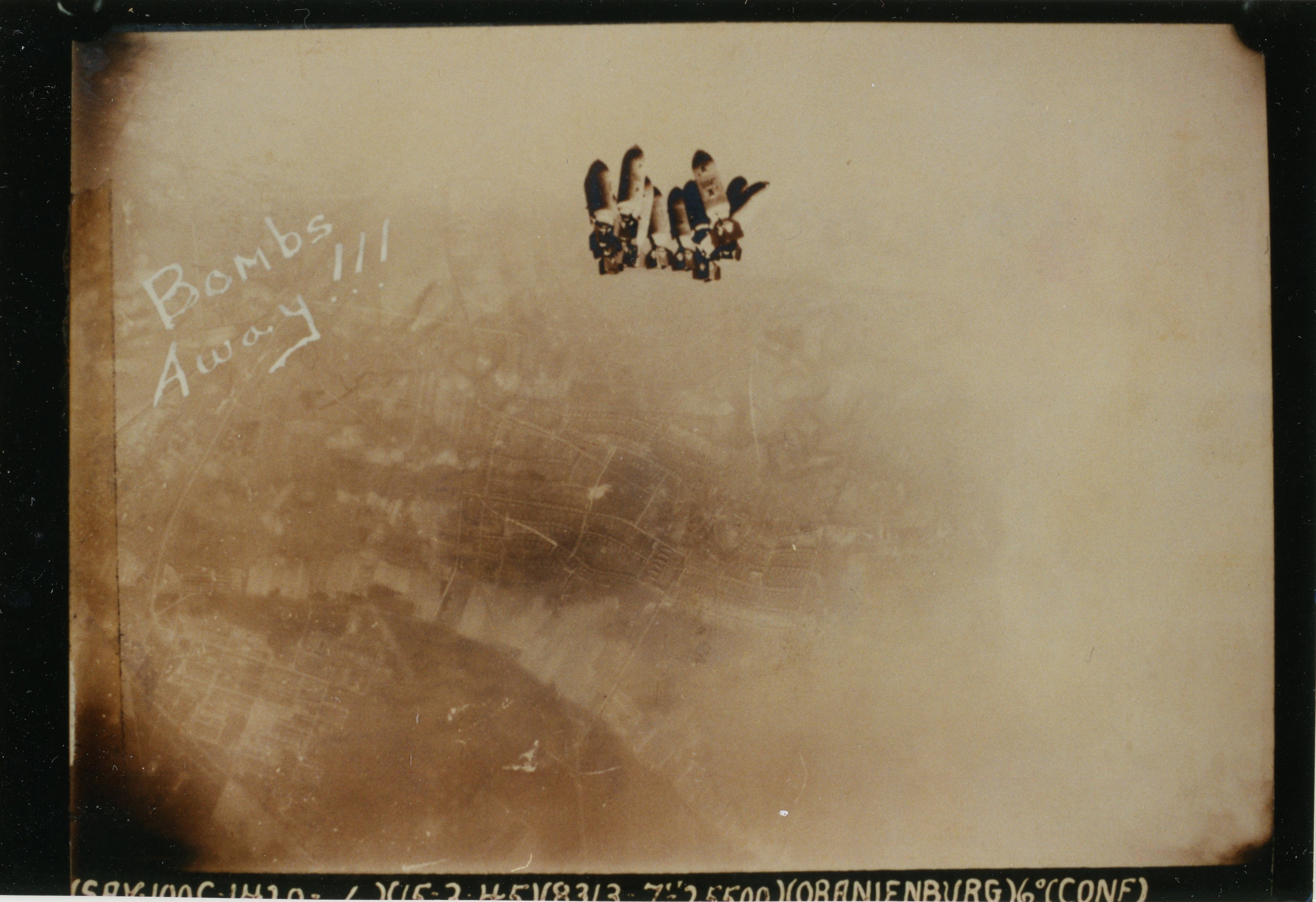
Mission Date: March 15, 1945
ORANIENBURG, MY
100th BG Mission #: 280
Mission Summary
ON THIS DAY...March 15, 1945
As the curtain over the map was slowly pulled back, the crews moaned as they saw that the red yarn went all the way to Berlin, the ‘Big B,’ the “terror of the heavies.” Their Primary visual target would be the marshaling yards in Oranienburg, a suburb seven miles north of Berlin. The Secondary target (visual) would be the Durener Metalwerks, five miles northwest of Berlin and their Tertiary via H2X bombing would be an armament factory in the same location. An alternate Tertiary target was the locomotive depots in the marshaling yards near Wittenberg. With the Sachsenhausen Concentration/Prisoner of War camp close by, the men were warned to only bomb the Primary target under visual conditions. And they knew that Berlin would be heavily defended.
The 3rd Division’s column of B-17s would be led by the 93 CBW, followed by the 13th CBW which would be led by the 100th BG, flying the 390th as its ‘B’ and the 95th as its ‘C.’ Leading the 100th would Lyster/John Williams. The High squadron would be led by Gibbons/Dawson and the Low by Albrecht/Ellis
Thirty-eight ships took-off that morning assembling at 3000 feet over Buncher 28. By the time the Group's formation was crossing the North Sea, the weather had cleared and the boys were again flying in CAVU conditions, planning to make a visual bomb run on the Primary.
The IP was made good and individual squadron runs were commenced on the Primary target under heavy flak. The Lead squadron's bombardier was unable to visually identify the target until it was too late for visual synchronization, making the decision to attack the alternate last resort of Wittenberg. For the High and Low squadrons however, visual bombing on Oranienburg was completed at 1457 hours, while the Lead’s bombs hit Wittenberg at 1528.
According to BOM Robert Fitzgerald, “On the bomb run we received very heavy and accurate flak. We could hear the shell fragments hitting our plane. We then heard and felt a hard hit. Bob King our engineer reported we had a very large hole through the right wing just behind the #3 engine and there was gas pouring out the back of the wing. Wilson shuty (sic shut) #3 engine and feathered it to keep the exhaust from exploding the gas. We then noticed that the right wing was flopping like a bird wing. Wilson ordered us to put our chutes on first just in case we should lose the wing. The shell had passed through the gas tank then cut the main span in half leaving a 6 inch diameter hole in our wing and didn’t explode, a dud. Luck was still riding with us …”
Lady Luck was also riding on the wings of the David Wood ship. According to BTG Frank Volk, “another near disaster happened over Berlin … Our plane was hit with flak and the right wing was dumping fuel. I remained in the ball turret voluntarily to assess the situation. 100 octane fuel was dumping in on me and I was saturated. I radioed the pilot and he told me to get out of there. I said I was staying. It didn't matter where I was, if something happened, we were all going to be a puff of smoke. After a tense half hour, the leaking stopped…” Pilot Dave Wood, stated, “ Frank Volk voluntarily remained in the ball to determine the location of the damage and the amount of fuel being lost. This act of bravery was not without considerable risk.”
And LT William Wellings, flying in the Lead Squadron recorded, “Had rate killed so sat back and waited for Lead to drop. There was quite a bit of flak on the Group ahead of us but not very much on us. Just a few were close enough to scare us. Went right past the old smoke bombs and never did drop because the Lead couldn't pick up the target. We didn't want to make a turn and go down on "B" itself so we went on to Wittenberg. We were heading into the sun on this run and it was really a rough job trying to find anything through the haze…Wasn’t supposed to be any flak at Wittenberg and there wasn't until a few seconds after bombs away and then they really gave it to us and some darn accurate bursts. They flung about 5 at us that looked as tho they burst right between #3 and #4 and then they started pounding away underneath us for about 45 seconds. Again we were lucky because we only got one hole — through the chin turret.”
SGT Becker also flying in the Low squadron recorded, « … We were much relieved when the leader radioed to Painter where we were headed--we were on the bomb run when all hell broke loose-we were hit once-my head crashed against the plexiglass & was stunned-we were hit again & again-I died four times. I was without a flak suit or helmet & a dead duck if shrapnel hit me---but then the light but perfectly accurately barrage was over & we were clear--we had ten hits on our ship-ranging from the size of a grapefruit on down-but all were O.K. tho Mac, Painter, Rabbit & I had close calls…”
After Bombs away, the 100th's Lead and High squadrons were quickly reassembled at the RP with their Low squadron soon joining them. The Dummer Lake flak corridor was made good and the Continental Coast was crossed at 1711 hours at an altitude of 16000 feet, letting down to 4500 feet where the English Coast was crossed at 1757.
LT Fitzgerald, nervous about his ship’s flak damage remembered, “We kept an eye on our flapping wing, received more flak while leaving the coast and landed at 1820. The right wing had to be replaced. Two wings in two days. Thats what they mean in the song "coming in on a wing and a prayer." We counted 12 large holes in the plane and numerous small ones.”
After a seven and one-half hours mission, the ships returned to Thorpe Abbotts with no losses but with eleven ships returning with flak damage. The mission light was red, signaling a mission alert for the next day.
The Groups were all measured on their bombing results for each mission. For this mission, the 13 CBW Supplement to the Tactical Report reflects the unhappiness of Wing Commander, General Huglin, over the day's results. Six of nine squadrons flying in the wing were marked as showing poor judgement or leadership. Huglin commented, “This operation was the nearest to complete failure the Wing has had for some time. Visibility conditions in the target are were almost completely responsible for failures of visual sighting. However, errors of leadership and bombardier performance occurred…Air Leaders were careless about making good briefed altitudes both along route and on bombing run. The flight plan is not followed when altitudes are not made good…Air Leaders are independent commanders from IP to RP. Bombs must be released as a result of a proper and complete sighting operation. Two Group lead bombardiers did well to carry their bombs on to attack some other target.”
Bombing Results
Bombing Results: MISSED
Aircraft Lost: 0
Crew Lost: 0
Claims of Enemy Losses (CLS): 0
Aircraft Returned: