Mission Date: March 18, 1945
BERLIN, MY; FALKENBURG, TOWN, RR
100th BG Mission #: 282
Mission Summary
ON THIS DAY...MARCH 18, 1945
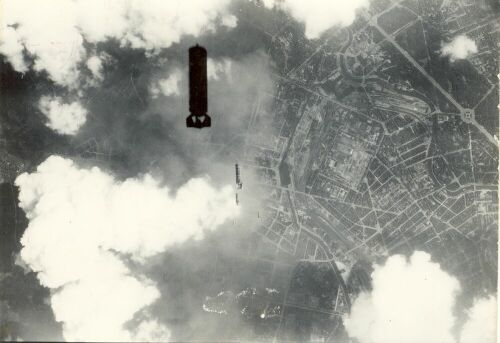
When the mission briefing commenced at 0430 hours, groans and whistles soon followed when the divulged map showed the red string stopping at Berlin. The Primary visual target would be the railway goods station in the marshaling yards with the same target as the Secondary, if H2X was required. Located just miles away from the five hundred twenty acre Tiergarten park, the rail goods station was being used to supply the Germans at the Russian front.
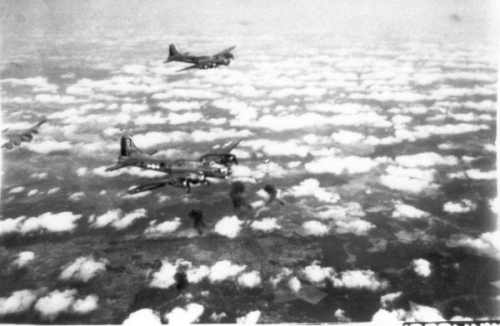
The 3rd Division would be led by the 13th CBW, with the 95th BG flying Lead, the 100th as its ‘B’ group and the 390th as its ‘C.’ Leading the 100th would be Cruver/Dawson with Swain/DeWeerdt leading the Low.
Loaded up with six 1000 lb. bombs, the men readied their ships and prepared for take-off.
Earl Cullimore, whose TG, Johnny Orr, had been killed on the March 14 mission to Hanover remembered, “After a three day layoff from flying to attend Johnny’s burial we were scheduled to fly a mission — when I inspected our plane there was still blood and sulfa powder in the plywood crawl space and I refused to put my crew in the plane in that condition. I was told I could be court-martialed but I refused to fly the plane in that condition. The Colonel came out and inspected the plane and agreed with me. New boards the next day.”
LT Lantz, flying his #2 combat mission remembered, “We had been alerted for the mission the night before and I was to fly in the low flight of the low squadron, best known as "Purple Heart Corner”…A truck took us and our equipment out to the hardstand where 805 was parked. We entered the shack and the boys started getting their guns ready and putting them in the ship. We had almost two hours until start engines so Johnnie (John W.Greenlee) and I just sat around and kidded the boys and ourselves by saying, ‘this don't mean a thing.’”
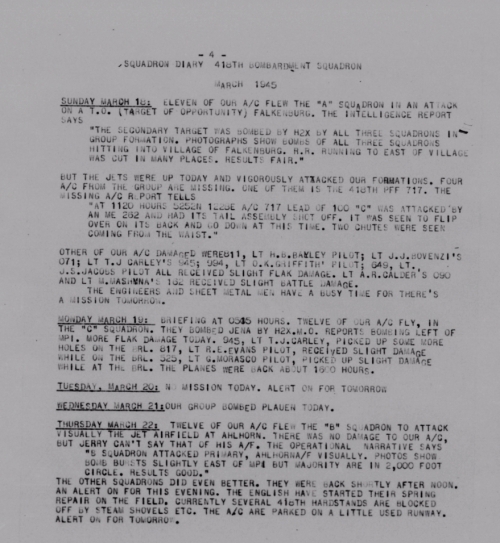
With take-off and assemblies completed without any incidents, the formation crossed the North Sea, and then the Dutch coast, climbing through dense contrails and clouds to 25,000 feet bombing altitude. The Group’s formation was between the Pre-Ip and the IP when “without warning, four jet-propelled Me262’s appeared from out of the clouds and contrails and proceeded to attack the Hundreth’s low squadron, which was badly strung out…” In a dangerous flying position, Lantz remembered, “We put on 2500 RPM and 46 inches (an engine power setting) and shoved everything but the seats forward, but we were still falling behind…Johnnie and I both struggled with the controls to try and get the last bit of power out of the engines to keep up with the formation. We knew once we fell out we were lost.”
Although the Air Leader called for the P-51 escorts several times, they were nowhere to be seen. It would not be until later that the Group would learn that the 44th Fighter Group, which was to provide the 13th CBW its support that day, had been vectored off to Frankfurt just as the Wing had reached the IP.
Rollie King’s ship in the Low was attacked first. The enemy aircraft came straight in on King, then peeled to the left after closing to point blank range. King stated, “The first fighter pass knocked out our vertical stabilizer and the tail turret, killing the tail Gunner. (SGT James M. Baker) On the next fighter pass we received a great deal of damage to the plane and practically all of the controls were knocked out. …On the third fighter pass we received a burst near the front which knocked out all of our controls and put the plane into a silent spin. I ascertained that I was going to be unable to get the plane out of the said spin due to the lack of control and I told everybody to bail out.” Archie Mathosian, ROG remembered, “…I was thrown to the opposite side of the plane. When I finally was aware of what had happened I noticed my gun was hanging askew from the shattered plexiglass and intense fire and heat was entering the plane. A large hole in the wing adjacent to the body of the plane was fueling the flame. The din from the air rushing in and the roaring flame was deafening…There was a large cannon hole close to Gitlin. I jumped across. I pulled the tab that is supposed to free the door from the plane. I considered myself as being a strong person; however, as hard as I tried, I couldn't release the pin holding the door. In frustration I glanced back to Gitlin. He apparently realized my inability to release the door. He looked down at the hole which fortunately was large enough for him to exit. This was the only way out. Gitlin put his hand on the rip chord and disappeared down the hole. I followed suit. This was the first and only time I used a chute. The danger of not opening never entered my mind — it was do or die!…”
Six minutes later at 1114, Edward Gwin’s ship in the Low was attacked. Their ship with two engines on fire was seen diving away from the formation. When the B-17 nosed up, its tail fell off and it fell down spinning. TG Joseph Griego remembered, “…I saw two Me 262 jets, with guns blazing heading our way. I called out “fighters 3 o’clock” and began to fire my guns when I was tossed around in the tail. I didn’t know what had happened but I knew there was an explosion behind me. After the tail settled down, I moved my legs to see if they were still there, and since there was no pain, I looked to see what damage had been done to the plane. I was shocked to see nothing but blue sky. The rest of the plane was gone! I was floating to the ground in the tail section…”
At 1120, both the Merrill Jensen’s ship and the Lead DeWeerdt ship were attacked. Although an engine was on fire in the Lead ship, the pilots were able to maintain control for some time. Turning and flying for some 50 miles towards home, the ship was either hit again or it exploded. When the Jensen ship was attacked, NAV Richard Scrozton remembered, “…I had one quick glance of ours just off our left wing tip which was then five feet too short. Our element lead was also hit and turned directly into us. We turned in formation and he slipped below us…No one bailed out of our plane partly because several chutes were destroyed. In addition to the wingtip damage, #4 engine prop was hit resulting in very severe vibrations. These and other hits on #2 and #3 made it clear that we were no longer a part of the formation…”
The remaining ships in the Low squadron assembled quickly behind the second element leader, Ernest “Tracy” Gilbert while two additional enemy jets made an unsuccessful pass on the 100th’s High squadron. Through the heavy flak, the ships kept flying to their target, where at 1129 hours, they attacked Berlin in group formation for added protection.
Although the enemy aircraft attacks had persisted for twenty-five minutes, the Rally Point was successfully reached at which point but the dense and persistent contrails made visual contact so difficult that the 100th's formation turned inside the 95th’s formation, automatically becoming the Division leader. With the 100th’s Lead ship having a weaker radar set, the Lead was then turned over to its High Squadron, which subsequently ended up leading the Group and the Division during the remainder of the mission.
A rough mission for the 100th, after seven and one-half hours, the ships returned back to base with four ships and crews missing and an additional eighteen B17s with battle damage.
Bombing Results
Bombing Results: FAIR
Aircraft Lost: 4
Crew Lost: 38
Claims of Enemy Losses (CLS): 1
Aircraft Returned:
Media Articles
Use your thumb to scroll through the results box below.
| Media Item | Type | Page | Volume/Issue | Broadcast Source | Time | Description | File |
|---|---|---|---|---|---|---|---|
| Edward Gwin March 18 1945 mission to Berlin | The Whittier News July 13 1945 | 12:00 am |