Mission Date: March 21, 1945
RUHLAND & PLAUEN
100th BG Mission #: 284
Mission Summary
ON THIS DAY...MARCH 21, 1945
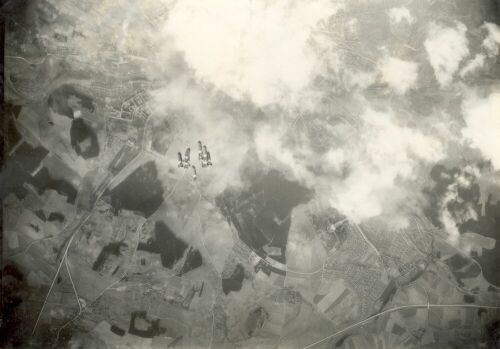
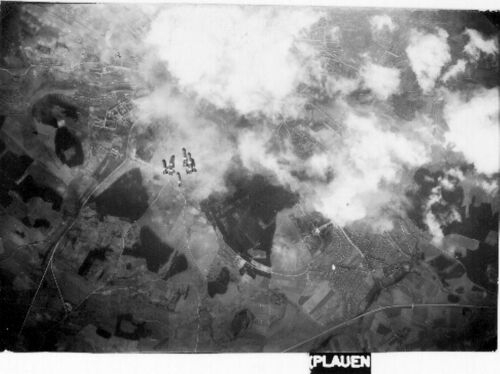
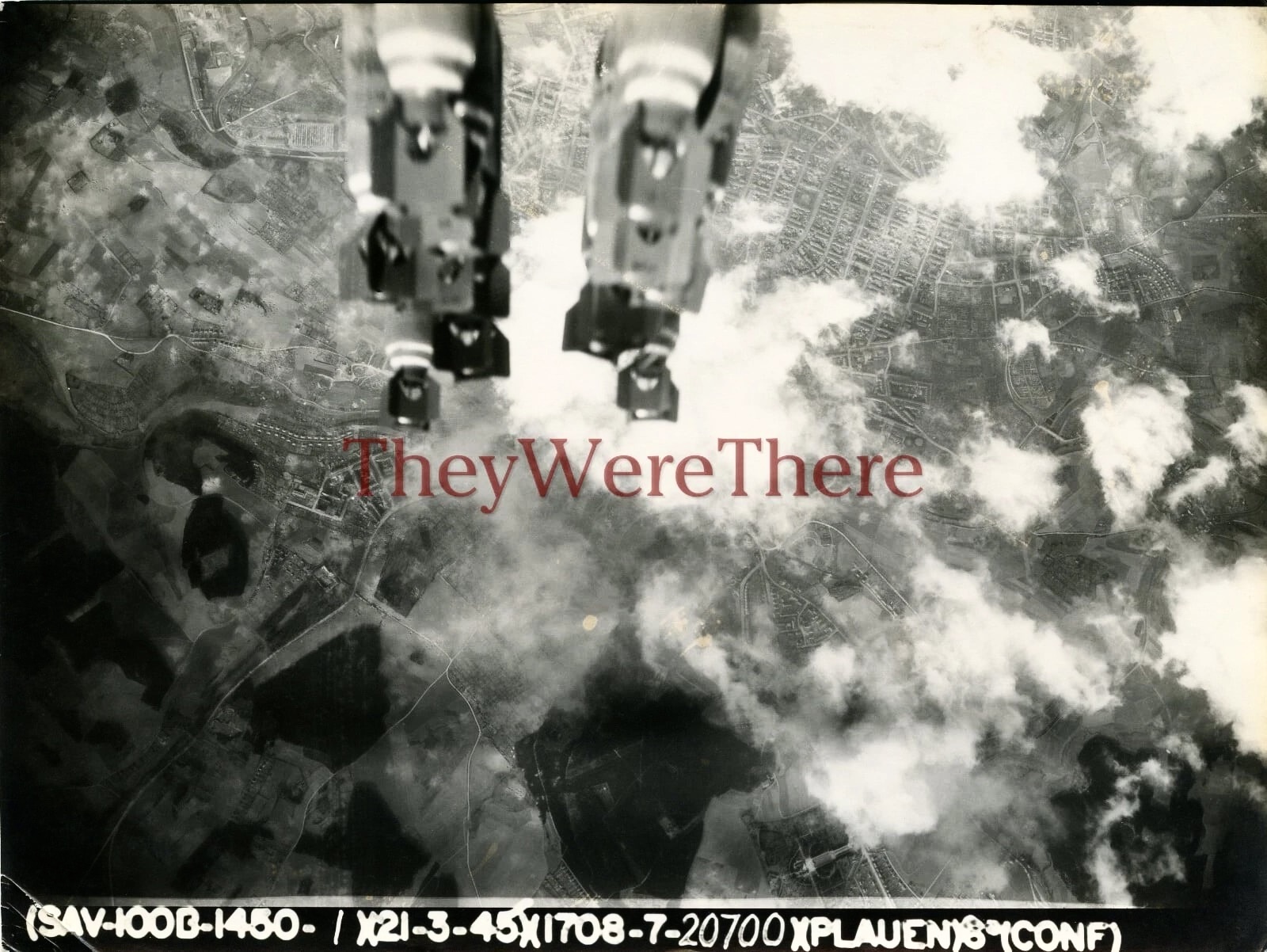
At the door, the attendance man checked in the thirty-eight crews scheduled for the early 0230 general briefing. When the curtain hiding the map was drawn, they saw that that their target would take them again to Ruhland. S-2 divulged the target - Primary visual target of its synthetic oil plant located just outside the city, ninety miles south of Berlin. A Secondary visual target would be a machine and forging shop in the tank factory located in Plauen, southeast of Ruhland.
Mixing formations up, the 3rd Division would fly two Task Forces to multiple targets. Task Force I would be made up of one Group from each Wing: the 94th, 388th, 100th and the 490th BGs, flying in that order. Task Force II would include the remaining Groups in the Wings, with the 45th and 13th CWs targeting an ammunition and dispersal area of Luftwaffe’s Handorf Air Field near Munster, the 4th CW targeting Witt-Mundehafen and the 93rd Zwischenahn,
Leading the 100th’s formation would be David Lyster and John Williams. The High squadron would be led by Staple/DePlanque and the Low by Cope/Hutchinson.
With the B17s loaded up with twelve 500 lb GP bombs, take-off was under CAVU conditions and the 100th’s pilots successfully assembled the Group over Buncher 28 and then again behind the 388th BG as Task Force I headed across the North Sea.
Flying through the Osnabruck corridor towards Berlin, BOM William J. Wellings recorded, “…We got in around the I. P. and found that the weather was closing in. Kodak called and said Target was 10/10 so at the I. P. we headed south to make another I.P. good for the secondary. Just about that time we got a little flak and two ships had feathered engines and dropped behind. We had some high cloud overhead and quite a few contrails and bandits were reported in the area.”
Bernard Painter flying in the Lead Squadron on his #14 mission, had left the formation due to a supercharger failure. After salvoing his bombs, he and copilot Charles Higginbotham struggled along behind the formation trying to catch up, when at 0949, five German ME-262s attacked him. LT Painter stated, “Although our gunners were firing at them constantly, they were able to shoot out #2 engine and set it on fire, foul the controls rendering them useless and scored several hits in the nose section, setting it on fire. Painter gave the order to abandon ship, doing so himself from 18000 feet. Although Painter recalled counting five chutes, observers reported Painter’s ship as “receiving a hit in the left wing which exploded and then went down in a tight spin. Three chutes were said to have been seen, two of which were reported to be on fire.”
Meanwhile, making the IP, the formation’s Lead BOM Joseph Orendorff took over. Flying through moderate and accurate flak, he synchronized on the target and bombs were away at 1004. Remaining in Group formation for protection, the High squadron released on its own while the Low encountering heavy prop wash, released off of the Lead's smoke bombs. LT Wellings recorded, "We were aiming at some factories on the S. edge of town and really clobbered them. All this time we were still being pestered by blow-jobs. Misch called up three times that he was being attacked but they never did get him down.
It was about 15 miles N. of Geissen when about a dozen 262s attacked us — the Lead sqdn — from 6 o'clock level and high and barreled right straight through the formation. But every ship on the formation was blazing away at them and they got very few strikes on us. We had 4 groups of P-51s escorting our 4 groups of bombers but they didn't scare the jet-jobs at all. One of them came right over top of our ship and he was so close you could see the swastika plain as day. He looked big as hell too but was going so fast that I only got a few shots at him. He only had one jet going but he was doing about 550 anyway. He went spiraling down to 12 o'clock low and 4 51s went after him but didn't have a chance of catching him. The jets kept pestering us clean up to the front lines and then 4 FW 190s came up from 12 low with their cannons blazing. But they were scared off easily enough by a few chin turrets and we came on back without any further trouble. Altogether, we had fighters for about an hour and a half but only lost one ship. There was a claim put in for one 262."
After close to an eight hour mission, the pilots brought their ships back to Thorpe Abbotts, landing at 1300 hours, with fourteen out of the thirty-eight ships sent up that morning returning with battle damage. The 3rd Division would lose four ships and crews to enemy fighters on this mission with the official report stating, “Skillful use of haze and high cirrus cloud at bomber altitudes enabled an aggressive enemy to definitely destroy four of the five bombers lost by this bomber force.…The 3rd Group in the bomber column (100th BG) lost the lead a/c of the low element to a five minute attack by three to four Me-262s which aggressively approached from 6 o’clock level. The last Group in the column (490th BG) was attacked viciously by 7 to 8 Me-262s for nine minutes…These attacks on the last Group resulted in the loss of three bombers, one of which is reported to have been rammed by e/a….During strongest e/a attacks escorting fighters were at an extreme disadvantage, being unable to employ an altitude advantage to break up enemy attacks on bombers flying just below and in lower edge of cloud layer…In all, our fighters encountered 30 or more Me-262s today for claims of nine destroyed.”
Bernard Painter Crew - All crew members were KIA except Painter who became a POW
Bombing Results
Bombing Results: EXCELLENT
Aircraft Lost: 1
Crew Lost: 9
Claims of Enemy Losses (CLS): 1
Aircraft Returned: