Mission Date: March 23, 1945
UNNA, MY, 100TH A-B-C SQUADRONS
100th BG Mission #: 286
Mission Summary
ON THIS DAY...MARCH 23, 1945
Crews were awakened across the base in preparation for the 0400 briefing. Thirty-eight crews had checked in with the attendance man and as the map was unveiled, learned that their Priority visual target for the day would be the railway station and junction at Unna. A 2nd Priority visual target was Meschede, while the 3rd Priority either visually or via H2X would be the marshaling yards at Marburg.
The 13th CW would be flying in the dangerous last position in the Division Column. Led by the 100th BG, the 390th would fly as its ‘B’ group and the 95th as its ‘C.’
Although previously practiced, that Friday would be the first time that the new four Squadron formation would be flown in combat by the 100th. Colonel Sutterlin would be leading the 13CW and the 100th’s formation with Jean DePlanque. The 100th's High squadron would be lead by Cruver/Blanding, the Low by Ellis and the new Low Low (D) would be led by Liljenquist/Hellerich. With nine B17s in each squadron formation, the Lead and Low Low squadronss would fly at almost the same level with the Low Low trailing the Lead and the High and Low echeloned to the right and left.
Loaded with thirty-four 100 lb. GP bombs and two M-17 incendiaries, the ships took-off in order of their position in the formation, assembling as a Group over Buncher 28 with the rest of the Wing forming behind the 100th at Felixstowe. As it flew over the North Sea, the Wing’s formation had to ’S’ quite a bit so that it wouldn’t overtake the 4CBW flying ahead.
Reaching bombing altitude forty minutes prior to IP and with CAVU conditions reported in the target area, the 100th prepared for visual individual squadron runs on Unna with the Lead, High and Low dropping from 22800-24200 at 1343-1345 hours.
Smoke from the preceding squadrons’ bombs had completely covered the MPI and target area and since they were briefed to only attack the Secondary Priority in a group formation, the Low Low squadron set up for an attack on Marburg. After the 100th’s Lead and High's bombs were away, their pilots completed two 360 degree turns west of Marburg while waiting for the Low Low to execute its run, which it did, attacking from 21,010 feet at 1406 hours. The Low Squadron, unaware of the attack on Marburg had already decended to a lower altitude, consequently tagging on to the 390th's formation for the return home.
Flying in the Low Low squadron, James Lantz tells us, ”There’s always a sigh of relief when bombs are away, as if some great weight has been lifted from our stomachs and all we wanted to do was get the hell out of there.” Flak was reported as accurate and light. After 'bombs away', the Low Low’s formation made a sharp descending turn to the right but not without taking at least three direct flak hits. Flying in ‘Patriotic Patty,’ Alphonso Guardino’s ship was hit by flak at 1428 hours, turning into the Laurence Lazzari ship with Guardino’s horizontal stabilizer hitting Lazzari’s wing, bending eight to ten feet of the wing tip. Lazarri’s ship fell 5,000 to 10,000 feet but he and his copilot Guiher G. Greenwood were able to recover. Tragically, Guardino’s ship went into a first spin which he and copilot William E. Davis reportedly recovered from but then went into a second spin, exploding on impact. Just as Guardino’s ship went out of control, pilot James Lantz, flying on the right wing of Lazzari’s ship was hit in the leg by flak, earning him the Purple Heart.
Within three minutes after the collision, the Lazzari ship was limping behind the formation when the “Me-109s were coming in for the kill. Lazzaro or Greenwood broke radio silence and called for fighter protection. Someone heard the call for help for in less than 2 or 3 minutes 4 P-51s came in and fought off the attacking ME-109s.” Deciding to try for home rather than force land in Belgium, one of the Lazzari enlisted men voted for home and was quoted as saying, “anyway, there’s a dance at the Red Cross Club tonight and if we don’t get there, some other crew will take over our girls.” Successfully returning to Thorpe Abbotts, it took both Lazzari’s and Greenwood’s legs on the right rudder to keep the plane flying straight. If that wasn’t enough stress, with numbed legs, the pilots reportedly had to make an additional landing approach when on their first pass, a British RAF plane flew right under them with an engine on fire and crash landed.
After a six hour flight with half that time on oxygen, all ships except Guardino’s returned to base. Seven ships returned with flak battle damage.
Bombing Results
Bombing Results: VERY GOOD
Aircraft Lost: 0
Crew Lost: 0
Claims of Enemy Losses (CLS): 0
Aircraft Returned:
Photos
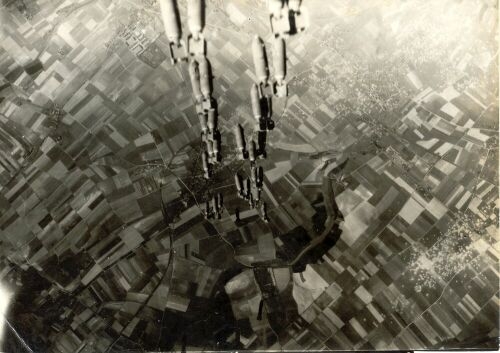
Unna, 23 March 1945
Unna, 23 March 1945, flown at 23,000 feet and took 6 1/2 hours to complete.