Mission Date: April 11, 1945
LANDSHUT, ORD DEPOT;INGOLSTADT, MY
100th BG Mission #: 300
Mission Summary
ON THIS DAY...APRIL 11, 1945
By this time, all of the men fighting the war, regardless of the theater, hoped that the end was near. In Europe, the American 9th Army was within ninety miles of Berlin. The 2nd Armored Division was twenty-five miles from Elbe River and Magdeburg, expecting to cross it within twenty-four hours. Essen and Brunswick had fallen. The British troops were preparing their final blows on Bremen and Hamburg while the Canadians and British were within ten miles of the North Sea, trapping Germans in Holland. Nazi leaders, planning to hold out in the Bavarian mountain redoubts had not planned on the swift drives from the Allies.
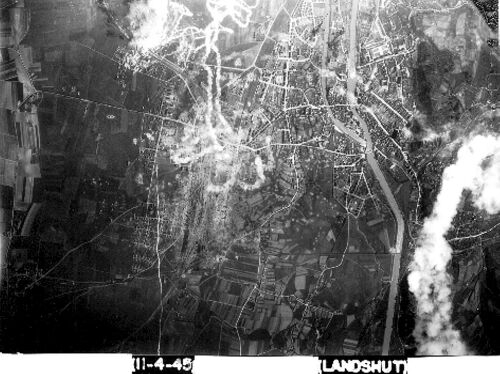
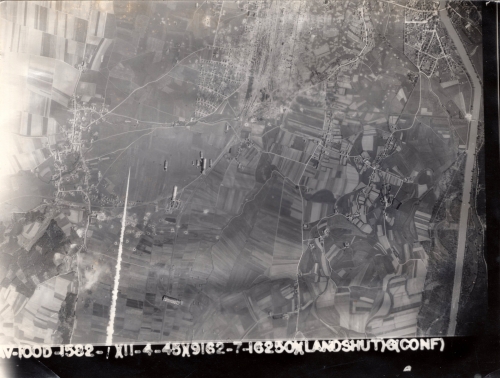
At the briefing on the 11th, the Crews learned that their first Priority visual target would be an ordnance depot located just north of Landshut and an important target as it was supplying the Bavarian redoubt area. The Secondary and third Priority targets would be at Ingolstadt, with its marshaling yards and city center respectively.
The Division column would be lead by the 13th Wing and by the 100th Bomb Group. This mission would mark the Group’s #300 mission so the Group's Commanding Officer, Colonel Frederick Sutterlin would fly as the Command pilot along with Charles Blanding. Pilot Gris Smith remembered, “It was quite an occasion and a lot of ‘wheels’ were around to wish us well.” Robinson/Raiford would lead the High squadron, Hellerich the Low and Albrecht/Gilbert the Low Low squadron.
Taking off at 0830 hours in 8-10/10 clouds, the 100th’s thirty-eight ships, loaded down with eight 500 lb. GP bombs and four 500 lb. incendiaries formed over Buncher 28. The Wing assembly altitude was lowered to 6000 feet by Colonel Sutterlin so that the High SQ could clear the cloud layer.
Aborting early was W. Griswald Smith’s ship. While still climbing in altitude, the other pilots called him over VHF to tell him that he was leaking gas. With oil pressure problems, gas leakage and a VHF system that wouldn’t work, Gris didn’t want to become a straggler and unable to call the fighters, especially after what he had witnessed the previous day.
Arriving at the French coast five minutes early, a strong tail wind put the formation fourteen minutes early to the target, missing the briefed fighter escort rendezvous time. Bombing altitude was reached and the squadrons fanned out for their turns on to the bomb run. Fortunately, the P-51s showed up at the IP and their support was reported as excellent through the bomb run.
Over the target the weather had cleared and the downward visibility was twenty to thirty miles. Bombs were away between 1257 and 1314 hours from 18000 feet with all but the High squadron bombing Landshut. On the bomb run, the oxygen hose had become disconnected on Robert F. Cheney, the High’s lead navigator. Disoriented from lack of oxygen, Cheney had inadvertently picked up his Bombardier’s target folder while trying to replug his own oxygen hose. Consequently, unable to synchronize on the Landshut target in time, the High squadron went on to bomb Ingolstadt.
After a flying time of close to nine hours, the 100th’s formation landed back at the base at 1345 hours, with the Crews thankful that it had been an easy mission. Although bandits had been reported in the area, no enemy fighters or flak had been encountered. Commenting on the bomb tags that he would keep, copilot Gene Greenwood had noted on this mission’s tag, “I only hope that the next 8 missions are like this one.”
The mission light was red that evening and another mission was planned for the next day.
Bombing Results
Bombing Results: EXCELLENT
Aircraft Lost: 0
Crew Lost: 0
Claims of Enemy Losses (CLS): 0
Aircraft Returned:
Notes
Mission Stories
3RD AIR DIVISION LEAD