Mission Date: November 5, 1943
GELSENKIRCHEN, SYTHETIC OIL
100th BG Mission #: 40
Mission Summary
OPERATIONS
The Group bombed the synthetic gasoline and oil manufacturing plant at Gelsenkirchen. Secondary target was any city in Germany which would disrupt the fighter supported regular group formation of twenty-one aircraft was led by Major Ollin Turner, Four aircraft were contributed to a composite group formation. Took off at 0930 hours.
We were low group in the second Combat Wing in the Division. This position was held throughout the mission, Approximately 20 FW 190's, 20 ME 109's and 5 twin-engined enemy aircraft were seen in the target area. Only one ME 109 came in from three oclock low and fired on a ship of our formation from about 1000 yds. Several FW 190's which came in close enough to be identified had yellow noses, Rest of the enemy craft were engaged in dogfights with our fighter escort, Enemy aircraft could be seen attacking friendly bombers several thousand yards ahead of our formation and as many as 15 fighters were seen attacking one straggling B-17. Approaching target no flak could be seen within five miles, Over the target intense flak was encountered, the heaviest appearing to concentrate at about 25,000 feet. The target area was heavily smoke-screened. Bomb hits could not be observed.
Regular group landed at 1450-1528 hours. One of our aircraft is missing. This aircraft took off as a spare and it is not known whether it filled in the formation or when it left the formation, Another plane was hit in number one engine after bombs were away. All crew members except the pilot and co-pilot bailed out over target area. Three other aircraft failed to bomb. The first turned back when number one and three engines failed and bomb load was jettisoned in the North sea. Second turned back due to failure of Pilot's oxygen system, and brought bomb load back to the base. The third had a number three engine failure and jettisoned bombs.
The composite group observed smoke in target area which obscured their hit vision, but all bombs are believed to have hit the target. No aircraft were lost. Of the four dispatched, two turned back before bombing due to defective oxygen and operational failure of intervolmeter.
Pilots criticised lead ship for speeding up after the bomb run to such an extent that many of the planes could not keep up with the formation, They also want electrical heating equipment for officers as well as gunners, some method of defrosting nose and tail windows, more walkaround oxygen bottles, and more cups for the mess hall.
Following are the names of the officers and men who are missing,
2nd Lt Thomas R. Martin Pilot
2nd Lt James A. Kennemer (Co-Pilot)
2nd Lt James W. McCurley Navigator
And Lt Joseph P, Murphy Bombardier
S/Sgt Donald H. Allwine Rad Op
Sgt Lloyd B. Arnett Eng.
Sgt Cosmas J. Braun Jr Ass't Rad Op
S/Sgt David M. Davis Jr Gunner
Sgt Merritt. K. Gillespie
Sgt Laverne E. Clarke
2nd Lt James J. Lux Bomb.
1st Lt Omar Gonzales Nav.
T/Sgt Conner D. Brewster Rad Op
T/Sgt Harold L. Pope Eng.
S/Sgt Francis G. Dolsen Ass't Rad Op
S/Sgt George P. Gineikis Gunner
S/Sgt Leon E. MacDonald
S/Sgt James Marasco
Bombing Results
Bombing Results:
Aircraft Lost: 1
Crew Lost: 18
Claims of Enemy Losses (CLS): 0
Aircraft Returned:
Media Articles
Use your thumb to scroll through the results box below.
| Media Item | Type | Page | Volume/Issue | Broadcast Source | Time | Description | File |
|---|---|---|---|---|---|---|---|
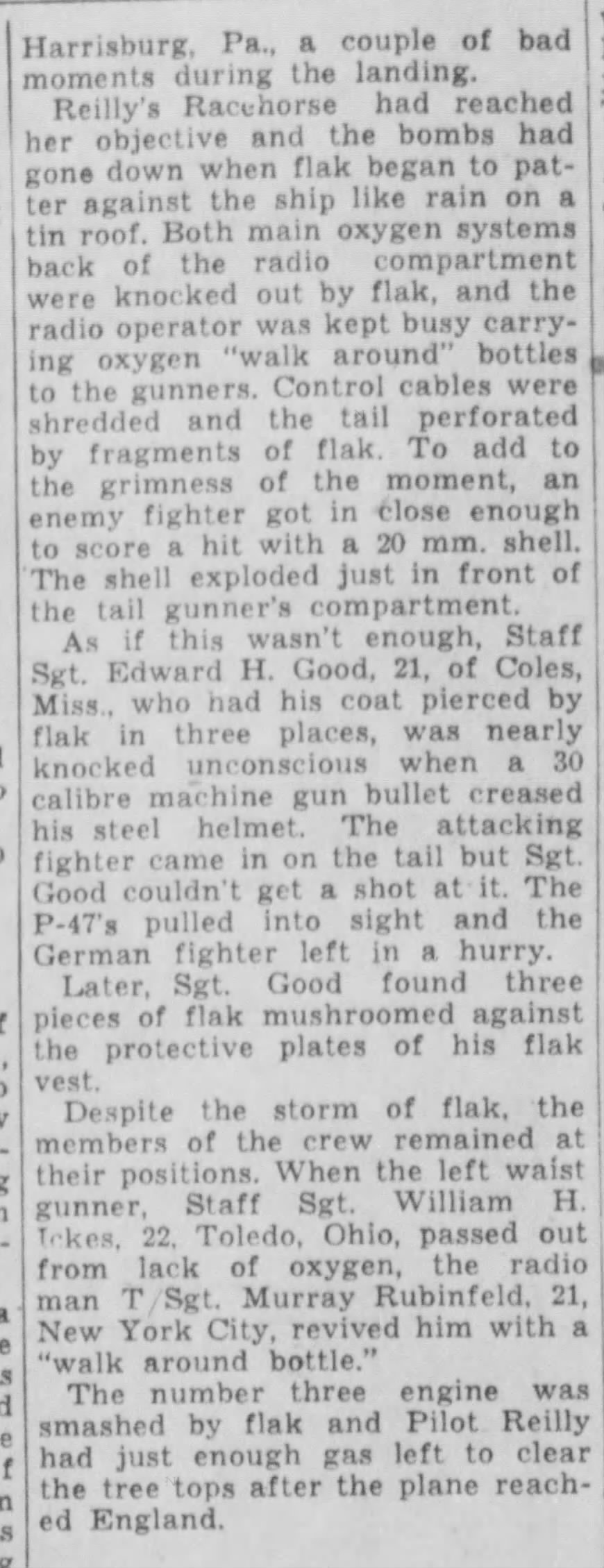
| Edward Higham, Thomas Reilly, Gelsinkirchen mission part 1 | The Post Register Nov 30 1943 | 12:00 am | |||||
| Edward Higham, Thomas Reilly, Gelsinkirchen mission part 2 | The Post Register Nov 30 1943 | 12:00 am | |||||
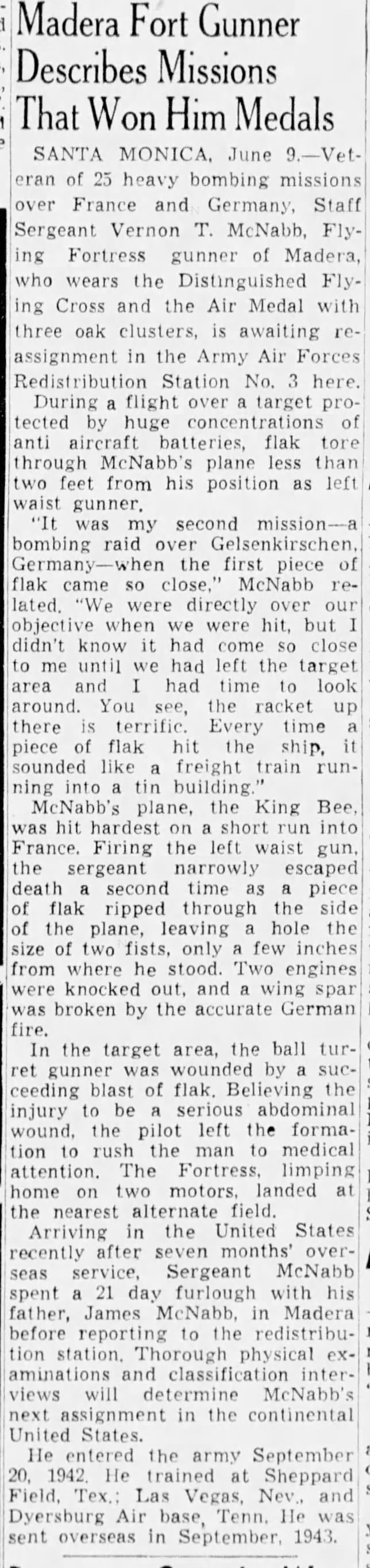
| Vernon McNabb home tells of missions on King Bee | The Fresno Bee June 9 1944 | 12:00 am |