Mission Date: March 3, 1944
BERLIN, ELECTRICAL EQUIP.
100th BG Mission #: 79
Mission Summary
ON THIS DAY…MARCH 3,1944
On March 3, orders had been received across the 8th Air Force’s heavy bombardment units for the American’s first daylight attack on Germany’s capital city of Berlin. The 1st, 2nd and 3rd Air Divisions would send their heavy bombers to attack various industrial targets at Berlin.
At Thorpe Abbotts, forty-one crews had been seated in the briefing room and were soon told of their historic mission for the day. With the target of the Bosch electrical engineering factory divulged, the veteran crews who were close to finishing their tours as well as those about to fly their #1 combat mission, like the Randall Chadwick and John Gibbons’ crews, had hoped for an easier target than Berlin. And there was no doubt that all of the airmen seated felt the weight of ‘Big B’ target on their shoulders and in their guts.
The 3rd Division would be led by the 4CBW, followed by the 13CBW and the 45CBW at four minute intervals. The 13CBW flying two wings of three groups, would be led by the 95B in the 13A, a composite wing, with the 95A flying as its low group and the 100A as its high. Following behind, the 13B wing, another composite, would be led by the 390A group, with the 390B flying as its low group and the 100B as its high.
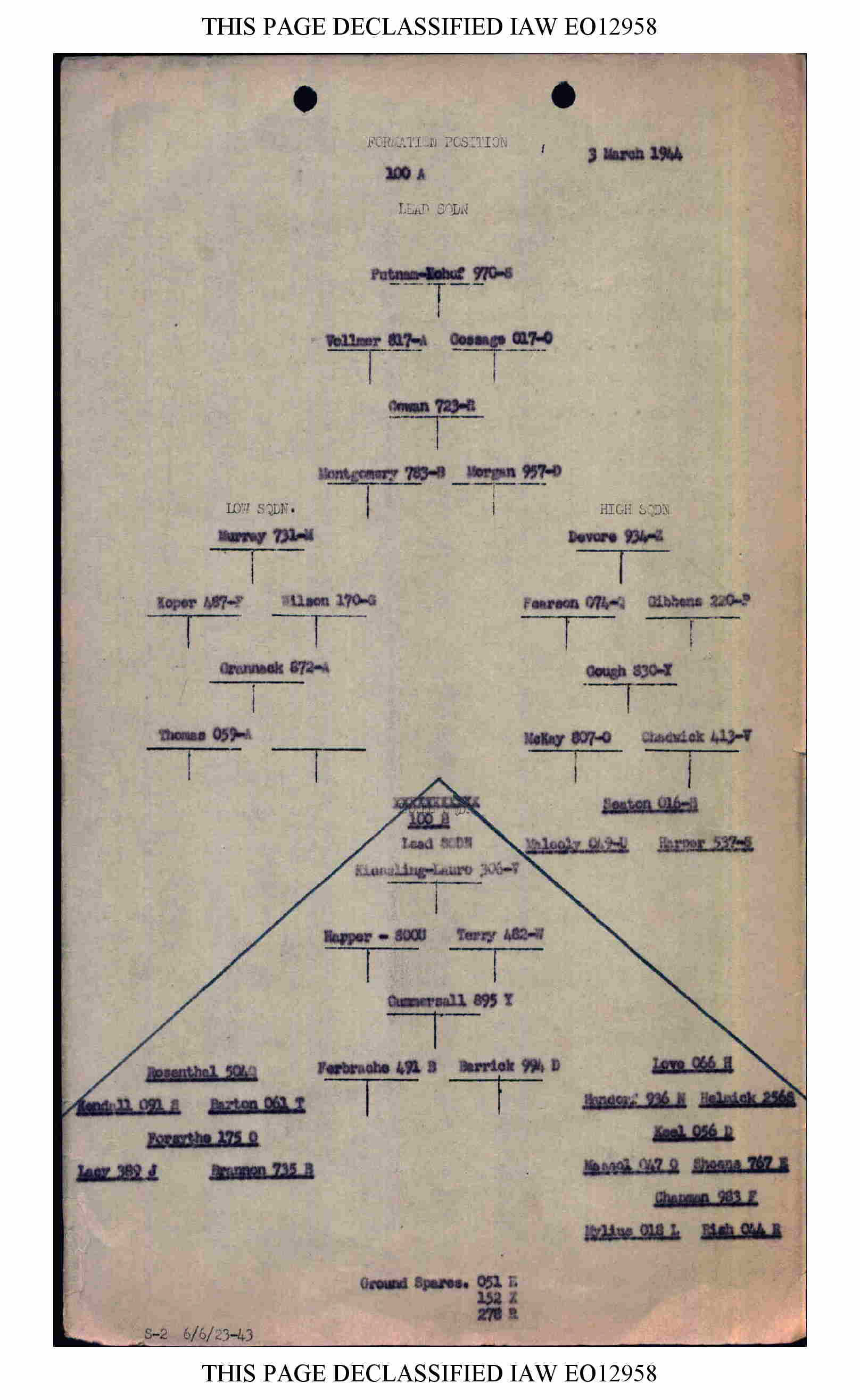
The 100A group formation would consist of twenty crews and would be led by the 349th squadron flying under the call sign of ‘Fathand.’ Twenty-two year old Gerald Putnam, an experienced pilot flying his first mission as the command pilot would fly along side Bob Lohof, who was fresh off his recent furlough in London. Twenty-four years old, this would be Bob’s 24th mission. The 349th’s William Murray would lead the low squadron. Nine crews from the 350th flying under the call sign of ‘Rearwheel’ would make up the high squadron and would be led by Herbert Devore.
The 100B’s formation would be led by the 418th squadron, under the call sign of ‘Shyboy’ and with Ernest Kiessling flying as command pilot with Frank Lauro. Robert Rosenthal would lead its low squadron and the 351st squadron would fly nine of its crews in the high, led by John Love.
Briefed on the weather, the men were told to expect, “7-8/10 cumulus clouds with tops at 8000 feet over the bases and 12000 throughout the target area.”
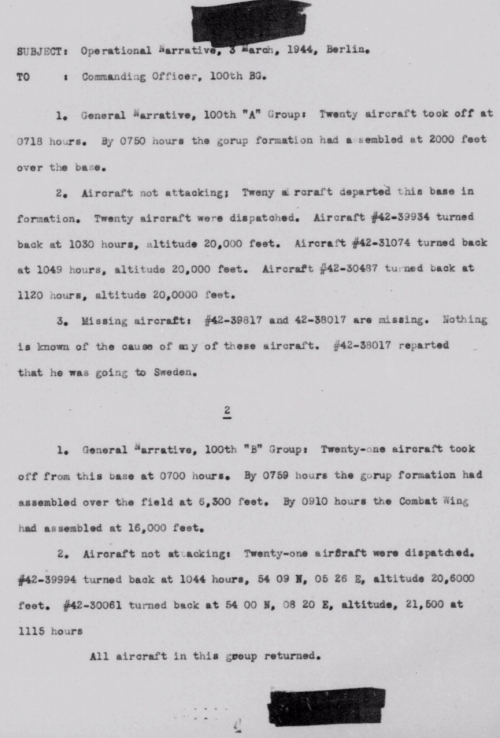
Over the fields, assembly was without incident. Taking off first at 0700 hours, the 100B’s twenty-one Fortresses spiraled up to 6300 feet over the field to assemble. The 100A’s twenty Fortresses took off next at 0718 hours, and had assembled at the lower 2000 feet by 0750. Proceeding to Horham, the 100A joined up with the 95BG and the 13A combat wing began its climb to the Division line together.
By 0759 hours, the 100B had completed its assembly over its base and proceeded to Framlingham, where assembly with the 390BG into the 13B CBW was completed. By 0917, the 13B had fallen into proper formation, echeloned right of the 13A as the Division proceeded to the coast at Cromer.
Crossing Cromer at 15000 feet, the climb to the briefed bombing altitude of 21000 feet commenced over the North Sea with the 13CBWs in good formation.
The formations took the long planned route over the North Sea and by the time the original bombing altitude had been reached by 1037, the pilots were still deep into 8-10/10s cloud coverage with no top in sight.
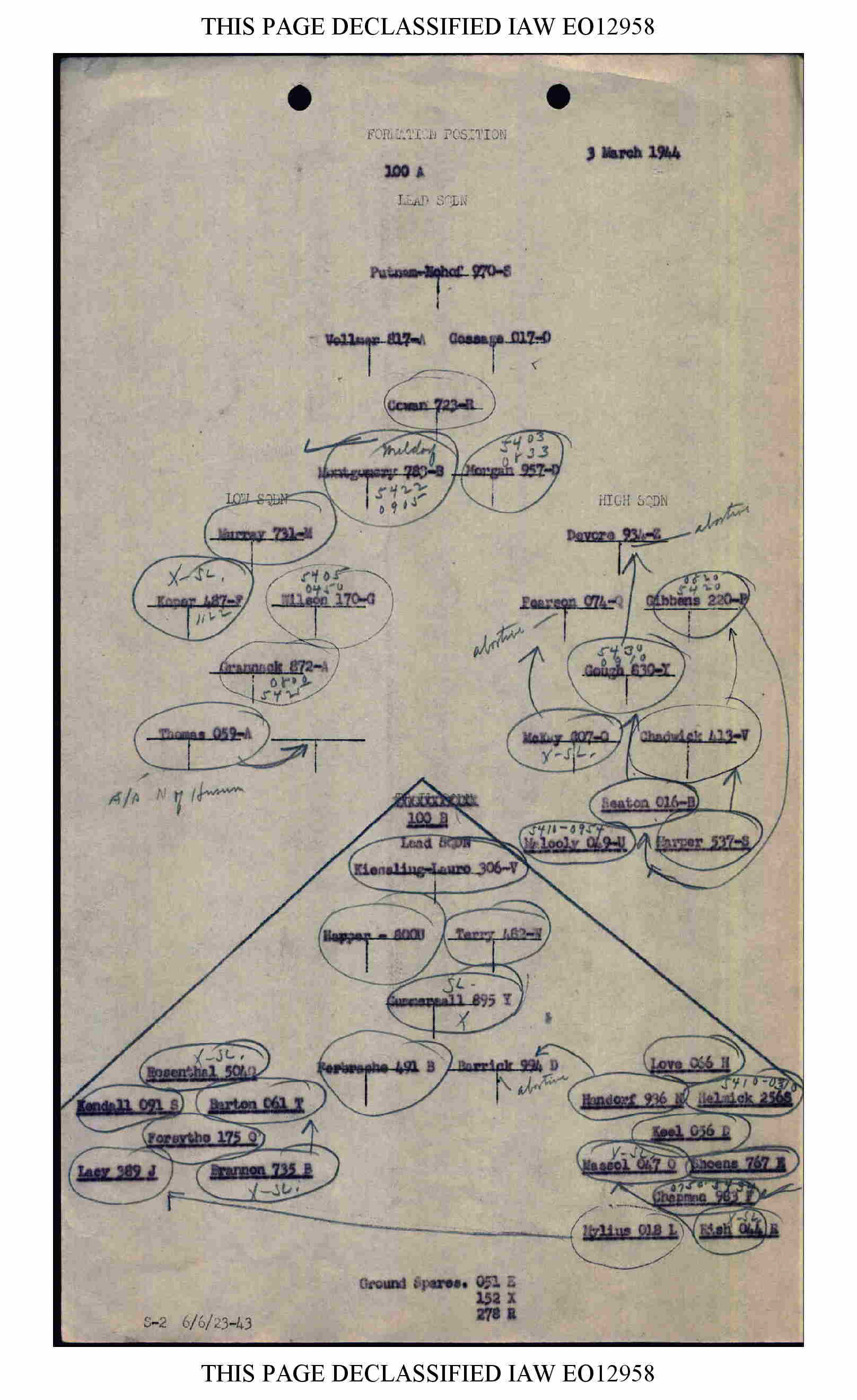
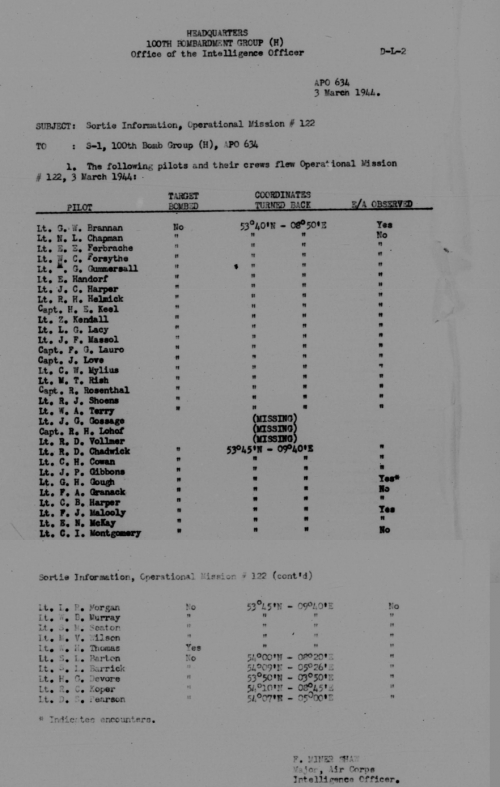
In the 100A formation, two pilots from the high squadron would abort the mission early: Herb Devore, leading the high in 42-39934 ‘My Achin’ Back,’ would turn back at 1030 hours, followed by his left wingman, Delbert Pearson in 42-31074 ‘Cahepit,’ who would pull out at 1049. In the low squadron at 1115, Robert Koper, in ‘Torchy 3’ 42-30487 would also abort the mission.
Meanwhile in the 100B lead squadron, at 1044 hours, Samuel Barrick flying in 42-39994 ‘Snort Stuff’ would be the first to abort. At 1115 hours in the low squadron, Samuel Barton, flying in 42-30061, ‘Just a Snappin’ and as Rosenthal’s wingman, would pull out of formation.
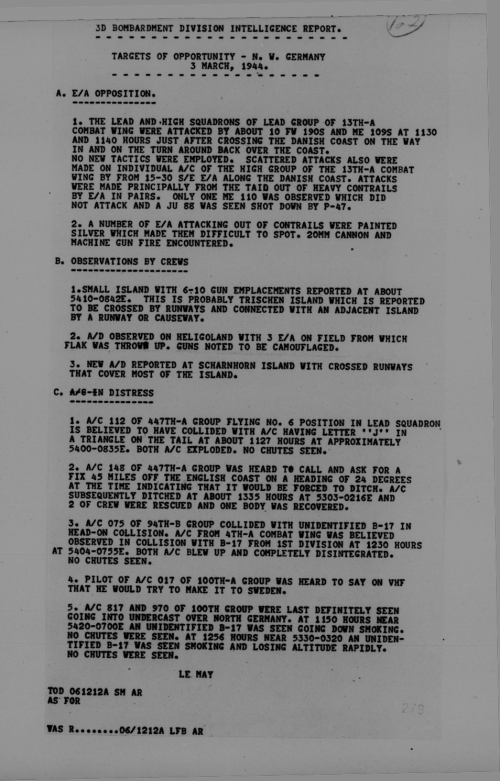
Crossing the enemy line at Schleswig-Holsteinisches at 1118 hours, the dense clouds and persistent contrails at the even higher 23000 feet continued to cause major problems for the pilots in maintaining formation. In an attempt to get the formations above the clouds, the 13A wing leader continued to climb even higher. By the time, it broke out above 25000 feet, the formations had been broken up and a mission recall was issued.
Experiencing a faulty radio in the 100A’s lead aircraft, the recall message had not been received by Putnam or Lohof. His wingman, twenty-five year old Robert Vollmer had received the notification and vainly attempted to communicate with the lead aircraft via a code gun but Putnam had already made the decision to turn his formation back once it cleared the top of the clouds. Continuing into the dense wall of clouds in front of them, the 100A disappeared.
Command pilot, Gerald Putnam stated, “When the recall went out, we did not receive it and very shortly found ourselves in thick soup over Germany. Afraid to turn the group back into the following waves, we decided to climb on course for ten minutes before turning and heading back. By that time, we had lost visual contact with all except our wingmen - Gossage and Vollmer. Before the 10 minutes were up, we started breaking out of the clouds, just in time to be met by three FW 190’s coming at us from the sun…” Sidney Goldenberg, Lohof’s TTE adds, “The pilot announced we were turning back, so I disconnected from my oxygen and went to check on fuel. I heard gunfire…pilot came on intercom and said ‘We’re hit, we’re going down, bail out!’ There were injuries. I had to push the bombardier out of the hatch. We were in clouds, didn’t even know if we were over land or water. It was snowing heavily. Difficult to breath or see…”
Wingman Robert Vollmer tells us, “Our element remained together and broke out on top of the clouds at 31,000 feet. For the next five or ten minutes it looked like the mighty 8th Air Force, consisting now of only three B-17s, was going to try to make the first strike on Big B. It didn't last long. A bunch of FWs hit us from about 2 o'clock high and got all of us. Two shells exploded in the cockpit, starting a fire in front of the rudder pedals and causing flames to come through my oxygen mask. At that altitude, I was unable to secure the walk around bottle before losing consciousness. The plane then dived and climbed alternately until it finally broke up. I don't know how I got out, but I did parachute with debris falling all around me…”
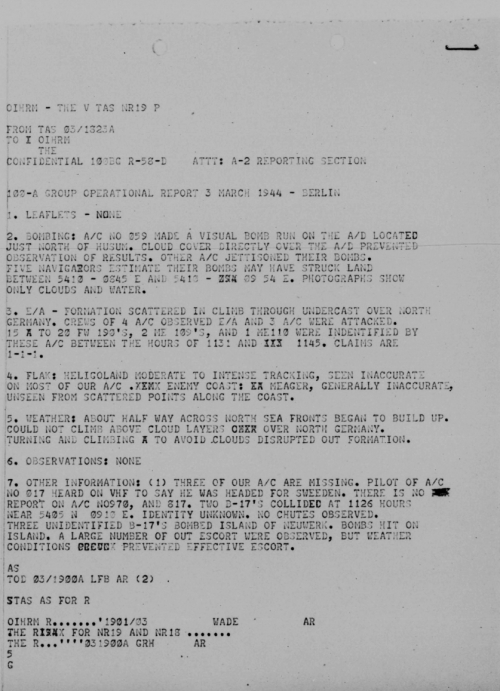
And in Gossage’s Fortress, “…some electrical systems were dead. Fire blazed from one engine, dangerously close to the fuel tanks. Gossage, struggling, threw the plane into a steep dive, leveling out at 5000 feet, but the fire was out…The engineer had been hit in the knee by bullets, The co-pilot administered morphine. The tail gunner did not respond to his radio. He was dead or wounded, or his intercom has been knocked out.” Radioing on VHF Gossage reported that they would try to get to Sweden.
Meanwhile, in the 100A’s high squadron, Delbert Bruns on Randall Chadwick’s Fortress recorded, “ …We got within 50 min of the target and we hit an overcast that you couldn't see much more than the end of the wing. We were flying at 25000. We were lucky we were on top formation. We pulled up out of it but some of the other planes collided into one another. The formations were broken up and you could see planes all over the sky…”
Also flying in the high squadron, Robert Bailie, twenty-three year-old copilot on Frank Malooly’s Fortress tells us, “…ran into heavy cloud wall at 28,000 ft. Started through in formation. We broke through at 30,000 ft. Alone… A sqdn of FW were sitting there waiting for us. Saw a small formation of 17's at 2 o'clock about 5 mil. off. Trying to reach them we were attacked several times. Looked back behind us and saw two B-17s break through clouds and collide exploding. No chutes seen. Made a diving turn to the left and had to drop bombs to keep from tearing wings off. It also helped us gain a little speed. This was about 20 mi. West of Hamburg. Reached group of 8 ships of the 95th that were split from their group. Turned on heading home, and was attacked again by FW's and ME 109's. Shot our way through, dropping one ME 109. Our P-47 and P-51 escort finally reached us and from there on didn't have any trouble.”
The 1st Division, upon receiving a recall message had made a 180 degree turn and ran through the oncoming 3rd Division’s Fortresses, “causing it to disintegrate badly and to break up the formations. During this confusion and milling about of aircrafts from both Divisions, several aircraft collided and were lost.”
After being separated in the clouds, “the route back was mostly by individual Groups along the same route as going in. Some Groups, being boxed in by Groups on either side, had to fly through the flak at Heligoland.” Jettisoning their bombs into the North Sea, after eight hours in the air, the recalled aircraft landed back at Thorpe Abbotts with Gerald Putnam, Lohof, Vollmer Gossage and their crews to never return. At Interrogation, most of the men reported hearing a big collision and assumed it had been Lohof and Vollmer, while they thought that Gossage had hopefully made it to Sweden.
The entry made into the 349th’s Squadron diary for the day’s mission read:
“March 3: This was the day when nine of our ships went out to bomb Berlin – the first time and actual start was made by US day bombers toward this greatest and most perilous target. Weather, and weather alone, defeated this mission, and brought particular disaster to the 349th. Three of our best crews, to say nothing of their planes, vanished in the clouds somewhere over Northern Europe, or the sea; there was no evidence to indicate they were victims of enemy action. One pilot, Lt. John G. Gossage, sent out a brief radio call to the effect he was going to try to reach Sweden; no word came from the planes commanded by Capt. Gerald R. Putnam and Lt Robert D. Vollmer, both top-line pilots who the Squadron could ill afford to lose. The same was true of Lt. Gossage, our hard luck skipper whose skill and courage had on in three previous close contests with death, and of Capt. Robert H. Lohoff, another senior pilot who rode with Putnam. All these officers were in sight of the end of their tours of duty, as were many of their crew members.
Our six planes which survived the indescribable dangers of blind flying in a sky full of bomber planes also had to combat severe icing conditions as they flew low over the North Sea, coming home. Incidentally, there was confusion over the radio recall; it did not appear to have been received promptly by all ships, and some wandered farther than was required."
Returning from his first mission, Bailie ended the day’s journal entry with, “We were very lucky to get back. I hope they won’t all be this rough…on alert again for tomorrow. Time 7 1/2 hours (OF HELL)”
Robert Rosenthal had been through training together with Gerald Putnam, flying overseas together, they had both been assigned to the 100th. Rosie tells us, “When Gerry was lost, I was truly distraught - if Gerry could be lost, then I could be lost too. I was at the Officers Club that evening, to hear about the day’s mission, and reports were that Gerry’s lead plane was in a mid-air collision, there were no survivors…” Fortunately though, all ten men on the Putnam-Lohof Fortress survived, parachuting safely into Germany and becoming POWs.
Already rescued at sea on a previous mission, Gossage had tried to get to Sweden, but his dingies had been shot up by the attacking fighters and he soon became surrounded by five JU88s. Putting his wheels down indicating surrender, Gossage put down on a Schlewig airfield and the Germans had possession of an intact B-17. All crew members became POWs. Radio operator Michael Polanick had relayed a last minute radio message before landing hoping someone back at Thorpe Abbotts would pick it up: “Going down over Germany. Wheels down. So long, Sully. So long, B.O. Request Q.D.M. Most Vital Request Q.D.M” which was a message to lock onto the signal and determine coordinates for the captured B-17. Although photos of the captured B-17 were taken, it was later reported that allied fighters strafed the Fortress, putting it out of commission.
For the Vollmer crew, he along with four others were taken prisoners after parachuting to land but five of the crew member were killed in action.
Crews flying this mission:
100A:
Lead: Putnam-Lohof, Vollmer, Gossage, Cowan, Montgomery, Morgan
Low: Murray, Koper, Wilson, Granack, Thomas
High: Devore, Pearson, Gibbons, Gough, McKay, Chadwick, Seaton, Malooly, Harper
100B:
Lead: Kiessling-Lauro, Harper, Terry, Gummersall, Ferbrache, Barrick
Low: Rosenthal, Kendall, Barton, Forsythe, Lacy, Brannan
High: Love, Handorf, Helmick, Keel, Massol, Shoens, Chapman, Mylius, Rish
On March 3, orders had been received across the 8th Air Force’s heavy bombardment units for the American’s first daylight attack on Germany’s capital city of Berlin. The 1st, 2nd and 3rd Air Divisions would send their heavy bombers to attack various industrial targets at Berlin.
At Thorpe Abbotts, forty-one crews had been seated in the briefing room and were soon told of their historic mission for the day. With the target of the Bosch electrical engineering factory divulged, the veteran crews who were close to finishing their tours as well as those about to fly their #1 combat mission, like the Randall Chadwick and John Gibbons’ crews, had hoped for an easier target than Berlin. And there was no doubt that all of the airmen seated felt the weight of ‘Big B’ target on their shoulders and in their guts.
The 3rd Division would be led by the 4CBW, followed by the 13CBW and the 45CBW at four minute intervals. The 13CBW flying two wings of three groups, would be led by the 95B in the 13A, a composite wing, with the 95A flying as its low group and the 100A as its high. Following behind, the 13B wing, another composite, would be led by the 390A group, with the 390B flying as its low group and the 100B as its high.
The 100A group formation would consist of twenty crews and would be led by the 349th squadron flying under the call sign of ‘Fathand.’ Twenty-two year old Gerald Putnam, an experienced pilot flying his first mission as the command pilot would fly along side Bob Lohof, who was fresh off his recent furlough in London. Twenty-four years old, this would be Bob’s 24th mission. The 349th’s William Murray would lead the low squadron. Nine crews from the 350th flying under the call sign of ‘Rearwheel’ would make up the high squadron and would be led by Herbert Devore.
The 100B’s formation would be led by the 418th squadron, under the call sign of ‘Shyboy’ and with Ernest Kiessling flying as command pilot with Frank Lauro. Robert Rosenthal would lead its low squadron and the 351st squadron would fly nine of its crews in the high, led by John Love.
Briefed on the weather, the men were told to expect, “7-8/10 cumulus clouds with tops at 8000 feet over the bases and 12000 throughout the target area.”
Over the fields, assembly was without incident. Taking off first at 0700 hours, the 100B’s twenty-one Fortresses spiraled up to 6300 feet over the field to assemble. The 100A’s twenty Fortresses took off next at 0718 hours, and had assembled at the lower 2000 feet by 0750. Proceeding to Horham, the 100A joined up with the 95BG and the 13A combat wing began its climb to the Division line together.
By 0759 hours, the 100B had completed its assembly over its base and proceeded to Framlingham, where assembly with the 390BG into the 13B CBW was completed. By 0917, the 13B had fallen into proper formation, echeloned right of the 13A as the Division proceeded to the coast at Cromer.
Crossing Cromer at 15000 feet, the climb to the briefed bombing altitude of 21000 feet commenced over the North Sea with the 13CBWs in good formation.
The formations took the long planned route over the North Sea and by the time the original bombing altitude had been reached by 1037, the pilots were still deep into 8-10/10s cloud coverage with no top in sight.
In the 100A formation, two pilots from the high squadron would abort the mission early: Herb Devore, leading the high in 42-39934 ‘My Achin’ Back,’ would turn back at 1030 hours, followed by his left wingman, Delbert Pearson in 42-31074 ‘Cahepit,’ who would pull out at 1049. In the low squadron at 1115, Robert Koper, in ‘Torchy 3’ 42-30487 would also abort the mission.
Meanwhile in the 100B lead squadron, at 1044 hours, Samuel Barrick flying in 42-39994 ‘Snort Stuff’ would be the first to abort. At 1115 hours in the low squadron, Samuel Barton, flying in 42-30061, ‘Just a Snappin’ and as Rosenthal’s wingman, would pull out of formation.
Crossing the enemy line at Schleswig-Holsteinisches at 1118 hours, the dense clouds and persistent contrails at the even higher 23000 feet continued to cause major problems for the pilots in maintaining formation. In an attempt to get the formations above the clouds, the 13A wing leader continued to climb even higher. By the time, it broke out above 25000 feet, the formations had been broken up and a mission recall was issued.
Experiencing a faulty radio in the 100A’s lead aircraft, the recall message had not been received by Putnam or Lohof. His wingman, twenty-five year old Robert Vollmer had received the notification and vainly attempted to communicate with the lead aircraft via a code gun but Putnam had already made the decision to turn his formation back once it cleared the top of the clouds. Continuing into the dense wall of clouds in front of them, the 100A disappeared.
Command pilot, Gerald Putnam stated, “When the recall went out, we did not receive it and very shortly found ourselves in thick soup over Germany. Afraid to turn the group back into the following waves, we decided to climb on course for ten minutes before turning and heading back. By that time, we had lost visual contact with all except our wingmen - Gossage and Vollmer. Before the 10 minutes were up, we started breaking out of the clouds, just in time to be met by three FW 190’s coming at us from the sun…” Sidney Goldenberg, Lohof’s TTE adds, “The pilot announced we were turning back, so I disconnected from my oxygen and went to check on fuel. I heard gunfire…pilot came on intercom and said ‘We’re hit, we’re going down, bail out!’ There were injuries. I had to push the bombardier out of the hatch. We were in clouds, didn’t even know if we were over land or water. It was snowing heavily. Difficult to breath or see…”
Wingman Robert Vollmer tells us, “Our element remained together and broke out on top of the clouds at 31,000 feet. For the next five or ten minutes it looked like the mighty 8th Air Force, consisting now of only three B-17s, was going to try to make the first strike on Big B. It didn't last long. A bunch of FWs hit us from about 2 o'clock high and got all of us. Two shells exploded in the cockpit, starting a fire in front of the rudder pedals and causing flames to come through my oxygen mask. At that altitude, I was unable to secure the walk around bottle before losing consciousness. The plane then dived and climbed alternately until it finally broke up. I don't know how I got out, but I did parachute with debris falling all around me…”
And in Gossage’s Fortress, “…some electrical systems were dead. Fire blazed from one engine, dangerously close to the fuel tanks. Gossage, struggling, threw the plane into a steep dive, leveling out at 5000 feet, but the fire was out…The engineer had been hit in the knee by bullets, The co-pilot administered morphine. The tail gunner did not respond to his radio. He was dead or wounded, or his intercom has been knocked out.” Radioing on VHF Gossage reported that they would try to get to Sweden.
Meanwhile, in the 100A’s high squadron, Delbert Bruns on Randall Chadwick’s Fortress recorded, “ …We got within 50 min of the target and we hit an overcast that you couldn't see much more than the end of the wing. We were flying at 25000. We were lucky we were on top formation. We pulled up out of it but some of the other planes collided into one another. The formations were broken up and you could see planes all over the sky…”
Also flying in the high squadron, Robert Bailie, twenty-three year-old copilot on Frank Malooly’s Fortress tells us, “…ran into heavy cloud wall at 28,000 ft. Started through in formation. We broke through at 30,000 ft. Alone… A sqdn of FW were sitting there waiting for us. Saw a small formation of 17's at 2 o'clock about 5 mil. off. Trying to reach them we were attacked several times. Looked back behind us and saw two B-17s break through clouds and collide exploding. No chutes seen. Made a diving turn to the left and had to drop bombs to keep from tearing wings off. It also helped us gain a little speed. This was about 20 mi. West of Hamburg. Reached group of 8 ships of the 95th that were split from their group. Turned on heading home, and was attacked again by FW's and ME 109's. Shot our way through, dropping one ME 109. Our P-47 and P-51 escort finally reached us and from there on didn't have any trouble.”
The 1st Division, upon receiving a recall message had made a 180 degree turn and ran through the oncoming 3rd Division’s Fortresses, “causing it to disintegrate badly and to break up the formations. During this confusion and milling about of aircrafts from both Divisions, several aircraft collided and were lost.”
After being separated in the clouds, “the route back was mostly by individual Groups along the same route as going in. Some Groups, being boxed in by Groups on either side, had to fly through the flak at Heligoland.” Jettisoning their bombs into the North Sea, after eight hours in the air, the recalled aircraft landed back at Thorpe Abbotts with Gerald Putnam, Lohof, Vollmer Gossage and their crews to never return. At Interrogation, most of the men reported hearing a big collision and assumed it had been Lohof and Vollmer, while they thought that Gossage had hopefully made it to Sweden.
The entry made into the 349th’s Squadron diary for the day’s mission read:
“March 3: This was the day when nine of our ships went out to bomb Berlin – the first time and actual start was made by US day bombers toward this greatest and most perilous target. Weather, and weather alone, defeated this mission, and brought particular disaster to the 349th. Three of our best crews, to say nothing of their planes, vanished in the clouds somewhere over Northern Europe, or the sea; there was no evidence to indicate they were victims of enemy action. One pilot, Lt. John G. Gossage, sent out a brief radio call to the effect he was going to try to reach Sweden; no word came from the planes commanded by Capt. Gerald R. Putnam and Lt Robert D. Vollmer, both top-line pilots who the Squadron could ill afford to lose. The same was true of Lt. Gossage, our hard luck skipper whose skill and courage had on in three previous close contests with death, and of Capt. Robert H. Lohoff, another senior pilot who rode with Putnam. All these officers were in sight of the end of their tours of duty, as were many of their crew members.
Our six planes which survived the indescribable dangers of blind flying in a sky full of bomber planes also had to combat severe icing conditions as they flew low over the North Sea, coming home. Incidentally, there was confusion over the radio recall; it did not appear to have been received promptly by all ships, and some wandered farther than was required."
Returning from his first mission, Bailie ended the day’s journal entry with, “We were very lucky to get back. I hope they won’t all be this rough…on alert again for tomorrow. Time 7 1/2 hours (OF HELL)”
Robert Rosenthal had been through training together with Gerald Putnam, flying overseas together, they had both been assigned to the 100th. Rosie tells us, “When Gerry was lost, I was truly distraught - if Gerry could be lost, then I could be lost too. I was at the Officers Club that evening, to hear about the day’s mission, and reports were that Gerry’s lead plane was in a mid-air collision, there were no survivors…” Fortunately though, all ten men on the Putnam-Lohof Fortress survived, parachuting safely into Germany and becoming POWs.
Already rescued at sea on a previous mission, Gossage had tried to get to Sweden, but his dingies had been shot up by the attacking fighters and he soon became surrounded by five JU88s. Putting his wheels down indicating surrender, Gossage put down on a Schlewig airfield and the Germans had possession of an intact B-17. All crew members became POWs. Radio operator Michael Polanick had relayed a last minute radio message before landing hoping someone back at Thorpe Abbotts would pick it up: “Going down over Germany. Wheels down. So long, Sully. So long, B.O. Request Q.D.M. Most Vital Request Q.D.M” which was a message to lock onto the signal and determine coordinates for the captured B-17. Although photos of the captured B-17 were taken, it was later reported that allied fighters strafed the Fortress, putting it out of commission.
For the Vollmer crew, he along with four others were taken prisoners after parachuting to land but five of the crew member were killed in action.
Crews flying this mission:
100A:
Lead: Putnam-Lohof, Vollmer, Gossage, Cowan, Montgomery, Morgan
Low: Murray, Koper, Wilson, Granack, Thomas
High: Devore, Pearson, Gibbons, Gough, McKay, Chadwick, Seaton, Malooly, Harper
100B:
Lead: Kiessling-Lauro, Harper, Terry, Gummersall, Ferbrache, Barrick
Low: Rosenthal, Kendall, Barton, Forsythe, Lacy, Brannan
High: Love, Handorf, Helmick, Keel, Massol, Shoens, Chapman, Mylius, Rish
Bombing Results
Bombing Results:
Aircraft Lost: 3
Crew Lost: 30
Claims of Enemy Losses (CLS): 2
Aircraft Returned: