Gen
JIMMY DOOLITTLE
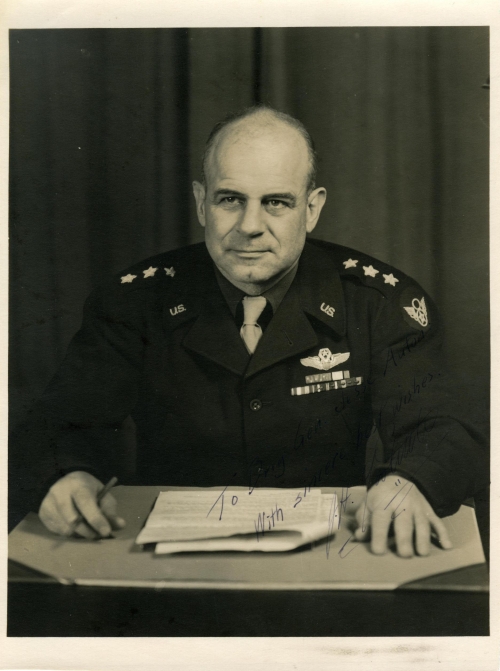
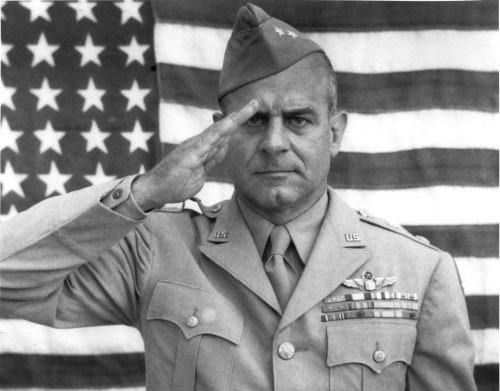
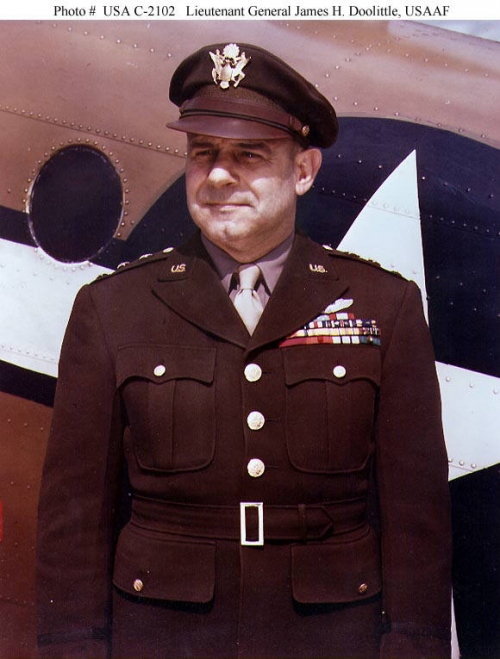
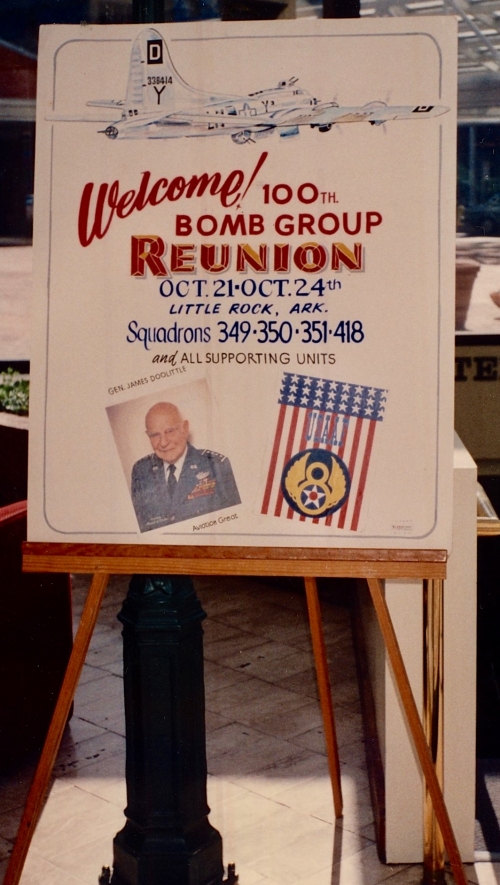
Assigned to the 100th Bombardment Group
Location:
Unit: 8th AF
Rank:
Position: Command Pilot Position
Additional 100th Service Notes
Status: DUR
Comments: COMMANDER 8TH AIR FORCE (Taps 1994)
Comments and Notes
Memo 1:
CREW

TAPS: GENERAL JIMMY DOOLITTLE


 As much as been published about the death of this great man, there is something that must be said of Jimmy Doolitte in a 100th Bomb Group publication.

 We recognized that he was a superior being. We knew he was a great flyer. We knew of his mastery of aviation technology, which included a Ph.D. from MIT and a first complete flight on instruments. But we also felt that he was our kind. Although we did not operate on the scale level which he did, his spirit was our spirit. Early in his career he was sent to a South American country to demonstrate an American airplane. When he arrived, he learned he was expected to engage a German pilot in a dogfight. On the evening before, drinks were plentiful and Jimmy demonstrated his 100th personality by walking on his hands around the railing of a two second-story building. He slipped but caught himself on some vines. Too proud to cry for help he eventually dropped to the ground and broke both ankles. On the next day, his ankles in casts, he did the contest with the German ace. He won so conclusively that the country purchased American aircraft instead of allying itself commercially with Germany. I don't know how much of this is apocryphal, but it was a 100th kind of story.

 Jimmy earned some of his early fame because he was the only man who could fly the stubby Gee Bee, which was hardly more than flying engine. It was fast, but it wouldn't turn, and it killed its pilots. Instead of trying tight turns around the pylons, Jimmy figured out that the Gee Bee was so fast that he flew a large oval around the triangle. He flew farther than his opponents, but much faster. He grazed the last pylon, and won.

 Jimmy loved to tell a tale about his visit to the 100th. After one of our heavy losses, he came to Thorpe Abbotts and was amused at the Officers' Club when a young and very tipsy bombardier came up to him and pushed a finger repeatedly into his stomach, all the while woozily saying, "I want you to know that even if the 100th lost a lot crews, we still don't need an God-dammed generals coming here to cheer us up."

 He had a special affection for the 100th. At the ceremony in which he became a member of the Aviation Hall of Fame in Cleveland, he was told he could have an Honor Guard, and he asked the 100th to serve. Twelve of us obliged, Irv Waterbury became the Aide-de-camp and Jimmy Doolitte got another laugh. When it came time to pay a parking fee and Irv found to his chagrin that he had left his wallet at home, he had to borrow two dollars from the general. Even though Jimmy promoted Irv on the spot to the honorary rank of major, he never let his aide forget the evening.

 At the height of the ceremony he was supposed to walk to the dais between two ranks of his 100th Honor Guard. He paused and started laughing. "In all my life," he said, "I have never seen such a motley crew."

 I have a personal reason to appreciate the man. When my editor at Harper Collins asked me to get endorsements for my book, I sent a copy to Jimmy Doolittle. Although he was not fit at the time, he read it, liked it, and wrote me a commendatory note about it. After I asked him for permission to use the compliment on the dust jacket, he had his son take care of the details. I shall be eternally grateful.

 When any great person dies, we all lose. As commanding officer of out 8th Air Force, he was important for us. But when a great man is special to us, when we think if him with affection and personal respect, we hurt all the more. We shall, of course, miss him, but we will all appreciate the part he played in our lives.


By Harry Crosby, editor Splasher Six
Memo 2:
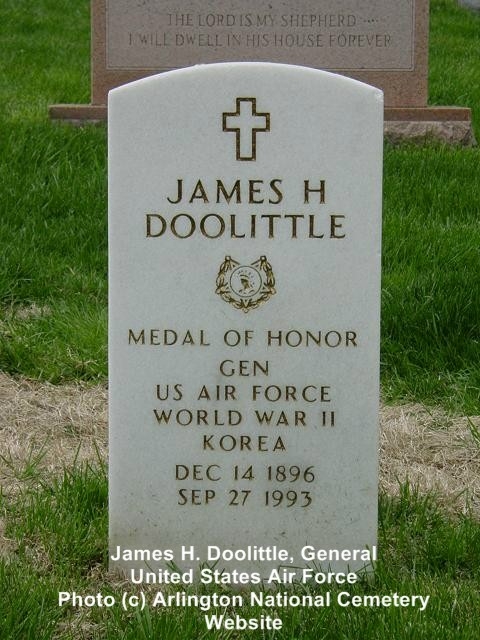
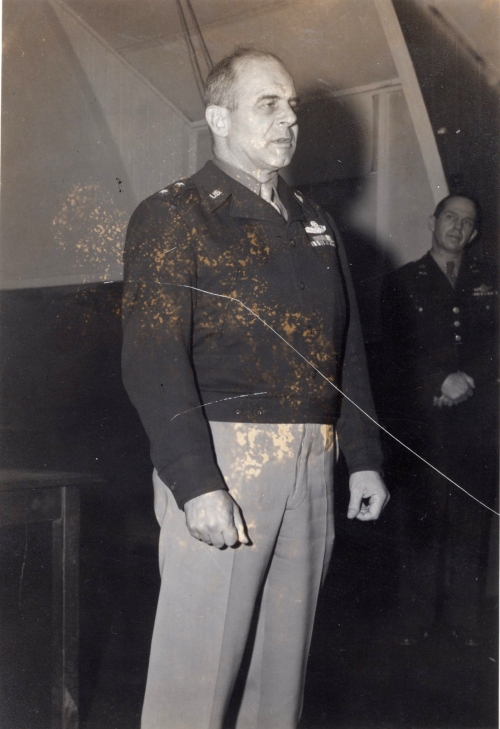
GENERAL JAMES HAROLD DOOLITTLE

Retired   May 10,1946

 Died  September 27,1993


Medal of Honor recipient, pioneering holder of speed records, leader of first aerial attack on the Japanese mainland, and famed World War II air commander.


James Harold Doolittle was born in Alameda, Calif., in 1896. James "Jimmy" Doolittle was educated in Nome, Alaska, Los Angeles Junior College, and spent a year at the University of California School of Mines. He enlisted as a flying cadet in the Signal Corps Reserve in October 1917 and trained at the School of Military Aeronautics, University of California and Rockwell Field Calif. He was commissioned a second lieutenant in the Signal Corps' Aviation Section March 11, 1918, and served successively at Camp Dick, Texas; Wright Field, Ohio; Gerstner Field, La.; and went back to Rockwell Field, chiefly as a flight leader and gunnery instructor. He then went to Kelly Field, Texas, for duty first with the 104th Aero Squadron, and next with the 90th Squadron on border patrol duty at Eagle Pass, Texas.


On July 1, 1920 Doolittle got his regular commission and promotion to first lieutenant. He then took the Air Service Mechanical School and Aeronautical Engineering courses at Kelly Field and McCook Field, Ohio, respectively. In September 1922 he made the first of many pioneering flights which earned him most of the major air trophies and international fame.


He flew a DH-4, equipped with crude navigational instruments, in the first cross-country flight, from Pablo Beach, Fla., to San Diego, Calif., in 21 hours and 19 minutes. He made only one refueling stop at Kelly Field. The military gave him the Distinguished Flying Cross for this historic feat. In the same year he received his bachelor of arts degree from the University of California, Berkeley.


In July 1923 he entered Massachusetts Institute of Technology for special engineering courses and graduated the following year with a master of science degree, getting his doctor of science degree in Aeronautics a year later, and being one of the first men in the country to earn this degree.


In March 1924 he served at McCook Field conducting aircraft acceleration tests. In June 1925 Doolittle went to the Naval Air Station in Washington, D.C., for special training in flying high-speed seaplanes. During this period he served for a while with the Naval Test Board at Mitchel, N.Y., and was a familiar figure in airspeed record attempts in the New York area. He won the Schneider Cup Race - the World's Series of seaplane racing - in 1925, with an average speed of 232 miles per hour in a Curtiss Navy racer equipped with pontoons. This was the fastest a seaplane had ever flown, and Doolittle next year received the Mackay Trophy for this feat.


In April 1926 he got a leave of absence to go to South America on airplane demonstration flights. In Chile he broke both ankles but put his Curtiss P-1 through stirring aerial maneuvers with his ankles in casts. He returned to the United States and was in Walter Reed Hospital for these injuries until April 1927 when he was assigned to McCook Field for experimental work and additional duty as instructor with Organized Reserves of the Fifth Corps Area's 385th Bomb Squadron.


Returning to Mitchel Field in September 1928, he assisted in the development of fog flying equipment. He helped develop the now almost universally used artificial horizontal and directional gyroscopes and made the first flight completely by instruments. He attracted wide newspaper attention with this feat of "blind" flying and later received the Harmon Trophy for conducting the experiments.


In January 1930 he was adviser for the Army on the building of the Floyd Bennett Airport in New York City. Doolittle resigned his regular commission Feb. 15, 1930 and was commissioned a major in the Specialist Reserve Corps a month later, being named manager of the Aviation Department of the Shell Oil Company, in which capacity he conducted numerous aviation tests. He also went on active duty with the Army frequently to conduct tests, and in 1932 set the world's high speed record for land planes. He won the Bendix Trophy Race from Burbank Calif., to Cleveland in a Laird Biplane, and took the Thompson Trophy Race at Cleveland in a Gee Bee racer with a speed averaging 252 miles per hour.


In April 1934 Doolittle became a member of the Army Board to study Air Corps organization and a year later was transferred to the Air Corps Reserve. In 1940 he became president of the Institute of Aeronautical Science. He went back on active duty July 1, 1940 as a major and assistant district supervisor of the Central Air Corps Procurement District at Indianapolis, Ind., and Detroit, Mich., where he worked with large auto manufacturers on the conversion of their plants for production of planes. The following August he went to England as a member of a special mission and brought back information about other countries' air forces and military buildups.


He was promoted to lieutenant colonel Jan 2, 1942 and went to Headquarters Army Air Force to plan the first aerial raid on the Japanese homeland. He volunteered and received Gen. H.H. Arnold's approval to lead the attack of 16 B-25 medium bombers from the aircraft carrier Hornet, with targets in Tokyo, Kobe, Osaka, and Nagoya. The daring one-way mission April 18, 1942 electrified the world and gave America's war hopes a terrific lift. As did the others who participated in the mission, Doolittle had to bail out, but fortunately landed in a rice paddy in China near Chu Chow. Some of the other flyers lost their lives on the mission.


Doolittle received the Medal of Honor, presented to him by President Roosevelt at the White House, for planning and leading this successful operation. His citation reads: "For conspicuous leadership above and beyond the call of duty, involving personal valor and intrepidity at an extreme hazard to life. With the apparent certainty of being forced to land in enemy territory or to perish at sea, Lt. Col. Doolittle personally led a squadron of Army bombers, manned by volunteer crews, in a highly destructive raid on the Japanese mainland." In addition to the nation's top award, Doolittle also received two Distinguished Service Medals, the Silver Star, three Distinguished Flying Crosses, Bronze Star, four Air Medals, and decorations from Great Britain, France, Belgium, Poland, China and Ecuador.


In July 1942, as a brigadier general - he had been advanced two grades the day after the Tokyo attack - Doolittle was assigned to the 8th Air Force and in September became commanding general of the 12th Air Force in North Africa. He was promoted to major general in November and in March 1943 became commanding general of the North African Strategic Air Forces.


He took command of the 15th Air Force in the Mediterranean Theater in November and from January 1944 to September 1945 he commanded the 8th Air Force in Europe and the Pacific, until war's end, as a lieutenant general, the promotion date being March 13, 1944. On May 10, 1946 he reverted to inactive reserve status and returned to Shell Oil as a vice president and later a director.


In March 1951 he was appointed a special assistant to the Air Force chief of staff, serving as a civilian in scientific matters which led to Air Force ballistic missile and space programs.


He retired from Air Force duty Feb. 28, 1959 but continued to serve his country as chairman of the board of Space Technology Laboratories. He also was the first president of the Air Force Association, in 1947, assisting its organization.


On April 4, 1985, the U.S. Congress advanced him to full general on the Air Force retired list. In a later ceremony, President Reagan and Senator Goldwater pinned on his four-star insignia, making him the first person in Air Force Reserve history to wear four stars.
Photos
Click here to see album - 8 items
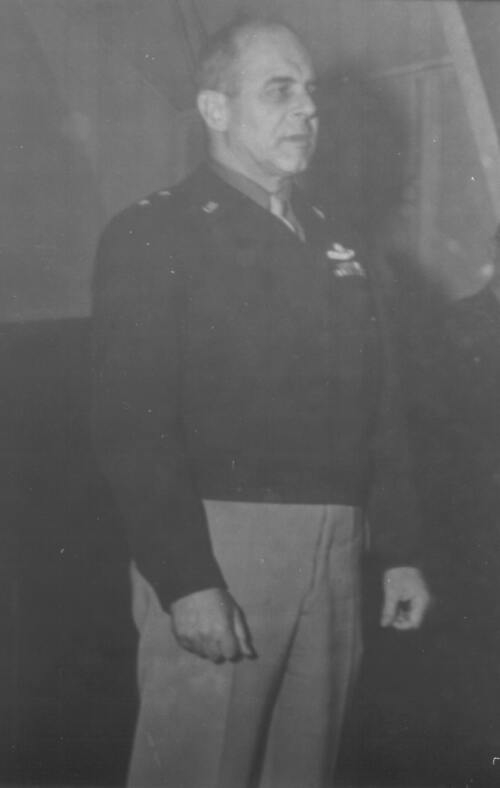
Click here to see album - 8 items
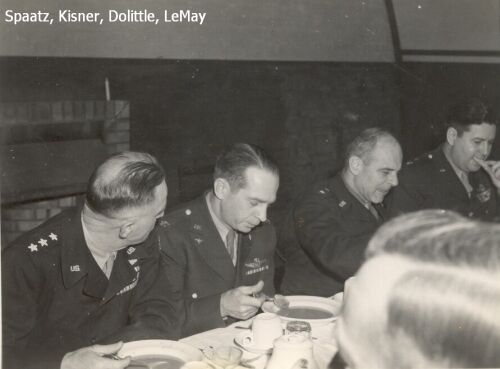
Click here to see album - 8 items
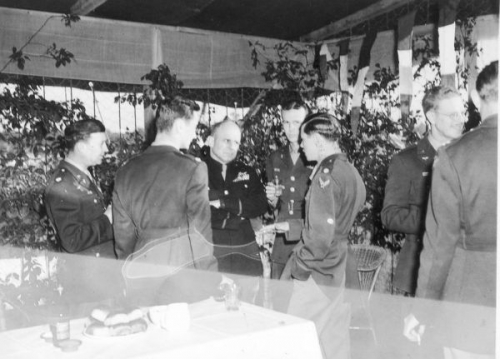
Click here to see album - 8 items
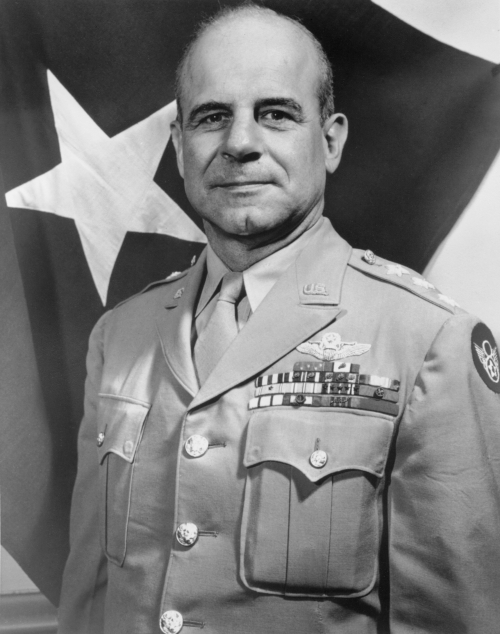
Click here to see album - 8 items
Click here to see album - 8 items
Click here to see album - 8 items
Click here to see album - 8 items

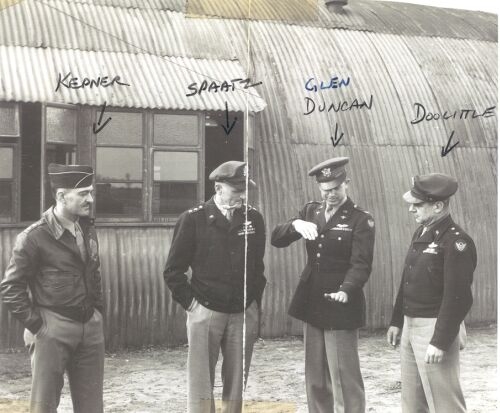
Doolittle, LeMay, Dauncey, Barr
From left: Jimmy Doolittle, Curtis LeMay, G.W. Dauncey and Sammy Barr. (100th Photo Archives)