S/Sgt
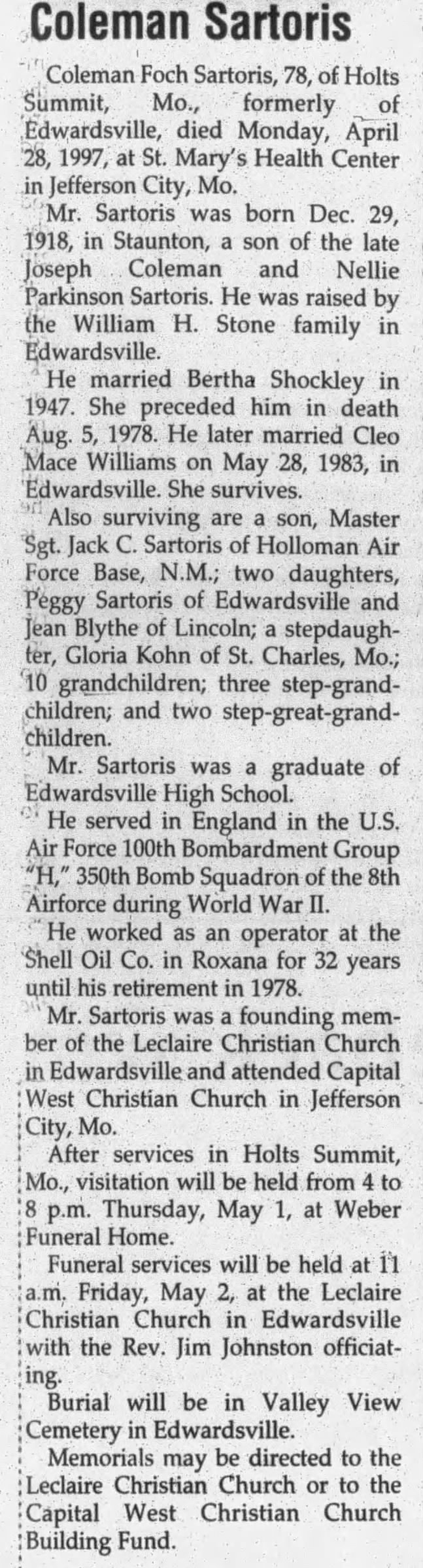
Coleman Foch SARTORIS
Assigned to the 100th Bombardment Group
Location:
Unit: 350th Bombardment Squadron
Rank:
Position: Ground personnel
Beginning Date of 100th Service: Unknown
Time of Service at Thorpe Abbotts: Unknown - Unknown
Additional 100th Service Notes
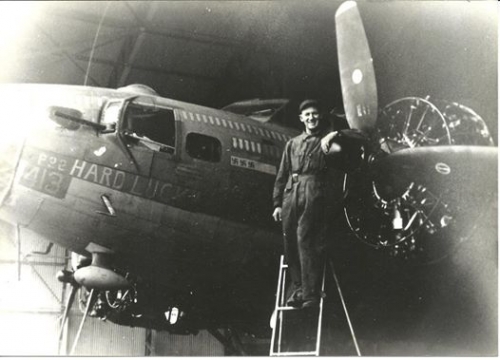
Comments: ENGINE MECHANIC, CREW CHIEF "HARD LUCK"
Biography
Born December 29, 1918
Birthplace: Staunton, Missouri
Died postwar on April 28, 1997
Media Articles
Use your thumb to scroll through the results box below.
| Media Item | Type | Page | Volume/Issue | Broadcast Source | Time | Description | File |
|---|---|---|---|---|---|---|---|
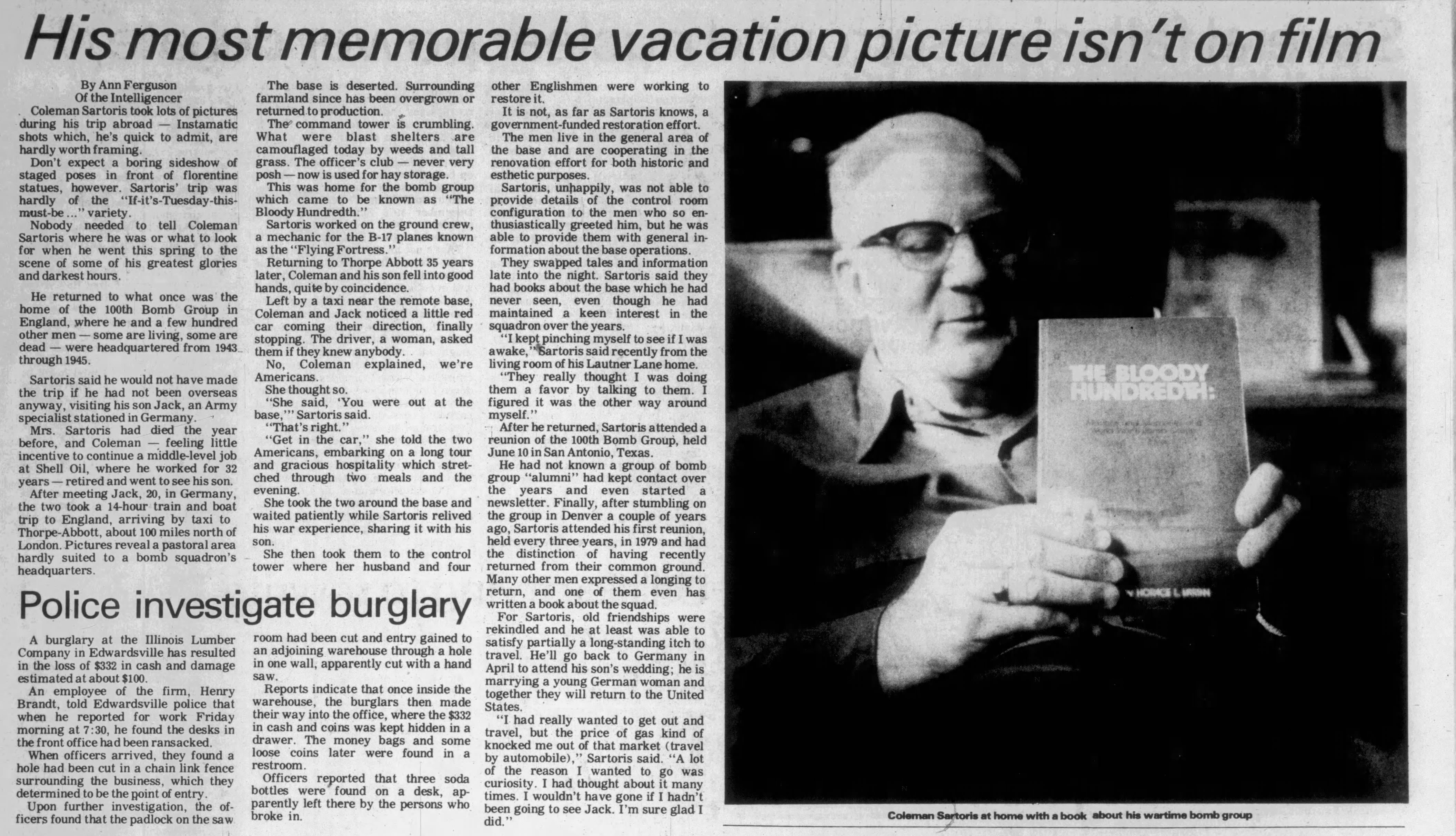
| Coleman Sartoris remembers | The Edwardsville Intelligencer December 15 1979 | 12:00 am | |||||
| Coleman Sartoris obituary | The Edwardsville Intelligencer April 30 1997 | 12:00 am |
Comments and Notes
Memo 1:
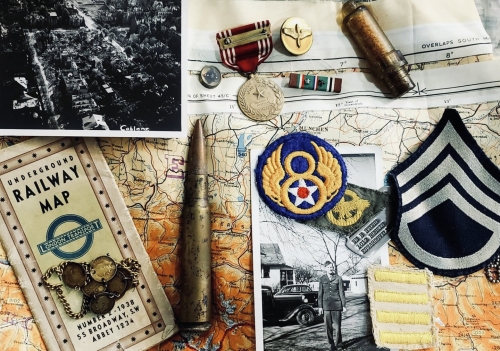
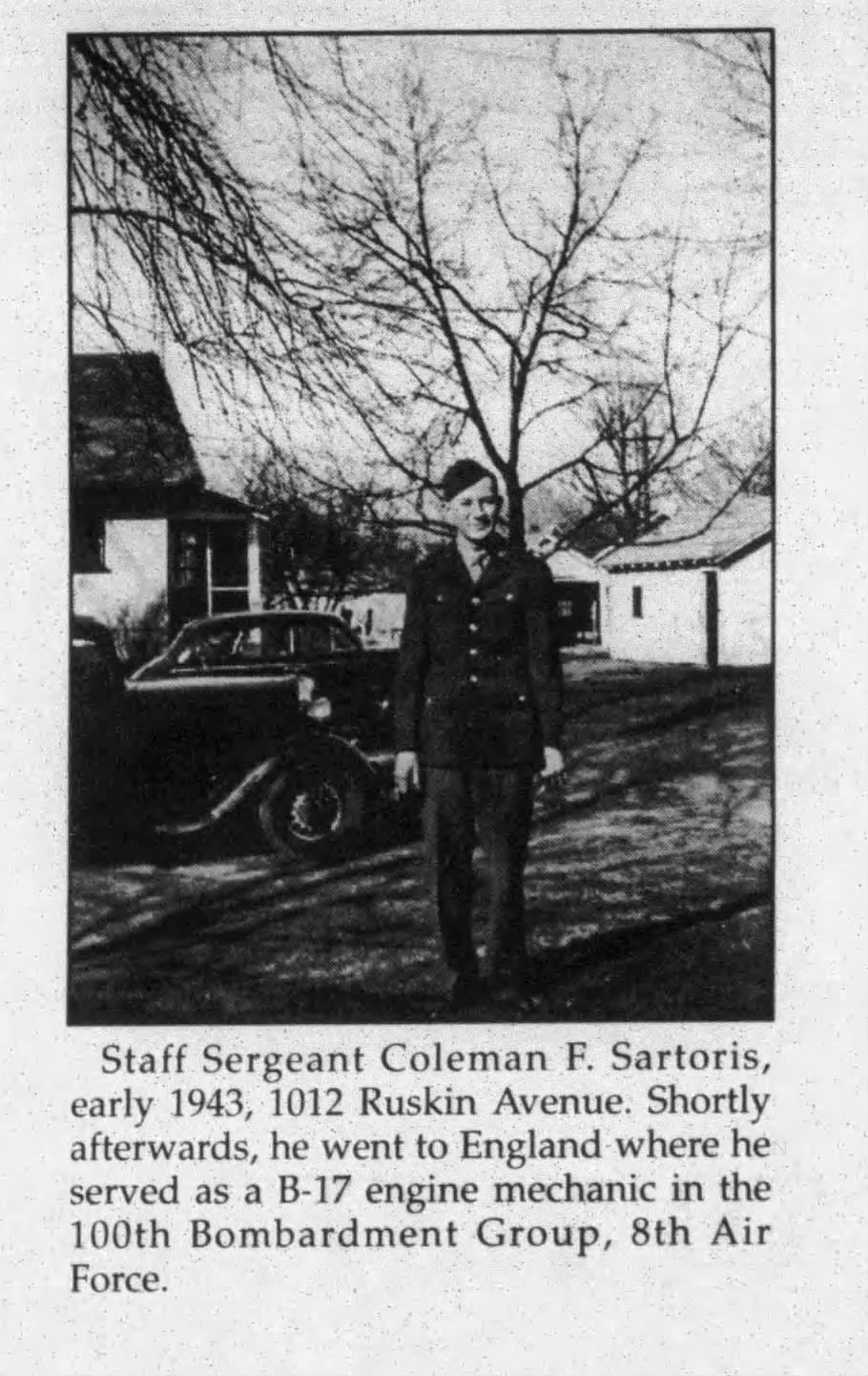
My father, Staff Sergeant Coleman F. Sartoris, 350th Bomb Sqdn, 100th Bomb Gp (H), served from November 1941 to September 1945 as a radial engine mechanic. He graduated from Sheppard Technical Training Center, trained on the R-1820 engine at the Wright Aeronautical factory, and was a "charter member" of the 100th. He had attained the rank of Technical Sergeant by 1943, but was reduced to Staff Sergeant late in the summer of 1944. During a period of heavy losses, he volunteered to be a Top Turret Gunner-Engineer, but his squadron commander refused: "It takes 30 [?] days to make a gunner, but it takes over a year to train a good engine mechanic. I need you on the ground."


My father, Staff Sergeant Coleman F. Sartoris, 350th Bomb Sqdn, in his "office" with Hard Luck. He was factory-trained on the R-1820, and spent much time just like this, working on the engines of the "Hard Luck". When this aircraft had been in combat for nine (9!) months, its factory-original engines were supposed to be overhauled. However, they were found to be in such good condition that only a ring-and-valve job was needed to put them back into service. When the Hard Luck was shot down after 366 days in combat, it went down with all four factory-original engines, and two of its original superchargers. Credit should be shared amongst the quality of those engines, the diligence with which the pilots operated them, the excellent care my father gave them, and the good luck that the engines had never been hit.


UNAME = Jack C. Sartoris, MSgt, USAF (ret.)

CONNECTION = I am a relative of a 100th veteran

QUESTION = Question: I am interested in hearing from any 100th BG or 350th Bomb Sqdn members who served with my father, SSgt Coleman F. Sartoris, an engine mechanic and crewchief in the 350th, including the B-17F 0413 "Hard Luck".  Dad passed away a few years ago, and we are trying to assemble some stories or remenisces about him for our family history.   Thank you very much.  Have a great reunion!


UNAME = Jack C. Sartoris, MSgt, USAF (ret.)

CONNECTION = I am a relative of a 100th veteran

TAPS_PERSON = Coleman F. Sartoris

TAPS_DATE = April 28, 1997

TAPS_UNIT = 350th


Subj: 100th Bomb Group Personnel Question

Date: 4/3/2005 9:16:01 PM Pacific Daylight Time

To: MPFaley@aol.com

Sent from the Internet (Details)


Dear Mike:


I'm doing some historical research, and Carol Batley told me I should contact you.


My father, Coleman F. Sartoris, served as an engine mechanic in the 350th.  I was reading some of his letters home the other day.  The return addresses on letters written 1941-1944 progressively change from Private up to Technical Sergeant, until a letter in early October 1944: after that, the return address was Staff Sergeant.


I read that letter carefully.  He was writing to his mother about an allotment change because he had just been busted to Staff Sergeant.  Just what it involved, he didn't say.  I read earlier letters, and found no clues.  I double checked my other records on Dad.  Sure enough, there are pictures of him wearing Tech Sergeant stripes on coveralls, next to an R-1820 radial engine on a stand; and there are also pictures of him when he got home in 1945, wearing Staff Sergeant stripes.


Dad's official records were destroyed in the fire at the Army Personnel Records Center in St. Louis.  All I have is a form with his service dates and rank at discharge: Staff Sergeant.


I talked with Dad a lot about his military service, and even visited Thorpe Abbots with him in 1979.  I remember him saying he had been a Technical Sergeant, but he never mentioned getting busted.  I never made the connection until now.


I am a retired Career Air Force NCO.  My son is about the enter the Air Force.  I'd like to fill in this gap in our family history.  Is there any orderly room record, or does anyone in the 350th know how or why he got busted?


Dad passed away 8 years ago.  I would not be embarrassed to learn the particulars: I got in hot water a time or two myself.  In fact, I had to earn my Staff Sergeant stripes twice.


Dad was a shy, quiet man who avoided publicity; he preferred to be a doer in the background, not a leader out in front.  He was rather patient, with a slow-burning fuse, but when he had reached the limits of his patience, he was fearsome.  So was his father.  So am I.  So are my sons.  The apple doesn't fall very far from the tree, does it?


I could speculate on a couple causes.  The big 200-mission party was held around that time, and from what I've read, it was a big drunken blowout.  Maybe Dad had one or two too many beers and said or did something he later regretted.


Back when I was a crewchief, I occasionally had some heated discussions with pilots and maintenance officers about just what constituted a safe aircraft.  As I related one of these stories to my Dad, he told me about a similar story of his own.


A pilot aborted a mission on Dad's plane, complaining of excessive engine vibration.  Dad ran up the engine: the cowling shook a little bit, but the engine developed plenty of power.  He changed the plugs, checked the prop and mags, and tweaked the carburetor a bit, but he found nothing else out of order, so he signed off the forms and released the plane for flight.


On the next mission, the same pilot aborted the plane again, for the same reason.  Dad did some more work on it.  He changed the ignition harness, adjusted the valves (a messy, messy job), checked the compression, changed the mags, and did a couple other things I can't remember.  He ran the engine again: there was still a slight vibration, but it had plenty of power and ran properly.  He saw no sense in changing a good engine, so he released it.


On the next mission, the same pilot aborted again, for the same reason.  He demanded an engine change, and the matter came to a head.


Apparently, my father opined that the pilot had lost his nerve and was looking for reasons to abort.  The ensuing discussion immediately escalated to involve the line chief, the engineering officer and the squadron commander.  They all got pretty hot under the collar, but Dad pleaded his case well, and the engineering officer went to bat for him.  I don't remember if he said that they finally made him change the engine, or not, but I think he said he didn't see that pilot again.


Maybe Dad got busted for what he said or did, right then, or maybe later on when everybody had downed a few(?)  beers.  Then again, it could have been for something else, I don't know.


Nevertheless, I would like to find out the rest of the story.  Who was the 350th Sqdn Commander in Sept and Oct 1944?  Are the line chief and engineering officer from that time still around?  Are any of his squadron mechanic buddies still around who might know the particulars?


Any leads you can help me with on this would be greatly appreciated, as I remain


Respectfully Yours,


Jack Coleman Sartoris

Master Sergeant, USAF (Retired)
Photos
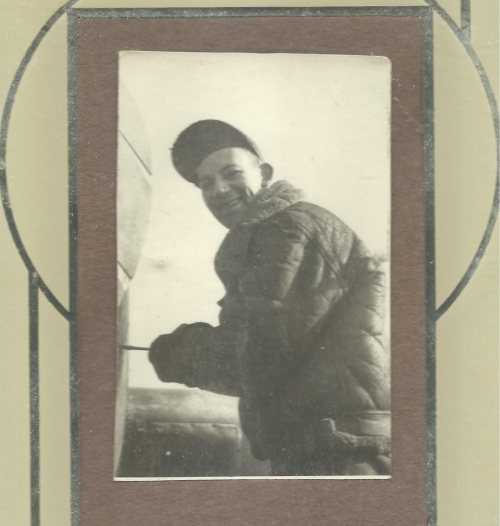
Coleman F. Sartoris mechanic on Hard Luck
Photo courtesy of Jack Sartoris