S/Sgt
Chester W. SKIBA
Assigned to the 100th Bombardment Group
Location:
Unit: 349th Bombardment Squadron
Rank:
Position: Ground personnel
Additional 100th Service Notes
Status: DUR
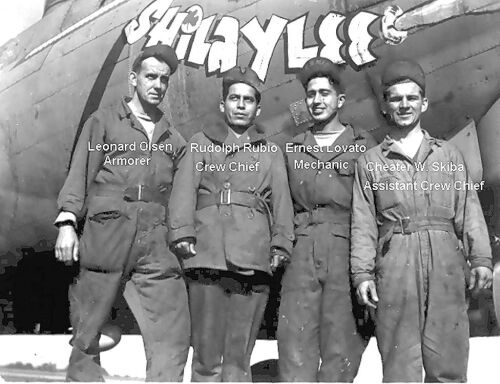
Comments: CREW CHIEF OF THE SHILAYLEE
Comments and Notes
Memo 1:
CREW

Chester W. Skiba, writing in the Fall 1989 Splasher Six


 "Whenever Shilayee flew, we were concerned about her and the air crew. As soon as they landed and Shilayee came to rest on the hardstand, we checked for battle damage and asked the pilot and crew what they needed to be serviced and repaired. If the wheels had been down, we were ready for trouble. We would work on the damage and sometimes it meant working all night if the plane was scheduled for a mission the next day. I remember one time when we spent the night replacing a fuel tank. We were putting in the last of 700 screws that held the tank panel while the air crew was pre-flighting the plane! The plane made the mission but it came back with flak holes in the same tank! So, down came the panels again. But I knew that none of the ground crew would ever let a plane go on a mission if it was not in the best possible condition.

 We loved Shilayee and the flight crew and we had a lot of pride in them. For example, I was replacing a generator on number three engine. I was standing on the landing gear and stretching to put the nuts on. I got all the nuts and pal nuts on when the last pal nut slipped out of my fingers and fell into the generator. I had been working on this for about an hour and when this happened I swore, took the generator off, found the pal nut, and replaced the generator again.

 Another example is when the number two engine was running rough at high altitude and the ground crew chief, Rudy Rubio, took a parachute and flew in the plane during a practice mission so he could check it out. The air crew, who were new, were surprised to see a ground crew man going up. They were told that they should have no doubt the ground crew said it was okay to fly. Rudy found out the ignition harness shorted out at high altitude and we replace it.

 I heard of an incident involving a new air crew who complained to an old crew about the ground crew. They almost came to blows because the old air crew would not permit any criticism of the ground crew. I remember at the Long Beach Reunion when Cowboy Roane's wife met Ray Morton, the ground crew chief of the "Big Ass Bird," she thanked him for doing a great job on the plane. She thought that was one of the reasons her husband came back She also thanked Fred Lehman because he was the assistant crew chief.

 The Shilayee ground crew did not sleep in tents on the line, although it must have seemed to the air crews that we did. We were there when they took off and when they returned. We slept in our barracks at the squadron sites, fifteen men to a  barracks. We were on 24-hour call. Because we worked on the planes at all hours of day and night, I still can fall asleep any time I have the opportunity. I have talked to other ground crew members and they all have the same ability, even after the years have passed.

 We got time off, I think it was a three-day pass once a month and a one week pass once a year, something like that. When we went on a 3-day pass we usually went to London and stayed at the Red Cross. The guys  I went with were Harold Davis and Fred Lehman, I had to go with other ground crews because only one person per plane could be gone. One our week passes we went to Aberdeen, Edinburgh, and once to Belfast, in Scotland. We still are the best of friends and have seen each other several times. We still have the same wives we married before we went into the service.

 There were usually four men to a ground crew for each plane, three mechanics and one armorer. When there were big repairs, other men would help us if their plane was okay.

 We had breakfast, lunch, and dinner in the mess halls. Most of the meals were okay. There were a lot men to feed, and the mess crews did a good job with what they had. Some of the food was not so great, such as green powdered eggs or what they called  lamb stew. The other meats were put on your tray, one piece per man, but if it was lamb stew - we called it goat meat - we could have all we wanted. When we were walking to the mess hall, we asked those leaving what was for dinner, if they answered 'Ba-a-a-a', we knew it was lamb stew!

 Once a month we got our rations, candy, gum, cigarettes and some other goodies. Since I didn't smoke, I sold my cigarettes for the price I paid. In the evening we went to the PX Pub to get an English beer called 'Whitbread'. It was potent, something about 12 percent, as I remember. One guy in our barracks, - his name was Montgomery and he came from Oklahoma - said that if you poured a little Whitbread on a rabbit's tail, he would fight a lion. We would drink it out of our mess cups, about a pint. There was a guy who played the piano a the beer hall. I don't remember his name, but I do know that he never had to but a beer. We kept him supplied.

 We drank the beer through our teeth to keep from drinking what we called 'Polwogs', the hops. My wife and I went to England a couple of years ago, and I asked on one of the pubs about the hops in Whitbread. I told him about our Whitbread and he said we never let the barrels set long enough. He lets the barrel set for ten days. We couldn't wait that long.

 I saw guys who drank, but I never saw anyone really drunk. A little happy, but not drunk. Some of the Barrack 4 guys would come back a little happy and would have to pass Barracks 3, where I lived. Before going into their barracks, they would stop by the side of ours and get rid of some of the beer. We told them to stop watering our barracks because it was beginning to smell. When that fell on deaf ears, another guy and I took and electric plug and put one wire on it and other end to a bolt on the barracks. Then we waited.

 Sure enough, that night when some fellows on the way back  from the PX Pubs stopped to relieve themselves, 'Pow'! The 220 volts went up the stream, and 'Bang' we never had anymore trouble.

 Even after that, we still remained friends and laughed a lot about it. We all liked and respected the brass and the flight crews too. They went on the missions and we knew they were brave men. The officers were always called by their rank, yet there was a closeness that was like family.

 It was a sad day for us when the Shilayee did not return.

 Mark Wilson and his crew had flown most of their missions with her, but when they neared the completion of their 25 missions, they were given a new plane - and they went down in it. We thought Shilayee would have brought them back, just as she did a new crew on that mission. A few days later Shilayee went on another mission, and went down.

 I remember Rubio, Lovato, Alsen and I sitting on our empty hardstand, waiting for her to appear as she had done so many times before. We just couldn't believe she wasn't coming back. We waited till dark, hoping, 'Come on Shilayee'!  We knew she couldn't fly that long, but we kept hoping. We finally gave up. There was never another Shilayee."

 Chester sums up: "I was stationed at Thorpe Abbotts from the time the 100th Bomb Group arrived until the way with Germany was over. I wouldn't want to go through that again, but the memories, and the friends - and Shilayee- I will never forget.


    -30-
Photos
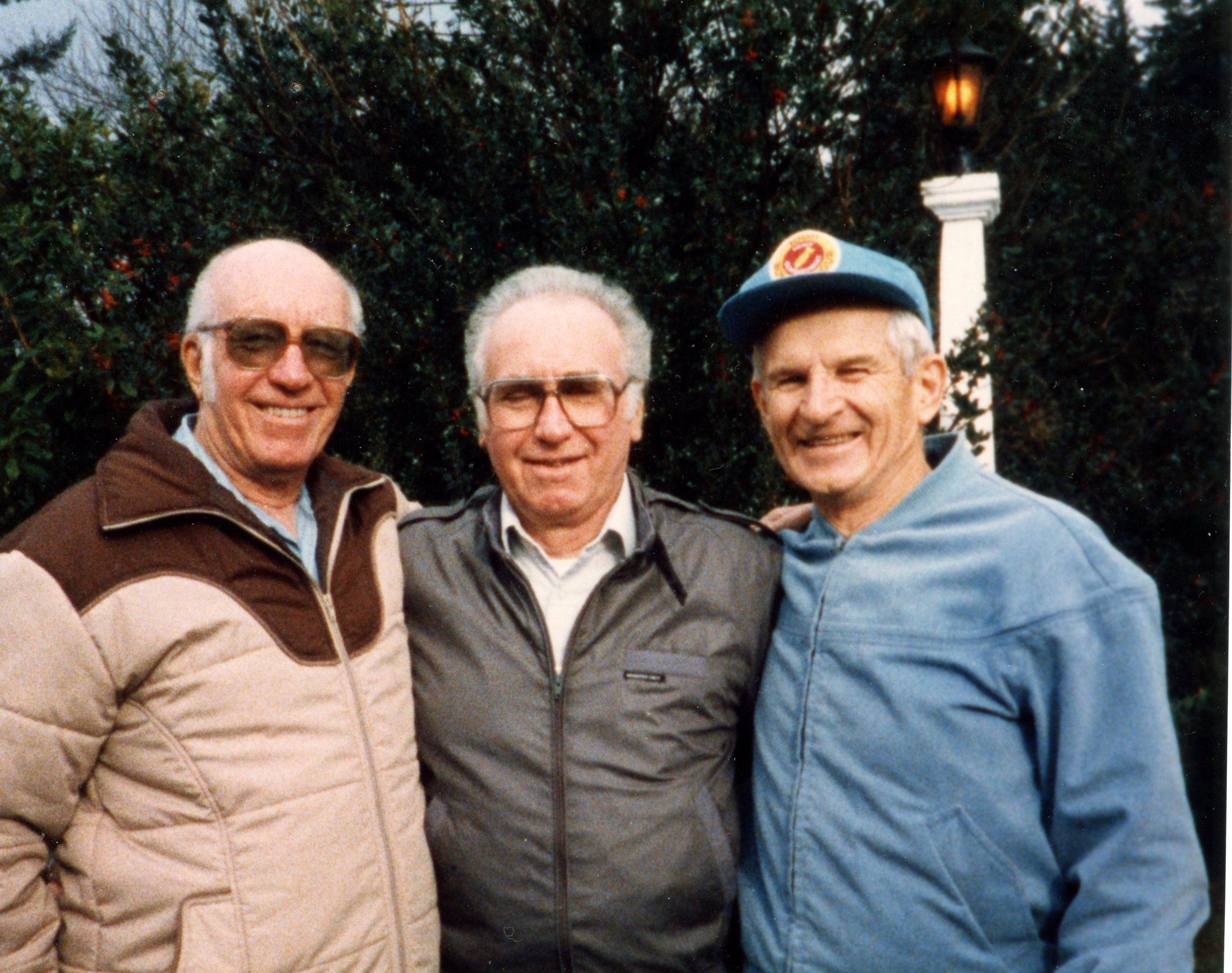
Fred Lehman, Ray Morton, and Chester Skiba
Fred Lehman, Ray Morton, and Chester Skiba (D. Bailey collection)