S/Sgt
Alvin WARNICK
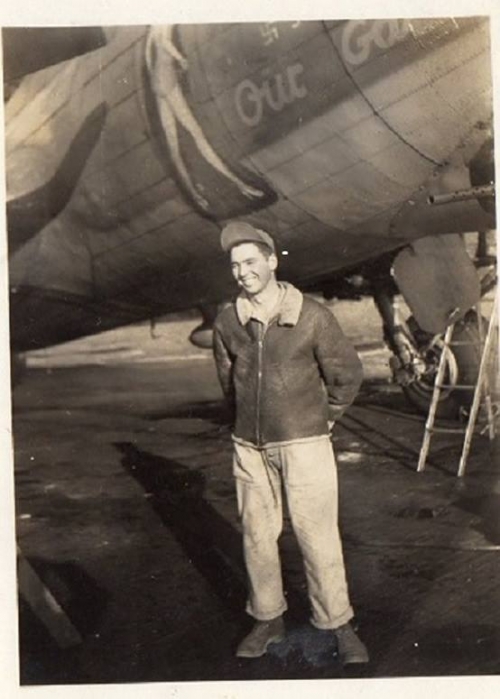
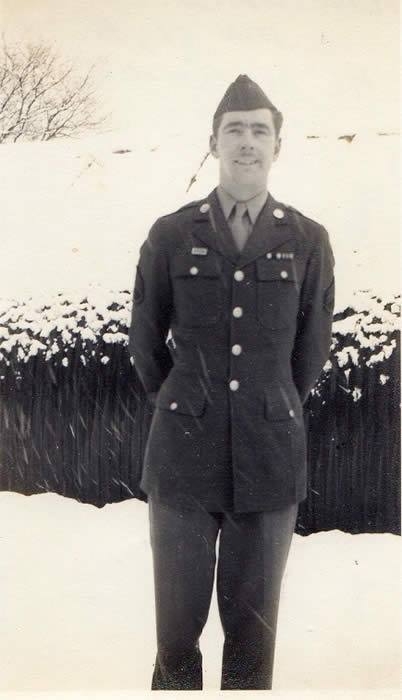
Assigned to the 100th Bombardment Group
Location:
Unit: Group
Rank:
Position: Ground personnel
Additional 100th Service Notes
Status: DUR
Comments: GP COMMUNICATION - RADAR COUNTER MEASURES
Comments and Notes
Memo 1:
Alvin Warnick is a founding member of Oak Hammock at the University of Florida and a retired UF Professor of Animal Science. A widower, he is the father of two daughters and a son. He has seven grandchildren and seven great grandchildren.


On December 7, 1941, I was in Chicago as a guest of Swift & Company, the meat-packing firm. I was one of 30 land-grant students, including E. T. York [now Chancellor Emeritus of the University System of Florida]. We students got to Chicago because the company liked our essays on meat-packing. I was there three days, December 5 – 8, 1941. I’d never even heard of Pearl Harbor. Like everybody else, I was upset about the Japanese attack. I realized it was war for the U.S. and I’d be involved. In June of ’42 I graduated from Utah State University with a degree in Animal Science. Before I graduated, I had a scholarship to the University of Wisconsin.

I was trying to earn money for graduate school and started working for the Army Corps of Engineers on the camp project to relocate Japanese. They had been living on the West Coast. My job was checking in lumber and building materials shipped in from the Northwest. The materials came into Delta, Utah, by rail. After they were checked in, they were hauled to the relocation camp in the Topaz Mountains about 15-20 miles away.


On September 4, 1942, I volunteered for induction. Most of us were anxious to be involved in the war. We went in the service to do a job and get it over with. Some misrepresented their age to get in. I scored high enough on the test at the Fort Douglas Induction Center to be assigned to the Army Air Corps at Traux Field near Madison, Wisconsin. My hearing wasn’t good enough for radio operator and I became a radio mechanic. We repaired communication equipment in the radio school. It wasn’t long before I was shipped to radar school in Boca Raton, Florida. We learned how to operate and repair IFF radar equipment [Identification Friend or Foe]. We were sent from Boca Raton to Atlantic City where we got basic infantry and overseas training.  I think we realized the dangers of war. If I go overseas, will I ever come back or not! But I started looking forward to the adventure. I really wasn’t that worried. I felt God was watching over me. I have always been a practicing Mormon. I prayed each day as if I was at home. I take a little book of Mormon with me at all times. Young Mormons have the opportunity to get a patriarchal blessing. That blessing states your lineage and blesses your potential. The blessing says if I’m called to military service, serve willingly, and keep all the Mormon Commandments that I will be protected. That blessing and my faith gave me a good feeling of security to meet whatever challenges I had to face.


In April of ’43 our group that had trained at Atlantic City sailed from New York to Liverpool, England, on the USS Mariposa. The trip took 9 days. We were trying to dodge German U-boats. We took a tortuous route, went south then north. Fortunately we didn’t run into any U-boats. We were assigned to the 8th Air Force and sent to radar school in South Kensington, England. We lived in a Red Cross facility near the school. I was very impressed with the RAF students. The British were kind, very helpful, and their instruction was very good. On weekends, the British showed us sites in London and along the Thames River.


From the radar school we were assigned to the 100th Bomb Group located near the town of Diss in East Anglia. We were assigned to barracks according to our job. We worked in a shop. At first there were only four of us radar mechanics, one per squadron. By war’s end there were 90 radar mechanics. Our job was routine repairing and training of navigators to use the GEE Box for short-range navigation, 300-500 miles. We never flew. Our job was to teach, install and repair the equipment in the B-17 bombers.  We became close to the people we worked with: the mechanics, navigators, and radiomen. We didn’t have much contact with the pilots. I’m sure the pilots had fears. In some of the early missions 30 planes, each with 10 men, would be sent out; only 20 returned. Each pilot had to fly 25 missions. They were looking forward to finishing their missions and getting out of harm’s way. They ranged in age from 19 to 25. Some were no more than 19 or 20. Flying a B-17 was dangerous work and took quite a bit of courage and daring. The young pilots tended to be more daring. On D-Day we didn’t lose a plane. Some of our crews flew three missions on D-Day. They’d fly over drop their bombs, come back, and fly another mission. By 1944 the Germans were running out of steam. I have a friend named Robin Baxter. Robin’s father was Rudolf Baxter who came here after the war. Rudolf was drafted into the German Army and flew a Messerschmitt night fighter. Rudolf said the last five or six months of the war the Germans had planes but no fuel. He died a couple of years ago.


How much evidence of the war’s destruction did you see?

I saw planes coming in badly shot up. Some came back with only one engine working. It was a miracle they could fly at all. The worst thing I saw was a plane with a hole three or four feet in diameter. All that was left of the radio operator was blood and body parts. One morning we were out on the flight line and heard the red alert. We ran to a ditch. A German plane was aiming for the runway but his bomb hit off to the side. Our planes were still able to take off. Toward the end of the war, the Germans started launching “buzz bombs” toward London. The buzz bombs were unmanned missiles the Germans launched from Holland. I never saw any buzz bombs, but I sure heard them. They made a hideous noise. As long as you could hear them, you knew the bombs were on their way to someplace else. Our shelters were made of concrete and brick, but we didn’t use them much.


I was in the Army over three years. Here’s the uniform I wore. It’s still in good shape. I made Tech Sergeant. These stripes represent 2 ½ years overseas. I got the ETO medal [European Theatre of Operations] and the Good Conduct Medal.
Memo 2:
Alvin C. Warnick

11/15/1920 - 05/07/2017

ALVIN CROPPER WARNICK


Alvin C. Warnick was born November 15,1920, along with a fraternal twin, Calvin. His parents, Parley Peter Warnick and Grace Cropper, were livestock farmers near Hinckley, Utah and Alvin, Cal, and their older brothers, Waldo and Marion, grew up as “Four Boys on a Farm”. He attended public school in Hinckley, graduating in May, 1938.  He became an Eagle Scout and was active in school, church and sports.


Alvin attended Utah State University and graduated in June 1942 with a degree in Animal Husbandry and was offered a fellowship at the University of Wisconsin. He joined the Army Air Corps in Salt Lake City. He was one of the first radar technicians in the military receiving training in both the U.S. and England before being assigned to the 100th Bomb Group in the 8th Air Force where he supported combat missions from 1943 to 1945.


After the war Alvin earned his Masters and PhD degrees in Animal Science and Genetics in 1947 and 1950, respectively, from the University of Wisconsin in Madison. . His first teaching position was at Oregon State University in Corvallis for four years followed by a thirty-seven year career as an Animal Physiologist at University of Florida Department of Animal Science.


He co-authored four books and published over 350 research papers, either as sole or joint author.  He also did sabbatical research in Argentina for the Food and Agriculture Organization of the United Nations in 1962-63, and further research in Brazil in 1977 and in Ethiopia in 1986.


Alvin had 70 Masters and PhD students and was a graduate and undergraduate advisor to countless more. He also served as Assistant Chairman of the Animal Science Department at the University of Florida.   After retirement in 1990 he continued as an active contributor and participant at beef cattle workshops throughout Florida, gave lectures in the College of Veterinary Medicine and participated in international conferences in Canada, Brazil, Australia, Sweden and Hungary.


Alvin was elected a Fellow in the American Society of Animal Science (1984) and inducted into the Florida Agricultural Hall of Fame in 2015.


He was also a member of the University City Kiwanis, Atheneum Society, and the Oak Hammock Singers. He was a member of Alpha Zeta, Phi Kappa Phi and the American Society of Animal Science. He was an active member of the Church of Jesus Christ of Latter-day Saints, serving in bishoprics and on church high councils in both Jacksonville and Gainesville.


He married Barbara Webster of Oshkosh, Wisconsin, in August, 1947. Barbara passed away in May, 2003 after almost 56 years of marital bliss. After her death Alvin became a proud resident of the Oak Hammock community, where he served as honorary “Mayor”.


Alvin had a great love of growing citrus and sharing the fruit with friends and neighbors. He was famous for his ability to connect with people. Alvin was a great friend to people from all walks of life, young and old.


Alvin is survived by his son, John A. Warnick (Carol) of Denver, Colorado, his daughter Ann Warnick of Asheville, NC, and his daughter Mary Warnick Dargan (John Dargan) of DeLand, FL. Alvin also has seven grandchildren and 15 great-grandchildren. He was preceded in death by his parents and three brothers, Waldo, Marion, and Cal.