Cpl
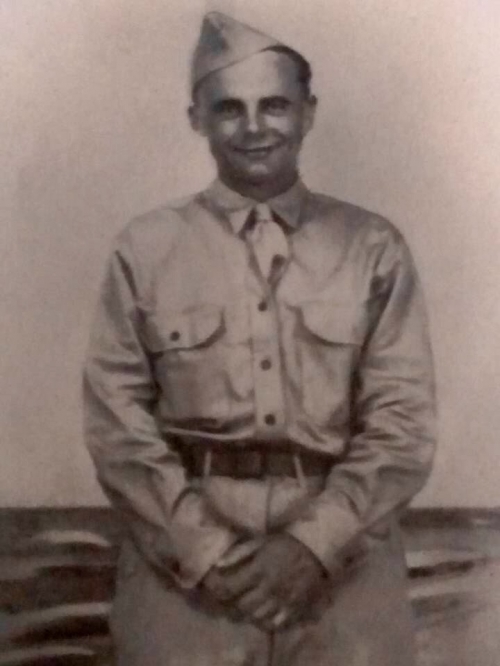
Shirley B. ELDRIDGE
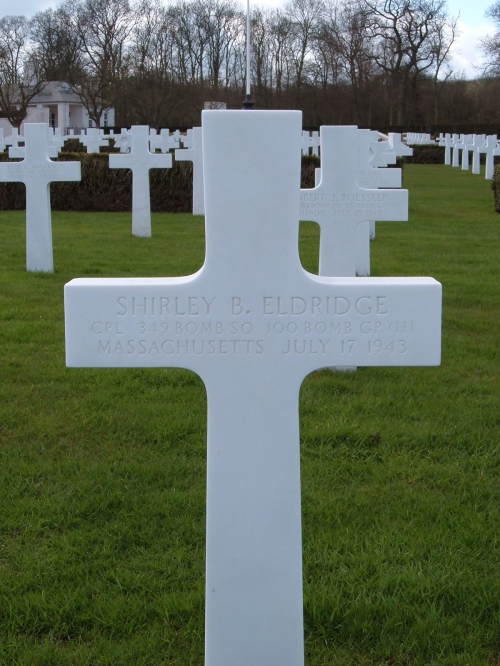
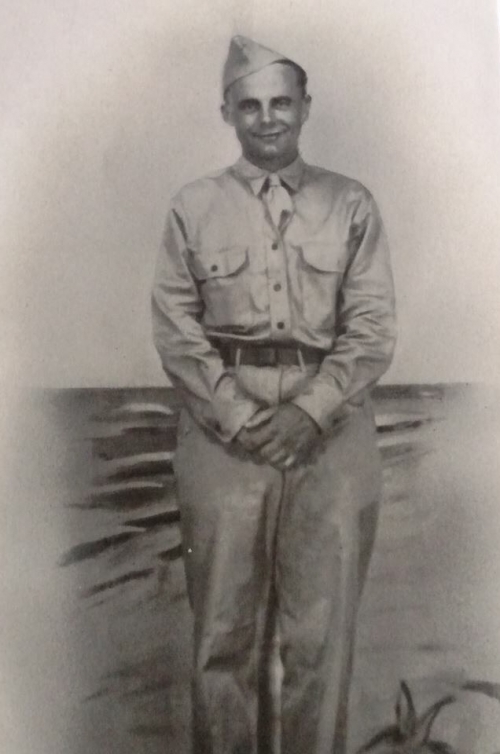
Army Serial Number: 31076294
Assigned to the 100th Bombardment Group
Location:
Unit: 349th Bombardment Squadron
Rank:
Position: Ground personnel
Additional 100th Service Notes
Comments: Killed When he backed up into prop of Squawkin Hawk.. Nickname was "Bunny"
Comments and Notes
Memo 1:
"The ninth of August was a day to try to forget but fifty years have done little to dim the vision. Our plane was still in the docks and we were to fly practice formation. Sammy Barr offered his plane for my crew's use. I would have declined the offer of Torchy, but since Sammy was Operations Officer, I had not much choice. The plane was on hardstand number 20, which was part of a combination of four parking places. Reeder was in number twenty-one parking place and was to lead our element on the flight. We had started Torchy and done our preliminary warm up but had to wait for Reeder to taxi past. A man on the ground just beyond my number one engine propeller was looking up at me as if he had something to say. I motioned toward Reeder's plane taxing out but instead of his turning to look, he backed up. The prop of Reeder's number four engine caught his head and part of it, with his cap was tossed toward us. He dropped like an empty sack. We taxied out behind Reeder and flew our six hour flight silently as if none of us saw the catastrophe. On return, we learned the name of the victim. It was written out as Eldridge, Shirley B.............. Owen "Cowboy" Roane


(The entry above was taken from Owen Roane's book  "A Year in the Life of a Cowboy".  A chilling account and remembrance of a very sad moment a young man carried for all his life!  There are a few corrections to the above as  actual dates of an event are sometimes  clouded by time.    It is confirmed that "Bunny Eldridge was Killed in a accident on July 17, 1943 and not Aug 9, 1943. He backed up into  a Propeller from Sumner Reeder's plane-"Squawkin Hawk" and was killed by..  Owen Roane was not on a Practice mission but an actual mission to Hamburg as was Sumner Reeder...MPF)
Memo 2:
                                A Casualty of War

                                 By Carlo D'Este

                               from Armchair General


During World War II the United States lost an estimated 291,557 killed in action. Another 113,842 are thought to have died for other reasons than combat. With such staggering statistics, it’s not surprising that few American families emerged unaffected in some way by the war.


My wife’s family was no exception. Like millions of other young Americans who served in World War II, her uncle was a member of the Army Air Corps.

His name was Corporal Shirley Barton Eldridge, and he served as an airplane mechanic in the 349th Bomber Squadron, 100th Bomber Group, Heavy (nicknamed “The Bloody Hundredth”). The unit was part of the Eighth Air Force and flew B-17 bombers, based at the East Anglian town of Thorpe Abbotts, Norfolk.“Bloody” was an apt word to describe the sacrifices made by the courageous airmen of the 100th Bomber Group who flew daily missions over Nazi Occupied Europe and suffered very heavy losses of aircraft and crews.


Corporal Eldridge was one of those who never came home.

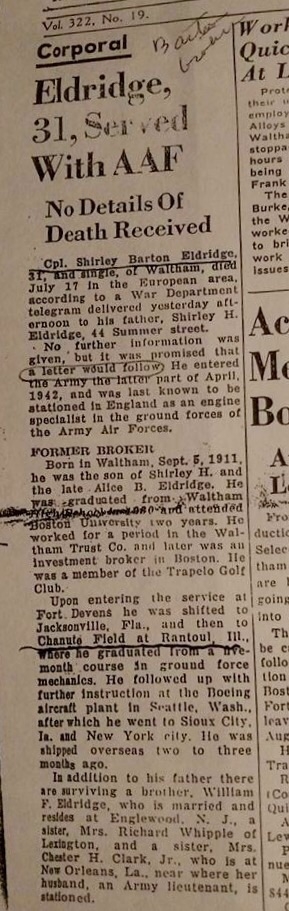
Like most casualties in war, the circumstances surrounding the death on July 17, 1943 of thirty-one year old Shirley Barton Eldridge (named for his father and nicknamed “Bunny”), is unclear. The family knew that he was briefly trained as an aircraft mechanic and also had had some additional instruction from Boeing Aircraft in Seattle before being shipped overseas and joining the 349th Squadron.


The 349th had only been operational in England about a month when Corporal Eldridge was killed. His death was apparently accidental.The usual method of notification during the war was a telegram to the next of kin from the War Department, announcing the death of the serviceman or woman. A brief article about Corporal Eldridge’s death appeared in the local newspaper in Walpole, Massachusetts but nothing more has ever been learned about his accident or how it occurred, although the family always believed he was killed by an aircraft propeller.


In 2006, while I was researching Warlord, my biography of Winston Churchill’s military life, my travels brought me to the archives of Churchill College, in Cambridge, England.

Occasionally, my wife and I had talked about her uncle, and when I asked where he was buried she said it was in the American military cemetery in Cambridge. Some research prior to my trip revealed that the cemetery was situated less than a mile from Churchill College.

I arrived in England determined to find time in my schedule to visit his grave. Before boarding a train to visit friends in Yorkshire after completing my last day of research, I left my luggage with the college porter and summoned a taxi to take me to the cemetery.


The deputy superintendent was the only cemetery official on duty that afternoon and, because my time was somewhat limited, it was fortunate there were no other visitors with whom he had to deal before assisting me. I told him of the purpose of my visit, but when I gave him Corporal Eldridge’s name, it failed to show on his computer. This was the first UK trip that I had a cell phone, so I immediately called my wife, and thankfully she was home to verify the right order of his name, which it turns out, was wrong. With the location of his grave resolved, the deputy superintendent asked if I’d like to have a photo of his gravestone, and having no camera with me, readily agreed. After a few minutes he emerged from a storage area of the visitor’s center with a camera and a bucket containing wet sand.


We found Corporal Eldridge’s white marble cross in Plot C Row 4 Grave 14, one of the 3,812 that comprise the only permanent American military cemetery in the United Kingdom.

The cemetery is also the final resting place of 128 other members of the 100th Bomb Group.

The deputy superintendent explained the reason for the sand (specially imported every few months from Omaha Beach, Normandy) is that it is rubbed into the engravings on the cross so that its beige color will enhance Corporal Eldridge’s name, rank and date of death.

It was suggested that I spend the next half-hour or so on my own while the photograph was developed and printed. As I stood in silent contemplation at the grave of a man neither my wife nor I had ever known, I thanked him for his service and hoped that the end of his life had been mercifully painless.


Spend some time among the graves of those who have served this nation and you come away with an almost overwhelming sense of sadness at the futility of war that brought these men to this place of honor, here to lie for eternity as comrades.

Those who glamorize war should instead visit Cambridge, and other burial grounds like it, where the realities of the cost of war are forever manifest.

During World War II, as indeed is the case in all wars, there are a great many who are lost and are never found. Within the cemetery, adjacent to a reflecting pool, is a large, very long wall called The Tablet of the Missing. Among the 5,127 names inscribed here are those of famed bandleader Alton Glenn Miller, and Joseph P. Kennedy, Jr., a pilot, and the older brother of a future president, both of whom were lost over the English Channel and never found.

After strolling through the cemetery and stopping from time to time to read the inscriptions on a number of crosses and several of the eighty Stars of David, I visited the Tablet of the Missing, and the memorial building, before returning to the visitor center where the deputy superintendent presented me with a package containing a photograph of Corporal Eldridge’s grave, a British and American flag, each attached to a small wooden stick, and an information booklet about the cemetery.


I left deeply appreciative of the gesture and the assistance rendered during my visit. It is what the men and women of the American Battle Monuments Commission (ABMC) do – and do exceptionally well each and every day of the year except Christmas and New Year’s. In this age of wasteful government spending and interminable wrangling by clueless politicians, the ABMC stands out for its efficiency and its commitment to honoring those buried or memorialized at their twenty-five permanent cemeteries outside the United States and their twenty-six memorials, markers and monuments.


According to the ABMC website:

“Presently there are 124,908 U.S. war dead interred at these cemeteries to include 30,922 of World War I, 93,236 of World War II and 750 of the Mexican War. Additionally 14,907 American veterans and others are interred in the Mexico City National Cemetery, Corozal American Cemetery and Clark Veterans Cemetery. Another 94,000 names of the missing are memorialized at the World War I and II cemeteries overseas and at the East Coast, West Coast and Honolulu Memorials in the United States: 4,452 names from World War I; 78,979 names from World War II; 8,200 names from the Korean War, and 2,504 names from the Vietnam War.”


“Bunny” Eldridge was one of a great many Americans to die of non-combat causes during World War II. His death may not have been heroic but it was nevertheless just as sad and as much of a sacrifice as that of those killed in combat.

Before leaving the site of his grave at Cambridge, I said a quiet prayer for his eternal soul, and though a bit out practice, rendered a salute to honor his service to America.

God bless them all.
Burial Information:
Plot:
C
Grave:
14
Row:
4
Cemetery:
Cambridge Military Cemetery