Fred WAGNER
Assigned to the 100th Bombardment Group
Location:
Unit: 351st Bombardment Squadron
Rank:
Position:
Beginning Date of 100th Service: Unknown
Time of Service at Thorpe Abbotts: Unknown - Unknown
Additional 100th Service Notes
Comments: ORDNANCE SECTION - ARMOURER
Comments and Notes
Memo 1:
Preparing the 100 th For Combat – The Service of Fred Wagner (From Splasher Six in 2019)


By Matt Mabe, 100 th BG Historical Team and Board of Directors


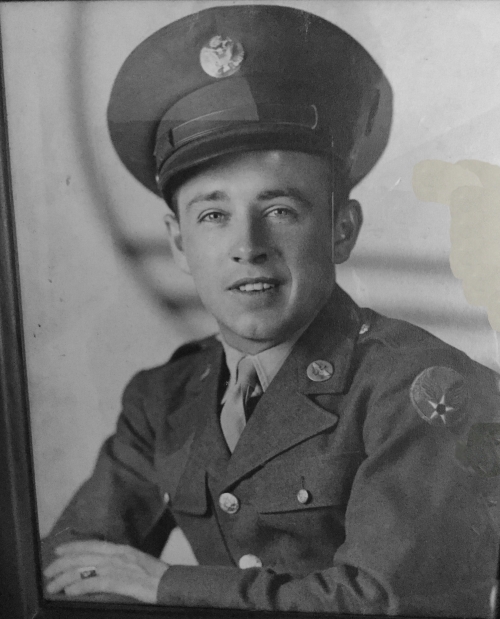
Fred E. Wagner grew up in Columbus, OH, and graduated from high school in the summer of 1941.

Shortly thereafter, he started working at the Curtis-Wright Aircraft Company, a job which served as a

formative education for Wagner as he learned about airplane construction and maintenance. The

Columbus plant where Wagner worked built the Curtiss SB2C Helldiver for the US Navy. When war broke

out in December 1941, Wagner wasted no time in enlisting. “I was at the age where I was very worked

up about what the Japanese had done”, recalled Wagner.

While in training in Salt Lake City, Utah, Wagner was approached by an officer who recognized that he

had airplane maintenance experience. When the officer advised there were openings in this field and

that skilled men were needed, Wagner accepted the offer and was subsequently sent to Kearney Army

Airfield in Nebraska. Here he was assigned to the original cadre of the 100 th Bomb Group. At this time

the squadrons were in process of being built up and trained. Wagner was assigned to the ground

echelon of the 351 st Squadron.

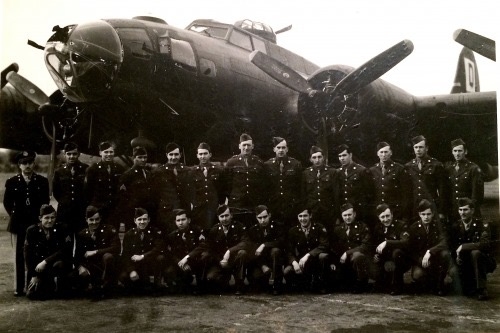
100 th BG ground personnel shipped out for overseas duty in May 1943, and Wagner began keeping a

diary of the significant events that occurred. At Thorpe Abbotts, Wagner was assigned to the Station

Ordnance section, and he reported to Lt. Eugene Craft, the ordnance officer for the 351 st . The men

assigned to this group were in charge of supplying, handling, and loading the bombs into the planes

prior to a mission. When the base received word that a mission was scheduled for the next morning,

Ordnance was immediately alerted. The four squadron ordnance sections were called out to load bombs

and while the Station Ordnance men set the fuses.

On the outside of the Orderly Room in the 351 st area, there was a red and green light denoting whether

there would be a mission the next day. When there was a mission, Sgt Phillip Goodwin would let Wagner

and the other ordnance personnel know what the bomb load would be for that day. Now awake and

with instructions in hand, Wagner and the others would get the truck with its bomb trailer, head over to

the bomb dump and pick up the bombs. Each bomb was carefully rolled up a wooden plank and placed

onto the trailer for transport. After the bombs were collected, Wagner remembered they would then

stop by a Quonset hut to pick up the fuses. As this activity took place during the late-night and very

early morning hours, Wagner said “it was always dark when we were working, and we had a job to do –

no matter what the weather or conditions were”. Ordnance personnel worked all night seven days a

week to equip the B-17s with their bomb load, and “we all knew we better have them loaded by

morning,” said Wagner. Each of the Ordnance men used standard issue flash lights to see while working,

which could be clipped to their coveralls to keep their hands free.

Ordnance personnel worked very closely with the B-17 ground crews as communication was important.

For example, Fred knew 351 st Crew Chief Dewey Christopher and they would talk with him and other

ground crews as they worked. Wagner and a couple other Ordnance men would load the bombs onto

the assigned plane, and then move on to the next one if additional help was needed. Wagner worked

on several planes during the war, including Piccadilly Lilly. Wagner recalled, “we put the fuses in and the

fins on. One man went up inside, and would open up the bomb bay doors. We would pull the trailer up

under the bomb bay, and then go to work.” After loading the bombs, they pushed the switch to close

the bomb bay doors. Next the armament personnel loaded the 50 caliber machine guns and made the

guns ready to fire. The Ordnance team and the ground crews worked in coordination with each other to


get the plane ready. When asked about the role of the Ordnance personnel, Dewey Christopher echoed

Wagner’s comments, citing the importance of “teamwork to get the planes ready for the next mission.

Ordnance would arrive at the hardstand after we had completed our maintenance of the plane, and the

fuelers would begin their work after the plane was armed. All of those guys worked really hard; I was

happy to know them.”

Wagner noted that most of the bombs they loaded were 500lb bombs, and it took twelve 500lb bombs

to fully load a B-17. In his diary, Wagner also kept a regular record of the weight and quantity of the

bombs loaded for each mission, and he took particular joy when he was able to record an entry stating

“no losses” or “all returned safely.” “It was fairly easy to load the fuses and safety wires, and the fuse

was ready to go once the fin came off the bomb,” recalled Wagner. Each bomb had a cotter pin to keep

the bomb safe in the air, and a member of the crew would pull the pin before they got over the target.

Also, there was an idea to use safety wire to tie to the fuses together from each bomb; when the doors

opened, the safety wire stayed attached to the plane and the wire would essentially arm each bomb

instead of the cotter pin. Early in the war, the planes would sometimes bring unused bombs back which

had to be unloaded and then taken back to the bomb storage site. However, later in the war they

started using a fuse that could not be removed once inserted into the bomb, so the planes didn’t bring

bombs back to base.

Wagner remembered that in a few instances, the fuses were acid fuses, which was another reason why

you could not bring the bombs back. Some acid fuses wouldn’t explode immediately until the acid

ignited the fuse. Delayed acid fuses would chew threw the fuse and then it would explode, often several

hours after it hit the ground. There was also a fuse that had a little ball bearing and the fuse was

screwed in, and this ball bearing fuse would prevent the Germans from disabling it. The nature of the

mission would dictate the type of bomb that the Ordnance personnel would load. In some instances,

they used fragmentation bombs for targets like rail yards, and in a couple instances they used napalm

bombs. Wagner believes that specialty bombs were used for the November 16, 1943 mission targeting

the German’s heavy water production plant in Rjukan, Norway.

Wagner held a great deal of admiration for the air crews of the 100 th Bomb Group, and he often watched

to see the planes as they returned from missions. One buddy of Wagner’s from the enlisted men’s club

was a ball turret gunner who was killed on a mission. “I felt very sorry for the men we lost, and it was

hard to watch when only a few planes would come back to the base.”

Looking back, Wagner had several memorable experiences during his time at Thorpe Abbotts. One time

he had an opportunity to fly along on a training flight over Northern England while the pilot gained some

practice hours. Another experience that really stands out was when 8 th Air Force Commanding General

Jimmy Doolittle visited the base, and Wagner had him sign his diary.

Wagner is also proud of the role he played in loading bombs in preparation for the June 6, 1944 D-Day

missions. In his journal entry from that day, Wagner wrote that “ships took off at 3:10 AM to bomb

France before the invasion. Another mission loaded at 10:30 AM – 500lb and 300lb bombs. Most of the

bombs were dropped.” On June 7, 1944, Wagner noted that the ordnance crew “unloaded at the ship at

1:30 AM this morning, and we had loaded 10 trailers with 2,000 pound bombs. The invasion is coming

off as good as can be expected. We then loaded 10 ships with two 2,000 pound bombs in each.” Wagner

also took pride in his involvement preparing the 351 st Squadron prior to the second Russian Shuttle

mission. “September 14, 1944: Not much to do today as our ships are loaded for the shuttle mission to


Russia with supplies for the Polish patriots. We helped ready each plane, and there were canisters full of

guns, ammo, and medical supplies for the Polish underground troops.”

Wagner remained with the 100 th until after V-E Day in May 1945, and was subsequently transferred to

work at a fighter base for a few months. Wagner returned to the US aboard the Queen Mary in

September 1945, and was home for about a week before being discharged.

After leaving the military, Wagner went to work at North American Aircraft in Columbus, where he

worked on planes for the next 10 years. Wagner spent the majority of his career with the State of Ohio.

“I still love aviation, and the fly boys are always on my mind; I can’t explain how much I admire them.

They put their life on the line every day. They deserve accolades, but they couldn’t have done it without

the ground crews.” When Wagner spoke of his work loading bombs for the 100 th , you can hear the

emotion in his voice, and Wagner was pleased that people have begun to recognize the role that the

ground echelon played. Over the years, Wagner spoke to school children about his service during World

War II.

Reflecting on his time with the 100 th , Wagner commented, “when I first came home I was just another

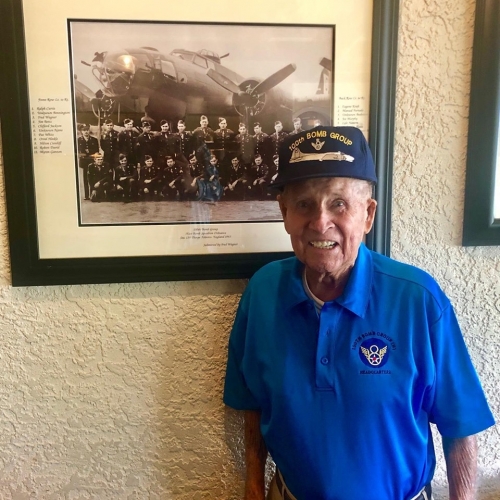
face in the crowd; now when I wear my 100 th Bomb Group hat I often get recognized and folks thank me.

That gives me a lot of pride.”

Author’s Note: Time was of the essence in preserving Fred’s story. I was privileged to talk with Fred over

the phone, where he provided the above recollections of his service. I had hoped to talk with Fred again,

though sadly he passed away on September 23, 2019. Shortly after Fred’s passing, I spoke with Dewey

Christopher, who was honored to offer comments on the importance of the Ordnance team. Dewey

passed away shortly thereafter. Fred and Dewey will not be forgotten, and they both helped to ensure

the legacy of the 100 th Bomb Group ground echelon will live on.
Photos
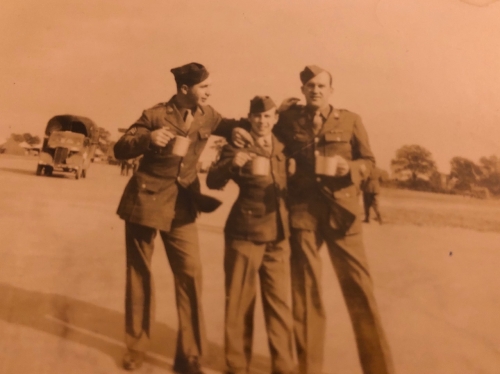
Fred Wagner
Fred Wagner is standing in the center, the other personnel are unknown (courtesy of the Wagner family)