Lt
Louis R. JAEBKER
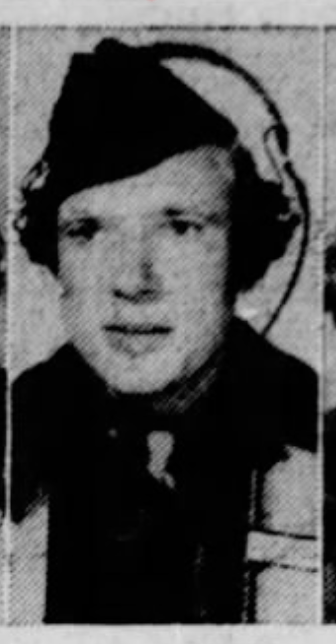
Louis Jaebker
Hometown During Time of Service: Fort Wayne, IN
Assigned to the 100th Bombardment Group
Location:
Unit: 349th Bombardment Squadron
Rank:
Position: Bombardier
Beginning Date of 100th Service: Unknown
Time of Service at Thorpe Abbotts: Unknown - Unknown
Additional 100th Service Notes
Status: CPT
Comments: 4 MAR 44 BERLIN (LEAD BOMB ON THIS MISSION)
Media Articles
Use your thumb to scroll through the results box below.
| Media Item | Type | Page | Volume/Issue | Broadcast Source | Time | Description | File |
|---|---|---|---|---|---|---|---|
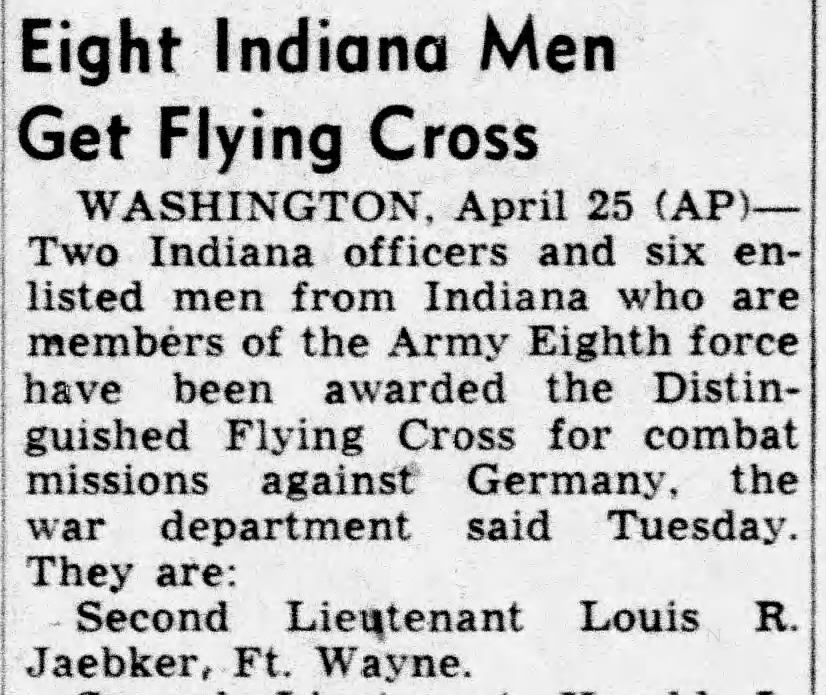
| Louis Jaebker DFC | The Indianapolis News April 25 1944 | 12:00 am |
Comments and Notes
Memo 1:
CREW (see graphic fld)


   Lt Herbert G.Devore         P         KIA    15/3/44  Brunswick

    Lt Jerry Felsenstein          CP       CPT     6/3/44  Berlin

    Lt Burton M.Joseph         NAV     POW  15/3/44  Brunswick (Severely burned)

    Lt Louis R.Jaebker           BOM     CPT     6/3/44  Berlin

 T/Sgt Harry S.Lenk            ROG      CPT

 T/Sgt Harrison L.Longhi      TTE      POW  15/3/44 Brunswick

 S/Sgt Nicholas Delcimmuto  BTG      KIA    15/3/44 Brunswick

 S/Sgt John J.Barry             RWG     KIA    15/3/44 Brunswick

 S/Sgt Darrell R.Dickenson    LWG     KIA    15/3/44 Brunswick          A/C #42 39934  "MY ACHING BACK"

 S/Sgt Knute Knudson           TG     CPT


350th Sqdn. Crew.. On 15/3/44, Lt.Martin TashJian was flying in the tail as an observer for the Command Pilot and was KIA. Capt.Robert Peel,who had flown overseas with the 100th Group as a bombardier without a crew, was flying as BOM and became a POW. Capt.Roland G. Knight,a pilot who had flown over with the Group unassigned to a crew, was this day flying as Command pilot. He was KIA.

This was the 25th mission for most of the crew.


A T/Sgt Robert D.Longworth was flying as ROG in the place of Harry Lenk and was KIA  Longworth was from the original crew of Martin Tashjian which had been involved in a crash at Thorpo Abbotts on 4/12/43. Both he & Tashjian had been injured in that crash and the crew , spending considerable time in the hospital.


MISSION LOG OF THE HERBERT G. DEVORE CREW


   NOV 03, 1943  WILHELMSHAVEN

   NOV 07, 1943  DUREN

   NOV 19, 1943  GELSENCHIRKEN

   NOV 26, 1943  PARIS - PAS De CALAIS

   NOV 28, 1943  NORTHWESTERN GERMANY

   DEC 05, 1943  BORDEAUX  -  FRANCE

   DEC 15, 1943  EMDEN

   DEC 16, 1943  BREMEN

   DEC 20, 1043  BREMEN

   DEC 22, 1943  MUNSTER

   DEC 24, 1943  MILITARY TARGET - FRANCE

   JAN 03, 1944  KIEL

   JAN 05, 1944  NEUSS-BAUER & SCHAURTE WERKE

   JAN 06, 1944  LUDWIGSHAFEN

   JAN 10, 1944  OSNABRUK

   JAN 20, 1944  SAINT OMER - FRANCE

   JAN 25, 1944  WESTERN REICH

   JAN 26, 1944  FRANKFURT

   JAN 30, 1944  BRUNSWICK

   FEB 03, 1944  FRANKFURT

   FEB 12, 1944  PAS De CALAIS - FRANCE

   FEB 24, 1944  ROSTOCK - POLAND

   FEB 25, 1944  REGENSBURG

   MAR 04, 1944  BERLIN - GERMANY

   MAR 06, 1944  BERLIN - GERMANY

   MAR 15, 1944  BRUNSWICK - SHOT DOWN BY FLAK


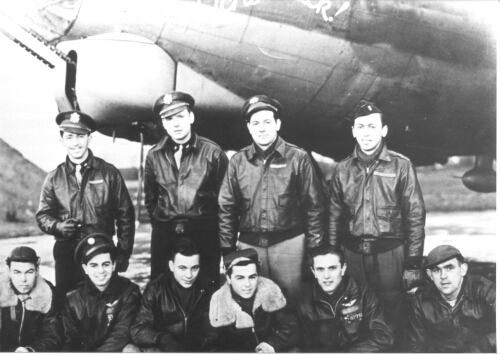
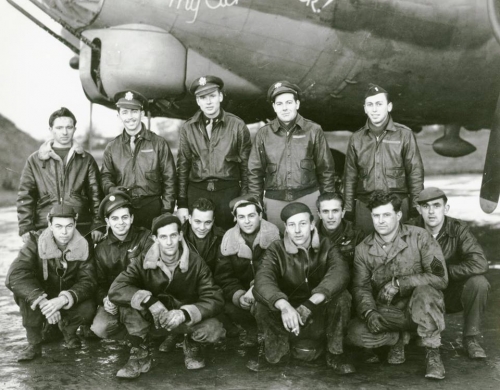
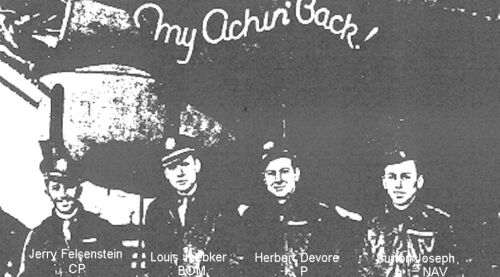
Crew Photo ID

Lt. Herb Devore Crew in front of 239934 My Aching Back!  Standing from left: Jerry Felsenstein (Copilot), Herbert G. Devore (Pilot), Louis R. Jaebker (Bombardier) and Burton M. Joseph, (Navigator, one of the 100th's greatest lead Navigators); Kneeling from left:Darrel Dickenson (Left Waist Gunner), Nicholas Delcimmuto (Ball Turret Gunner), Harry S. Lenk (Radio Operator),

Harrison Longhi (Top Turret Engineer),  John J. Barry (Right Waist Gunner) and Knute Knudson (Tail Gunner).


RECORD OF THE 15 MAR 44 BRUNSWICK MISSION OF THE H.G. DEVORE CREW

by BURTON M. JOSEPH, NAVIGATOR


It was 15 March 1944, and we were on our 25th mission with the "Bloody 100th" Bomb Group, flying lead plane for our group in the 13th Combat Wing of the 8th Air Force. This was the last mission required to complete our tour of duty. Our co pilot and bombardier flew their 25th, with another crew, on the 6 March mission to Berlin and were waiting for us back at Thorpe Abbotts so that we could all return to the States together.


I was a First Lieutenant and navigator of our B 17, "My Achin' Back," and our target was Braunschweig, Germany. Just past the IP (Initial Point of the bombing run), we took a direct hit from what I believe was an 88 mm "flak" shell.


The shell exploded in the hatchway directly below the cockpit and probably ruptured the oxygen tanks and ignited the fuel transfer system. There was a blinding flash of flame behind me and I knew we were "done."


After a moment's hesitation, I ripped off my flak vest, which in turn pulled off my oxygen mask. I then hooked my parachute to the chest harness I was wearing, turned and dived out the already open escape hatch. I was immediately behind Harry "Shorty" Longhi, our top turret gunner/flight engineer. Captain Bob Peel, who was flying with us for just that mission as lead bombardier, exited behind me. The other seven members of the crew, including the command pilot, perished.


I delayed pulling the ripcord until I was fairly close to the solid undercast, figuring that the cloud height would allow sufficient time for the chute to open before landing. This prevented my passing out for lack of oxygen at the higher altitude, and possibly saved me from becoming the object of further German target practice. I guessed that I probably fell free for 20,000 feet. The chute opened just as I broke through the cloud cover, perhaps 2000 feet above the ground.


Beneath me stretched a vast sea of flames. Our incendiary raid on the target city of Braunschweig was highly successful! However, much to my dismay, I had left a burning plane only to land in the still smoldering ruins of a burned out house! I had been burned about the face and hit by shrapnel while still in the plane. Now, I was burned again, about the hands and head, upon landing.


On leaving the burned out house, I was confronted with a new situation   an angry group of German civilians was moving toward me. You can well imagine their feelings with many of their homes destroyed by "Luftgangsters" such as myself.


Fortunately, a Wehrmacht (army) sentry stationed at a nearby air raid shelter got to me before the mob of civilians. He had to hold them off with his rifle, and in so doing, undoubtedly saved my life. This mob would most certainly have torn me apart had they gotten to me first.


It was several hours before someone arrived to give me first aid, and by that time the burns were almost intolerably painful. The medical orderly who finally arrived applied some salve to my face. He then cut off my leather flying jacket sleeve and dressed the flak wound in my left arm. After another look at me, he called for an ambulance.


Several hours later, I was placed on a stretcher and carried into an ambulance. My head was completely covered with bandages and I was unable to see any of my surroundings.


After a moment, I heard Shorty's voice    "Is that you, Burt?" I nodded my head in the affirmative. He asked if I was all right. To this, the M.O. replied "G'brendt" (burned). Shorty told me that he'd been hit in the thigh by the flak burst that got us, but didn't know how bad it was.


We were taken to a hospital at the Luftwaffe airfield outside Braunschweig. There a doctor had a nurse dress my burns with wet bandages (tannic acid solution, I believe), while he cleaned out Shorty's wound. The hole in his leg appeared to be 3" to 4" in diameter.


We were kept in a locked room while waiting further disposition. During our two day stay there, we were visited by a number of German airmen who were curious to talk to us. One thing that proved amusing to me later on was the fact that they were mislead as to my rank. I tried to tell that I was a First Lieutenant, but they thought I was a Lieutenant Colonel. In German, First Lieutenant is "Oberleutnant" and Lieutenant Colonel is "Oberst Leutnant", so my sudden "promotion" becomes understandable. Anyhow, they thought that I was a "lot of brass" and were quite respectful of my pseudo rank.


Although neither Shorty nor I could speak German, and the Luftwaffe pilots could not speak English, we swapped some interesting combat stores in my meager and their excellent French. I'm sure you've seen a wartime flyer start a story by holding out both hands to indicate aerial maneuvering and then say, "There I was at 20,000 feet, on my back, with two fans out, and the tail shot away, etc., etc."


I thought that I had been terrified on some of our missions   but these Germans had each flown more than 100 missions over England. Their fear of attacking London was just as great as my feeling toward hitting "Big B" (Berlin). London's terrific anti aircraft and fighter defense put the fear into these fellows.


On 19 March, we departed this Lazarette and were transported in the baggage cars of five different trains on a miserable two day journey to Frankfort am Main. Here the Luftwaffe had located their primary interrogation center, called Dulag Luft, and here Shorty and I spent several days in solitary confinement cells, notwithstanding our wounds. The only furnishing in my cell was a straw filled "paliasse" (mattress), but after our miserable trip, this filthy tick looked like a Beautyrest to me.


I now started to feel the first full impact of the situation: I was a prisoner of war in Germany! After the many fears that I had swallowed while flying combat missions, the sudden loss of my close friends on our crew and my doubtful future seemed more than I could bear. My wounds were an unwelcome, painful addition to this crisis.


I must have been too aggravated to remember where I was, because I told the English speaking "Unteroffizier" who tried to interrogate me "Go to hell and I won't answer any questions until you get me to a hospital." Evidently my burns appeared fearful enough that the "Feldwebel" thought I was out of my head. In any case, he limited further questioning to name, rank and serial number.


Here I was officially booked as Kriegsgefangenen (POW) #1843. I was issued a German dogtag and a set of records that were to follow me around until I was finally liberated. Here, also, the Germans liberated all my personal belongings: watch, wallet, shoes and my escape kit which I had kept under my bandages until now.


From Dulag Luft we went to a nearby dressing station where we spent a week and a half waiting further German assignment. We were furnished with our first Red Cross supplies including some very much needed clothing. This gave a big boost to our morale. Then, to my great good fortune, we were shipped to a POW hospital at Obermassfeld. On arrival, we found that the Lazarette was staffed by members of the British Royal Army Medical Corps, who had been captured at Dunkirk and in Africa. We knew that we would get the best possible medical attention from these doctors. Although they were eligible for repatriation under the Articles of the Geneva Convention, this medical group chose to stay in Germany in order to treat the everincreasing stream of wounded Allied prisoners.


In my mind's eye, all of the Lazarette staff and one other man who helped me in another way, were genuine heroes. Without the skill of an excellent plastic surgeon such as Major Sherman, it is likely that I would have remained one of those horribly disfigured scarfaces that came out of the war.


Here at Obermassfeld, I underwent a number of operations for the removal of burn scar tissue about my upper face, and subsequent skin transplants from my arms to my face. The other wounded prisoners under treatment around me told me that I was one of the lesser beauties of our surroundings. This did not bother me though, since I could not look at myself.


While waiting for my grafts to heal, I became acquainted with several of my fellow prisoner patients, one of whom had a considerable stabilizing effect on me. Captain Arundell was his name and he had been a prisoner for more than two years before my arrival. I later learned that Captain Arundell was Lord Arundell of Wardour and that he had developed tuberculosis after several years in a Nazi stone dungeon. Because of his condition, Captain Arundell was almost a total bed patient and had been listed for repatriation.


His illness, however, did not prevent us from having many hours of pleasant conversation. During discussions about his home and his feelings regarding nature, I began to learn about tranquillity and peace of mind, although I probably did not realize it at the time. Arundell of Wardour was a never failing spirit and was as serene an individual as I have ever encountered. I was pleased, when permitted to take a parole walk through the fields around the hospital, to pick wild flowers for Arundell's bedside. It was a great satisfaction to see his face light up when I brought in a few bright blossoms.


I was dismayed when informed months later that Arundell died upon his repatriation and return home. I have always regretted that I was unable to thank this wonderful man for the way in which he helped me to regain my composure. Without this "calming down," I certainly would have had an even more difficult time facing the long year of prison camps and forced marches ahead of me.


When my recuperation was about complete, I was sent to Stalag Luft III in Sagan, on 18 May 1944   but that's another part of my story.


Now, almost half a century later, I decided to try and find Lord Arundell's family and Major Sherman, or his surviving family, and personally express my gratitude.


To  start my search, I visited the British Consulate General's office, here in Chicago. I was fortunate in obtaining the assistance of Vice Consul Caroline P. Cracraft. With her diligence, she was able to find a lead to Lord Arundell's nephew, Major General Patrick F. Fagan (Ret.) CB MBE. As a result of my writing to General Fagan, I received beautiful letters from him and his mother, The Honorable Isabel Barker (Lord Arundell's sister).


Ms. Cracraft further suggested that I contact the Royal College of Surgeons of England for help in locating Major Sherman. She pointed out that my contacting the Royal Army direct would undoubtedly be turned down since they only respond to next of kin.


The Royal College of Surgeons was unable to locate Major Sherman in their records, but sent my inquiry to the Ministry of Defence and The Wellcome Institute for the History of Medicine. Mrs. Judithe Blacklaw, at the Ministry of Defence, wrote to me listing two names: Lt. J. B. Sherman and Lt. S. Sharman, both on the 1944 and 1945 Army lists under the section "Royal Army Medical Corps Regular Army Emergency Commissions."


Ms. S. M. Dixon at The Wellcome Institute suggested my contacting the head of the Royal Army Medical Corps, The Director General Army Medical Services, Major General Brian Mayes. I wrote to General Mayes requesting his assistance and sent him a copy of Mrs. Blacklaw's letter listing the aforementioned two names. General Fagan also stated that he would check with his army contacts.


I am still in the process of following several further suggested leads while waiting to hear on any of the foregoing.

4

Burton Joseph continues from an article in  Jackonville's Owen Success Guide,  fall 1994 issue.


 After following a number of leads for amost a year, a "last ditch" letter of mine was forwarded to Dr. Shereman's daughter in Scotland. To my unbelievable surprise, she worte me advising that her father was alive and living with his son and daughter-in-law in St. Augustine, Florida. After writing to him, I phoned and spoke to his daughter-in-law. She advised me that he was 90 years old, legally blind, hard of hearing and "very" much with it!"

 On January 26, 27 and 29, 1944, I visited with Dr. John B. Sherman in St. Augustine, Florida. I found him to be a truly remarkable man and we had an interesting series of discussions. It is hard to describe the emotional feelings arising from our reunion.

 Unfortunately Dr. Sherman passed away this past April (1994). But I feel fortunate in having succeeded in tracking down both Dr. Sherman and Lord Arundell's family. It is never too late to say 'than you'.

 After the war Dr. Sherman returned to England where he was reunited with his family. Upon his return he was award many honors. He recieved an MBE from King George VI. He recieved letter of commendation from President Eisenhower, on behalf of his activities during the war.

 Dr. Sherman and his family were intent on settleing down somehow. He went on to utilize is skills and training in an area of the world were they were sorely needed.

 He and his pediatric-nurse wife and two children left England to staff a one doctor hospital in Mazinde; a remote part of what was then Tanganyika (now Tanzania). He was a medical officer to a large sisal estate.

 While in Africa he became an accomplished wildlife photographer, choosing to use a camera rather than a gun. He published a book on the subject, titled Africa on Safari.

 After almost ten years, he and his family left East Africa and went to Canada, where he worked in private practice.

 He headed the department of preventive medicine for the State of New Mexico and latter fo the State of Michigan. Eventually his work brought him to Jackonsville's Naval Air Station; doing the Naval equivlant of industrial health research.

 Dr. Sherman lived the remainder of his life in St. Augustine, Florida where he died this past April (1994). Dr. Sherman was a man who spent his life saving the lives of thousands of people, literally from all over the world.


Burton Joseph returned to Chicago, Illinois where married his wife, Sylvia. Burt studied Chemical Engineering a the Chicago Institue of Technology. For many years he was a Chemical Engineer with various chemical companies in Chicago.

 He went on to work for the Federal Signal Corporation, where for 25 years he was an account executive for such companies as Goodyear, Hertz and Allied Signal. He retired the first day of 1990.

 Mr. Joseph and his wife have two daughters and one son.

 He is now writing his WWII memoirs and serves his old group, the 100th Bombardment Group (H) Association as a regional Vice-President.

 He is remembered by his old comrades as one of the best Navigators in the unit and was, for most of his missions, a Lead Navigator. He is well known for being the 100th's Lead Navigator on the groups March 4, 1944 Berlin mission. This was the first time the German capital had been hit by the 8th AF. There was a recall on the mission but parts of the 100th failed to hear the recall and Joseph directed them to the target and back to Thorpe Abbots with no losses.

 Four days later on March 8, 1944, Joseph again was the Lead Navigator for the 100th. The target - Berlin..
Photos
Crew List
1st Crew List
Use your thumb to scroll through the results box below.
| Rank | Name | Pos | Status |
|---|---|---|---|
| Capt | KNIGHT, Roland G. | COM | KIA |
| Capt | DEVORE, Herbert G. | P | KIA |
| Lt | FELSENSTEIN, Jerry | CP | CPT |
| Lt | JOSEPH, Burton M. | NAV | POW |
| Lt | JAEBKER, Louis R. | BOM | CPT |
| Capt | PEEL, Robert K. | BOM | POW |
| T/Sgt | LONGHI, Harrison L. | TTE | POW |
| T/SGT | LENK, Harry S. | ROG | CPT |
| S/Sgt | DELCIMMUTO, Nicholas | BTG | KIA |
| S/Sgt | BARRY, John J. | WG | KIA |
| S/Sgt | DICKENSON, Darrell R. | WG | KIA |
| S/Sgt | KNUDSON, Knute | WG | CPT |