S/Sgt
George E. JONES
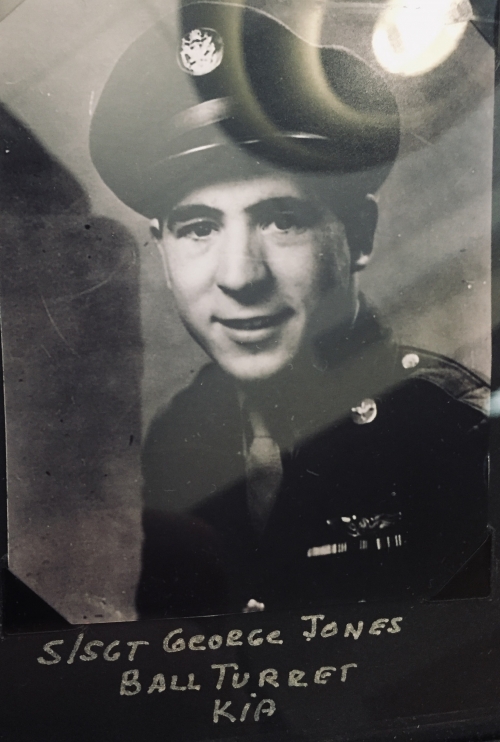
George E Jones
George E. Jones BTG on Lt Earl Williams / Lt Ford KIA
Hometown During Time of Service: Lewiston, PA
Army Serial Number: 13022168
Assigned to the 100th Bombardment Group
Location:
Unit: 349th Bombardment Squadron
Rank:
Position: Ball Turret Gunner
Beginning Date of 100th Service: Unknown
Time of Service at Thorpe Abbotts: Unknown - Unknown
Additional 100th Service Notes
Status: KIA
MACR: 01394
CR: 01394
Comments: 26 NOV 43 BREMEN (EAC)
Media Articles
Use your thumb to scroll through the results box below.
| Media Item | Type | Page | Volume/Issue | Broadcast Source | Time | Description | File |
|---|---|---|---|---|---|---|---|
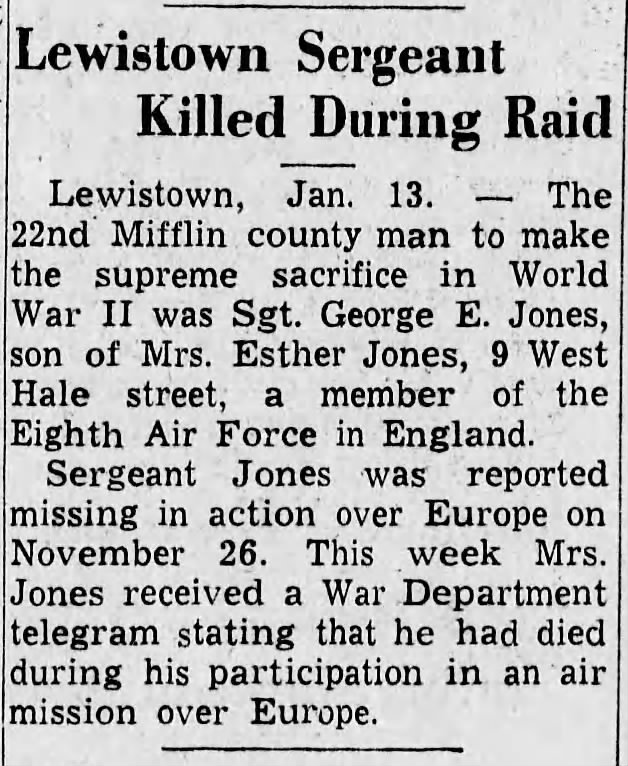
| George E. Jones killed during raid | Harrisburg Telegraph Jan 13 1944 | 12:00 am |
Comments and Notes
Memo 1:
CREW


2nd Lt Earl "Flakked Up Willie" Williams     P CPT        sn# O-742919

2nd Lt Jean B.Pitner                               CP EVADEE 26/11/43 BREMEN

2nd Lt Arno E.Plischke                          NAV EVADEE 26/11/43 BREMEN

2nd Lt Arthur G.Bodei                          BOM POW      26/11/43 BREMEN

 T/Sgt Max S.Newman                        ROG KIA         26/11/43 BREMEN

 T/Sgt Andrew F.Hathaway                  TTE EVADEE 26/11/43 BREMEN

 S/Sgt George E.Jones                         BTG  KIA       26/11/43 BREMEN

 S/Sgt Leo J.Bianchi                            LWG POW      26/11/43 BREMEN

 S/Sgt Delton L.King                            RWG EVADEE 26/11/43 BREMEN

 S/Sgt Carl G. Glasmeier                        TG POW      26/11/43 BREMEN


349th Sqdn. Crew, as above, apparently joined the 100th Group in Nov 1943 as this is believed to be their first mission.

According to Glasmeier (31/3/90) Lt George W.Ford who had arrived at the 100th with his own crew on 12/9/43 was pilot of the above crew on 26/11/43 and became a POW.  After 26 Nov 43 mission, Lt Williams was assigned to the Crew of Lt John T. Griffin.


2ND LT WILLIAMS FLEW AS CP ON THE JANSSEN CREW ON 3 MARCH 44 AND WAS MOST LIKELY WITH THEM ON 4 MARCH 44 WHEN THEY COMPLETED THEIR 25TH MISSION.  THE TARGET WAS BERLIN.  LT WILLIAMS WOULD BE TRANSFERRED TO THE 351ST BS AFTER 26 NOV 43  AND WAS STILL ON BASE AS OF JULY 2, 1944.  HE WOULD GO ON TO BECOME A CAPT. AND COMPLETE HIS TOUR.  HE FLEW AS CP ON LT JOHN GRIFFIN CREW.


CREW on 26 NOV 43 mission to BREMEN


2ND LT GEORGE W. FORD             P POW 26 NOV 43 BREMEN

2ND LT JEAN B. PITNER              CP EVA   26 NOV 43 BREMEN (see lettter below)

2ND LT ARNO E. PLISCHKE        NAV EVA  26 NOV 43 BREMEN

2ND LT ARTHUR G. BODEI        BOM POW 26 NOV 43 BREMEN

T/SGT MAX S. NEWMAN          ROG KIA   26 NOV 43 BREMEN

T/SGT ANDREW F. HATHAWAY TTE EVA  26 NOV 43 BREMEN

S/SGT GEORGE E. JONES         BTG KIA    26 NOV 43 BREMEN

S/SGT LEO J. BIANCHI             LWG POW 26 NOV 43 BREMEN

S/SGT DELTON L. KING            RWG EVA 26 NOV 43 BREMEN

S/SGT CARL G. GLASMEIER      TG POW   26 NOV 43 BREMEN

349th Sqdn. Crew, as above, apparently joined the 100th Group in Nov 1943 as this is believed to be their first mission.  MACR # 1394, Microfiche # 464, A/C # 42-31215


EYEWITNESS: A/C # 215 was hit in # 2 engine when two FW 190s attacked the low squadron at 1045 hrs. Fell out of formation and dived for cloud cover.  E/A followed but P-47s came to the rescue.  A/C was seen from time to time flying below the formation.  At 1048 hrs one chute was seen and at 1103 hrs nine more chutes were seen. At 1105 hrs it hit the ground and exploded, near 49 32N and 02 00E.  During the last few minutes of flight fire spread over the entire left wing.


That Pitner % Plischke were successful evadees is evidenced by signing a report to the Adjutent General's office dated 5 Feb 44.  This same report indicates Andrew Hathaway also returned to duty also evading. The record for Denton King was an evadee rather than a POW.


This is remains some difficulty in determining G.W Ford's role with this crew.  (Letter to Jim Brown from Jean Pitner regarding this matter follows..


Dear Jim: ( 26 November 1990)


Forty seven years ago today, I was shot down.  Twenty seven days before that I signed in at the 100th. First, let me answer your specific question regarding Earl Williams and George Ford.  Earl was first pilot on my crew. I met him, as well as my navigator and bombardiar, at Walla Walla, Washington.  Earl was an "old timer".  He had been an enlisted radio operator in Hawaii before the peacetime draft and during the attack of December 7, 1941.  When I met him he was a 1st Lt., married and no children.  The rest of us had just graduated from flying schools; in my case "travel time" from Blackland AAB, Waco, Texas, to Moses Lake, Washington, then on to Walla Walla.


Earl and I flew a couple of local flights after we arrived at the 100th.  He, as well as all of the crew (except me), flew

combat missions shortly after we arrived at the 100th. each of them flew with different crews at different times as substitutes on various crews


Our crew was scheduled to fly together for the first time on 26 November 1943.  I was not included.  An experienced multi missioned pilot would "check out the crew and sign off Earl as combat ready.  I do not know what happened during the night to change the plans, but I was awakened early in the morning and told that I would fly and Earl would not.  Earl was as surprised as I.


I met George Ford at briefing.  He was a captain, said very little, mentioned that he had flown fourteen (I think) missions. He also told me that this was a good starting mission for me (my first) and that it would be a "piece of cake" and a "milk run". The last time I saw George was as we were bailing out. I never believed, nor was I told, that George was a "new crew member" who would continue to fly with us.  I thought he was sort of a "check ride" for a new crew.  So much for George now back to Earl. The last time I saw Earl was when he came to London to make a personal identification of me for Army Intelligence. I recall that Earl had changed.  I thought he was "flak happy", and for a little while I thought he either did not know me, or would not make the identification.  He did, but the intelligence officers weren't satisfied.  Intelligence demanded two other officers from the 100th to come and make the identification. To shorten this phase, Intelligence had to accept Earl's ID because there were no officers in the 100th who knew me!


I haven't said anything about my escape from France, and that is not an oversight.  There are two reasons:

 (1)  It has been proven that the longer the time from the combat experience, the greater the distortion in the way

the person describes that experience.  If the action is told frequently, that too will alter the facts.  Often truth becomes fantasy.

 Most are unaware of what has happened and actually believe they are recalling the combat experience exactly as it happened.


 (2) Even if I could recount my escape in accurate detail, there is no way that I can separate a part from the whole.  I am certain

that it would be effortless for me to write hundreds of pages, single spaced with narrow margins, and probably leave out

something.  Even worse, I probably would exaggerate the facts.  It would be nothing but historical fiction at best.


Now you can understand why I opened this letter with those two observations, especially the forty seven years remark.

 Come to think of it, I wonder what kind of a story I would tell about my last combat flying   three years in Vietnam, including all

campaigns of the entire conflict?  This time I was shot up frequently, but not shot down.


I think that you have a difficult task before you in your research.  I suspect that time is running out.  Oddly, in my 33

years of service, I've met only one person who was in the 100th.  I was lecturing at Brown University, Providence, RI, in

the Fall of 1964, when I met a man named Brown.  He told me that he had been the historian of the 100th.  Coincidence? We talked

at length, but we were not at the 100th at the same time.


I congratulate you on the work you are doing and hope you can bring the account to an end soon.  I know from personal

experience how frustrating, tiring, and sometimes expensive research can be, especially oral and first person.  I know,

too, the great satisfaction of completion.  I hope you experience that soon.


                                         Sincerely Yours,


                                          Jean Pitner
Memo 2:
Local aviator among WWII’s “Bloody Hundredth” fallen In 1943


JUNIATA VALLEY MAGAZINE

MAR 10, 2026

CHRIS MOYER

Stories Behind the Stars

Special to the Lewistown Sentinel


[Editor’s Note: This article was previously published in the Nov. 25, 2025 edition of The Sentinel].


LEWISTOWN — America’s legendary 100th Bombardment Group (Heavy) earned its nickname “Bloody Hundredth” for the losses it sustained during strategic bombing missions over Europe in 1943. On its first mission on June 25,1943, the 100 BG lost three B-17 Flying Fortress bombers and 30 crew over Bremen, Germany. No combat unit sustained such heavy losses as the 100th Bombardment Group’s original flight crews. Only four of the original 38 co-pilots completed their combat tour of 25 missions. In 1943, the average survival of a B-17 crew member was 11 missions.


Eighteen PA aviators in the 100th Bombardment Group lost their lives during 1943. Volunteers with the non-profit Stories Behind the Stars (www.storiesbehindthestars.org) have written memorials to honor the sacrifice of each of the fallen. Mifflin County was home to one of those lost: SSGT George E. Jones.


George Ellsworth Jones was born July 4, 1921 in Lewistown to George Edward and Esther (Myers) Jones, both natives of Pennsylvania. Jones had one older brother and one younger brother. Their parents separated by 1930, after which Jones and his siblings lived with their maternal grandparentsy.


Jones enlisted in the Army Air Forces on Jan. 22, 1941 in Harrisburg. His enlistment record indicates he was single, had completed four years of high school and was working for an architect. After basic training, Jones attended aerial gunnery school. After additional training, he was assigned as a Staff Sergeant to the 349th Bomb Squadron of the 100th Bombardment Group (Heavy), Eighth Air Force, which flew B-17 Flying Fortress heavy bombers.


The 100th BG was activated on June 1, 1942, assembled at Gowen Field, Idaho, and moved to Walla Walla Army Air Base, Washington to receive its first four aircrews and four B-17 heavy bombers. Additional personnel, aircraft and crews were added at Wendover Field, Utah and began bombing, gunnery and navigation training. By December, the unit’s total strength reached 37 crews, with 10 men on each crew. Flight crews flew to England on May 25, 1943 and arrived at Station 139, Thorpe Abbotts, Norfolk, England on June 8, 1943. On 27 May 1943, the ground personnel set sail aboard the RMS Queen Elizabeth from New York and rendezvoused with the air echelon at Thorpe Abbotts, where they remained throughout World War II.


The 100th BG, from June 1943 to January 1944, concentrated its efforts against airfields, submarine facilities and aircraft industries in France and Germany. The unit was involved in the epic air battles over Regensburg, Germany on Aug. 17, 1943 (for which it received its first Presidential Unit Citation) and in Black Week from Oct. 8-14, 1943 over Bremen, Munster, Marienburg and Schweinfurt, Germany. These missions cost the group 28 Flying Fortresses shot down. The 100th BG drew the dreaded “Tail in Charlie” position on the terrible Regensburg shuttle mission and were the high group on the Oct. 8, 1943 Bremen mission and again at Munster. The 100th occupied positions in the formation that were certain to be the focal point of enemy fighters’ attacks.


During the Oct. 10 Munster raid, 18 100th BG aircraft were sent, of which five aborted and turned back before reaching the target. Twelve of the 13 aircraft that reached Münster were shot down. The only surviving 100th BG B-17 to reach Münster and return was seriously damaged and with several crewmen wounded. The Schweinfurt mission of Oct. 14 became known as “Black Thursday” because the 8th Air Force lost 60 bombers. The 100th BG led the bombing of Rjukan, Norway on Nov. 16, 1943, which delayed the manufacture of heavy water for the German atomic bomb.


Jones was the ball turret gunner of a replacement crew that joined the bomb group sometime in November 1943. On Nov. 26, 1943, Jones’ crew was flying its first combat mission aboard B-17G 42-31215 when the 100th BG sent nine aircraft as part of a larger force of 107 bombers to attack industrial areas of Bremen, Germany. Somewhere over France, the aircraft was attacked by enemy fighters and was seen to fall out of formation. Shortly thereafter, about 20 miles north of Paris, the crew was spotted bailing out of the aircraft with its left wing on fire. Four members of the crew were able to evade capture, and another four were captured and became prisoners of war.


Jones was killed in action on Nov. 26, 1943 during a combat mission to Bremen, Germany when his B-17 was attacked by German fighter planes. Although mortally wounded, Jones was able to bail out of the aircraft with the help of a waist gunner. He was captured by the enemy and died of his wounds in a German hospital. Jones initially was buried in a local cemetery in France. After the war, Jones was repatriated to the United States and was laid to rest in Maitland Brethren Cemetery.
KIA / MIA / EVA / INT Information:
Target:
Bremen
Aircraft:
(42-31215)
Date:
1943-11-26
Cause:
EAC
Crew List
1st Crew List
Use your thumb to scroll through the results box below.
| Rank | Name | Pos | Status |
|---|---|---|---|
| CAPT | WILLIAMS, Earl | P | CPT |
| Lt | PITNER, Jean B. | CP | EVA |
| Lt | PLISCHKE, Arno E. | NAV | EVA |
| LT | BODEI, Arthur G. | BOM | POW |
| T/SGT | HATHAWAY, Andrew F. | TTE | EVA |
| T/SGT | NEWMAN, Max S. | ROG | KIA |
| S/Sgt | JONES, George E. | BTG | KIA |
| S/SGT | BIANCHI, Leo J. | WG | POW |
| S/SGT | KING, Delton L. | WG | EVA |
| S/SGT | GLASMEIER, Carl G. | TG | POW |