T/Sgt
Melvin J. MADSEN
Assigned to the 100th Bombardment Group
Location:
Unit: 351st Bombardment Squadron
Rank:
Position: Tail Gunner
Beginning Date of 100th Service: Unknown
Time of Service at Thorpe Abbotts: Unknown - Unknown
Additional 100th Service Notes
Status: REC
Comments: 18 MAR 45 BERLIN (CRASHED Wilkowo Polskie, POLAND) EAC
Media Articles
Use your thumb to scroll through the results box below.
| Media Item | Type | Page | Volume/Issue | Broadcast Source | Time | Description | File |
|---|---|---|---|---|---|---|---|
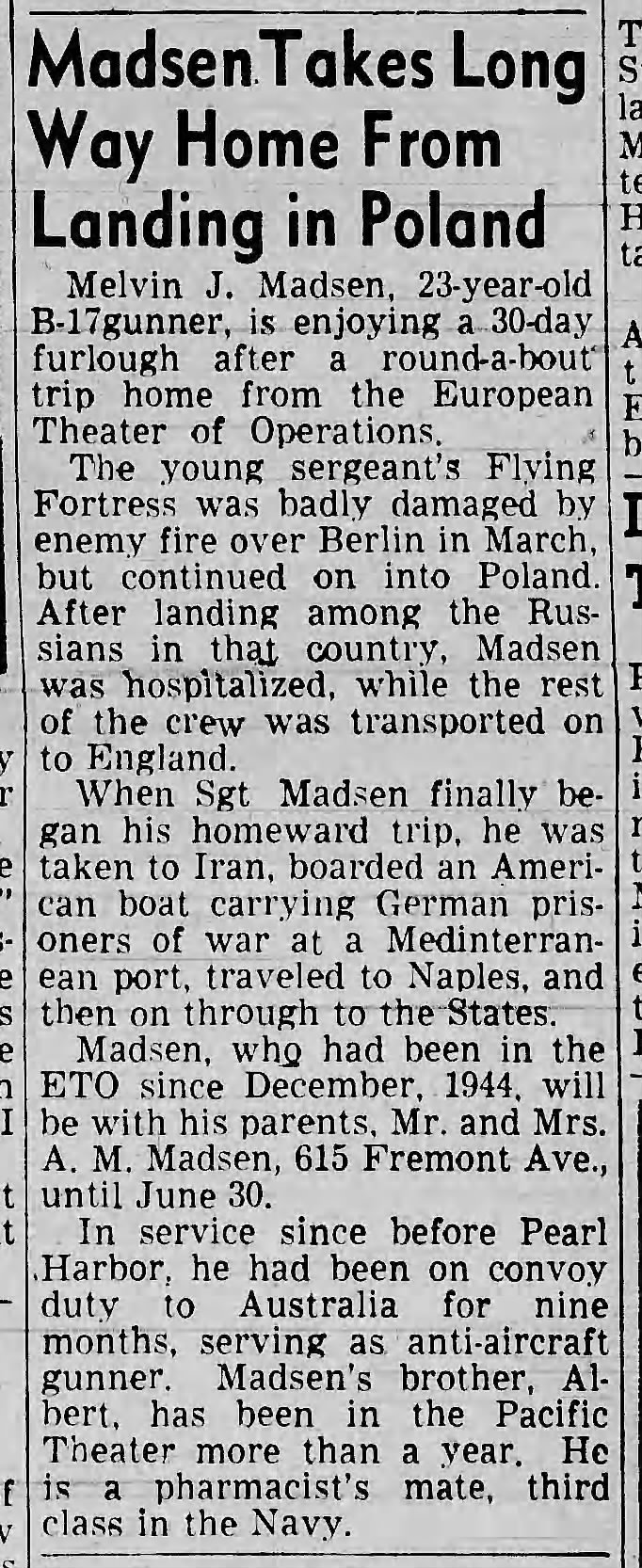
| Melvin Madsen on way home | Santa Barbara News Press June 3 1945 | 12:00 am |
Comments and Notes
Memo 1:
CREW


Lt Merrill E.Jensen              P     18 MAR 45   BERLIN, Crash Landed in Poland

F/O Charles L.Kemp          CP     18 MAR 45   BERLIN, Crash Landed in Poland

F/O Richard R.Scroxton     NAV  18 MAR 45   BERLIN, Crash Landed in Poland

Cpl Charles P.Friel       NG/TOG   18 MAR 45   BERLIN, Crash Landed in Poland

Cpl Thomas L.Gallagher    TTE    18 MAR 45   BERLIN, Crash Landed in Poland

Cpl Howard B.Hodges      BTG    18 MAR 45   BERLIN, Crash Landed in Poland

Cpl Melvin J.Madsen          TG     18 MAR 45  BERLIN, Crash Landed in Poland

Cpl John T.Palmer           ROG    18 MAR 45  BERLIN, Crash Landed in Poland

Cpl Anthony G.Schembri   WG    18 MAR 45  BERLIN, Crash Landed in Poland


This crew,as above, joined the 100th Group (351st Sqdn.) on 21/1/45

This crew was flying its 14th mission when they took off for Berlin 18 Mar 1945, in  A/C 46295 "White Cargo"


In a letter of Nov.1983 Richard Scroxton relates what occurred March 18, 1945:


"We were in the #3 position slightly behind and below the element

lead. As we neared our target of Berlin,the sky was clear but we were leaving

heavy contrails. There had been no warning of bandits when our tail gunner

opened fire. Four ME 262s came in hidden by the contrails and hit four of us.

I had one quick glance of ours just off our left wing tip which was then five

feet too short. Our element lead was also hit and turned directly into us  we

turned in formation and he slipped below us. This change in position was not

noted by the person who wrote the report as it applied to the other plane.

(He is here referring to a report of an eyewitness who had said that

Scroxton's a/c had the entire left wing afire and that two men Were seen to

jump from the ship. Jb) No one bailed out of our plane  partly because

several chutes were destroyed. In addition to the wingtip damage, 4 engine

prop was hit resulting in very severe vibrations. These and other hits on #2

and #3 made it clear that we were no longer a part of the formation. I gave

the pilot a heading of due East we crossed the Oder river front line at 9,000

ft down from 33,000. At 2,000 ft. we were able to maintain altitude and

picked an open field


We did take one very close flak burst that ripped up the chutes near the front

escape hatch. We landed near a town in Poland called Kostian. We thought that

our troubles were over when we landed   gave away all our provisions even

those in the life raft. We spent that day and next with Russians then they put

us on our own. We travelled by horse cart,railroad flat car,etc.untll we got

to Lodz. There we met a crew with a C-47 who had flown in to evacuate an

injured airman   it turned out to be Capt.Ernst of the 100th. (Ernst had flown

as pilot of a mission on 3/2/45 with  Robt.Rosenthal as Command pilot and suffered

a wound which caused amputation of his leg. Jb)


We flew with him to Poltava. Melvin Madsen had left us in Poland due to

sickness but he got back to the States before we got back to England. As we

got off the plane in Poltava, I saw a classmate from Navigation school who had

arrived the day before and left the next day. We expected to do the same but

the Russians had other ideas. We were not allowed to leave or write for four

weeks. We left Poltava on April 23 in a B -17 with another crew. We landed in

Bari,Italy dropping off the other crew then flew to Caserta and stayed two

days then flew back to England landing at Thorpe Abbotts on 25 April 1945."


Information received in October 1994 from the Polish Historian, Mr Michat Mucha,

places the the crash site of 44-8295 in a village of Turew farm field. This is near the town of Koscian,

Poland. Mr. Mucha gives the coordinates as 52° 05' North and 16°47' East. ..pw


List of Missions and Log of Lt Richard R. Scroxton (mpf 2000)


1.  9/2/45  Weimar- 3 ships aborted, ST bombed, 8hrs air time,                                                A/C 43-38963  EP-E

2. 15/2/45  Cottbus-  Moderat Flak, ST bombed, Bomb Bay doors froze open, 9:25hrs Air Time     A/C 43-37812  EP-A  PATRIOTIC PATTY

3. 17/2/45  Frankfurt-/Giessen-#4 Engine hit, heavy flak, ST bombed, 7hrs air time                      A/C 44-6613  LN-?

4. 19/2/45  Osnabruck-#3 engine failure-mechanical,solo bomb run, moderat flak, Primary bombed, 5:55 hrs Air Time

                                                                                                                                              A/C 42-31767  EP-E OUR GAL SAL

5. 21/2/45  Nurnburg-Light Flak front lines, Heavy flak at target, Primary bombed, 8:20hrs air time   A/C 43-38861 EP-M SWEET NANCY II

6. 22/2/45  Stetten/Villegen-5 dry runs at 12,000ft, Target of Opportunity, possible 15 mile error, 9:15hrs air time

                                                                                                                                               A/C 43-37815 EP-L YOU CAN'T LOSE

7. 23/2/45  Treuchtlingen-1st dry run at 14,000ft, ST bombed, excellent results, major impact visible, 9:25hrs air time

                                                                                                                                               A/C 44-8632 EP-H

8. 28/2/45  Kassel-G-Box burns, Primary bombed, light flak, 7:50hrs air time

9.  7/3/45  Siegen-light Flak on bomb run, ST bombed,  7:55hrs air time                                      A/C 43-37815 EP-L YOU CAN'T LOSE

10.  8/3/45  Giessen-1st dry run, light flak, ST bombed, No 1 Oxygen out, 7:30hrs air time             A/C 44-6295 EP-B WHITE CARGO

11. 12/3/45  Swinemunde-Moderate flak, German boats, Primary bombed, smoke columns to 15,000 ft. 9hrs air time

                                                                                                                                              A/C 44-8632 EP-H

12. 15/3/45  Oranienburg-Balloon Barrage, Primary bombed, moderate flak, 7:20hrs air time

13. 17/3/45  Plauen-Group to left hit heavy flak, 1 ship lost, 8 chutes out, light flak at target,  8:35hrs Air Time

                                                                                                                                              A/C 42-97126 EP-D THE LATEST RUMOR

14. 18/3/45  BERLIN-Heavy Flak, accurate, 32 min., B-17 inoperatrive, crash landed near Russian lines, 4hrs air time

                                                                                                                                              A/C 44-6295 EP-B WHITE CARGO

    18 March 45  Crash landed near Kostian, Poland, go to Russian HQ via wagons

    19 March 45 At Russian HQ, return to plane to remove Benzine

    20 March 45 Go to Posen via Truck, Register, Horse and Wagon to Railroad

    21 March 45 Flat Car to Wrzensia, long walk in rain to Polish Red Cross, crew split up and stayed with Polish families

    22 March 45 Take Madsen (TG) to hospital, take flat car to Kutno

    23 March 45 Take Trail to Lodz, street car to YMCA

    26 March 45 0800 take truck to Airfield, 10:30 take C-47 to Poltava, Russia

    23 April 45 Depart Poltava, land Bari, Italy, to Caserta via B-17

    25 April 45 Fly Caserta to Bovington, to Rackheath, to Thorpe Abbotts


ON MAY 20, 1945 LT JENSEN FLEW A DP MISSION IN A/C "424"


43-37815 EP-L  assigned to HARDSTAND # 1)

RE: MISSION # 10   JENSEN   295  B  10    C-SQDN, LOW FLGT,SHIP # 3                       ASSIGNED TO HARDSTAND  # 10

RE: MISSION # 11   JENSEN   632  H  1     C-SQDN, LEAD FLGT, ELEMENT 2, SHIP # 2    ASSIGNED TO HARDSTAND  # 1

RE: MISSION # 14   JENSEN   295  B  10    C-SQDN, LEAD FLGT, SHIP # 3                      ASSIGNED TO HARDSTAND # 10


Hi Mike:


Just a few months ago, I was able to establish the true landing spot for A/C “295”, our plane on Berlin mission 18 March 1945.   The nearest town is Wilkowo Polskie. It is a little WSW of Koscian where we were first taken by Russians. Our early reports listed Koscian as that was the only place we documented. Then about ten years ago, a fellow who lives in Poznan sent me pictures of a field where a plane had landed that day near town of Turew. That proved to be not our plane. We think we know whose plane it was.  I was able to establish the true site by a photograph of the plane taken several weeks after we landed.  While the sheet metal had been removed with most of the markings, the photo showed very clearly damage to prop on #4 engine  I had documented this damage several times.  A prop blade was hit a few inches from end and split the blade without removing any metal.  This caused very severe vibrations requiring that engine to be slowed down to just a few rpms. When we landed, I wanted to know what damage had been done and this was clearly the answer.  I am 100% certain that this damage would not occur on any other plane that landed that day.  In addition, reports about the landing are in complete agreement with facts- mention of severe damage to left wing tip-- we blew the Tokio tank, and mention of a gal being married wearing silk from a parachute we donated.

I had heard the name White Cargo several years ago, but had no documentation so never put it in my reports.   I am delighted to now have proof and to see your picture of the plane in England with the nose art on display.  I will be most happy to get this picture. In addition, I assume that some crew must have had this plane for several missions.. I would like to know who  and how many it had flown.

I have already sent the 100th details of how I got the picture taken in 1945 and details of our mission both before and after the crash landing.


Thank you for your help and for doing so much documentation.


Richard Scroxton  Nav on Lt Merrill Jensen Crew


On 18 March 1945, White Cargo landed on a plowed field in Poland. I do not remember seeing any houses, but about 25 local people arrived very soon after our landing. The Russian soldiers who arrived at the scene a few minutes later took us to their place in Koscian. That had been listed as our landing sight. About 1988, I made contact with a Polish man whose hobby was studying the aircraft activities in his area during the war.  He was most interested in knowing about a plane that actually landed nearby. He informed me of a landing site where a plane had arrived on the right date. It was called Turew and our Mission Report was  changed to include this location with a current picture. However, there was no actual connection to that site. In November of 2004, he sent me a picture of the remains of a plane that had landed a few miles away. Although the plane had been stripped of its sheet metal in the 4 months since our landing, I was able to see specific damage that clearly identified it as our plane. This was a split prop on No 4 engine.  This split from enemy fire had caused severe vibrations and was a detail I would always remember after inspecting it on the ground the next day. I was then put in contact with a high school boy who lived very near the new site and he sent me pictures of pieces of sheet metal that are still in the area, details of what was done with the metal and sent me a large piece of the metal which I turned over to Richard Gibson at the Pittsburg reunion.

Names and addresses of those in Poland will follow on separate letter.

Dick Scroxton


Michal Mucha

Al. Wielkopolska  43

60-603  Poznan

Poland


Bartosz Szpurek

Mlynska  17

64-100 Leszno

Poland

Email   wintersb@wp.pl


***************************************************************************************************************

                                                                                  INTRODUCTION


    Merrill Jensen's crew was assembled in Lincoln NE after earning their wings at various flying schools. We were then sent to Rapid City SD where we spent the fall of 1944 learning to operate a B-17 aircraft and how to work as a crew. We returned to Lincoln for overseas processing during the week between Christmas and New Years. Then we shipped to Camp Miles Standish near Boston and boarded the Ile de France for a five day cruise to Scotland.After two additional days aboard ship and a one day stop at Stone, we were sent to Thorpe Abbotts to join the 351st Sq. of the 100th Bomb Group, 3rd Air Division of the Eighth Air Force.While on the train, we heard the first of many tales about the

BLOODY HUNDREDTH and how the entire Germany air force was after them. These stories can still be heard at reunions, but they have

been disproved many times. We spent the next several days learning about combat flying and special equipment including the GEE box, ILS, bunchers and splashers.


One week before we were declared operational, our navigator was called to

the briefing room to spend the night learning how information about the mission

for the next day arrived from headquarters. The target was Berlin; the date was 03 Feb.1945.

The Division lead plane would be flown by Maj. Robert Rosenthal and Capt. John Ernst.


As the group approached Berlin, their plane was hit just

before bombs away. All but the bombadier bailed out and reached

the ground alive. Some of their crew landed in the German zone

and some, including the two pilots, landed in the Russian zone.

Capt. Ernst was badly wounded and lost one leg. Our crew had no

way of knowing how important this would be to us at a later date.


We flew missions on Feb. 9, 15, 17, 18, 21, 22, 23,28, and

on Mar. 7, 8, 13, 15, & 17 with relatively little battle damage.

Our targets included large cities and small towns. Some of them

were hit and some were not. By this time, American forces were

entering Germany and the Russians were nearing Berlin so the end

of the war appeared to be near. We had not had Berlin as a target

and we had not heard of a jet airplane; but that would change on

18 Mar. 1945. This is an account of that mission by those who

were there.


TARGET BERLIN 18 MARCH 1945

BERLIN-Big B-that was the target hidden behind the curtain

until the dramatic uncovering that started every breifillg. Our

group was No 2 in the second task force. Our position was  No. 3

in the low squadron. Page 3 shows an overhead view of tne entire

13 planes in our box. We were assigned the task of monotoring the

fighter frequency. The group leader was Harry Cruver. Maj.

Rosenthal was at the briefing, having just returned from Russia.


After an uneventful take-off and climb to altitude, the

pilots had to monitor number one engine very closely as the prop

tended to overspeed. As soon as the main tanks had sufficient

space, fuel from the Tokyo tanks located in the wing tips was

transferred to the mains; this allowed time for the vapors to be

vented prior to the bomb run. The pilot and copilot alternated

flying every fifteen minutes; as they did on all missions. It was

Jensens' turn as we neared the IP at Salzwedel (52 52N-12 23E).

At about 1120 hours, less than five minutes from the IP, the

aircraft started to shake. No one had to ask why- our guns were

firing. There had been no warning. The sky was clear, but we were

leaving heavy contrails which hid the attackers. A hole appeared

in the lead plane's wing just aft of the number one engine.

Flames and smoke poured from the hole, causing them to aborted

the formation in a sharp bank to the left, taking us with

them. We had not progressed very far into the turn when it became

obvious that we had to clear ourselves from the lead plane. The

smoke and flames had increased to the point where we were also

enveloped. The task was to get above the fire and to slide from

left to right so as to get far enough away that we would not be

caught in any explosion. It was necessary for the pilots to

switch controls twice during this brief maneuver. As we passed

over the lead plane, we could see some of their crew bailing out.

These actions caused those in the other planes to make a mistake

in reporting the damage; our plane was reported as being on fire

and out of control while the lead plane was reported as going

down, but in control. This mistake is easy to understand as

everyone was concerned about firing at the bandits, not about the

fate of the other planes. Two additional B-17s were hit in the

attack so we had all assumed that four planes had been in the

attack. In 1994, we learned that the attack had been by six

planes. They were from the III/JG Gruppe of Jagdgeschwader 7 and

were led by Oberleutnant Guenther Wegmann. For the first time in

combat, they were armed with R4M air-to-air rockets. Each plane

carried 24 of these 5.5 cm impact-fused missiles on wooden

racks. In all, 37 ME262s engaged 1221 heavy bombers which were

escorted by 632 fighters that day. 12 bombers and two fighters

were lost. A summary of Allied efforts against Berlin lists 1329

bombers dispached with 1184 being effective.-They dropped 3374

tons of bombs.


After breaking clear of the ill-fated lead plane, we were

some distance to the left and below the squadron when we added

max climb power and turned right to rejoin the squadron.


                 LOW SQUADRON 100th BOMB GROUP MISSION #282-BERLIN-18 March 1945


                                                SWAIN/DEWEERDT 418

                                                         1 KIA

                                          44-8717 PFF- DESTROYED IN AIR


               #3  JENSEN 351                                       #2 HUGHES 351

           44-6295 DOWN BY ME 262

          FLAK DAMAGE GOING DOWN

             LANDED IN POLAND

                 WHITE CARGO


                                         #4 GILBERT 351

                                             42-31530

                                          QUITTIN' TIME

                                        1 KILL CONF. BY TG


             # 6. BOVENZI 418                                     # 5 BAYLEY 418

                42-97071 FLAK                                         43-37811 FLAK

                ANDY'S DANDY                                          BABY SWEET


                                       #7 CARLEY 418

                                        43-38945 FLAK

                                        DUFFY'S TUFFYS


            # 9 GRIFFITH 418                                     # 8 JACOBS 418

              43-37994 FLAK                                          42-102649 FLAK

            MY BLUE HEAVEN                                        LADY GERALDINE


                               # 10   KING 3 KIA 351

                              43-37521 DESTROYED IN AIR

                                  SKYWAY CHARIOT


            #12 MASHYNA 418                                      #11 GWIN  4 KIA 351

              43-39162 FLAK                                            43-38861 DESTROYED IN AIR

                 GINGER                                                    SWEET NANCY II


                                 #13 CALDER 418

                                  42-32090 FLAK

                                  SILVER DOLLAR


THE CREWS THAT WENT DOWN MISSION #282-BERLIN_18 March 1945

  Position #1 Plane destroyed in air

 SWAIN RL            POW COMMAND PILOT

DEWEERDT PE      POW  PILOT

THOMPSON WE     POW  FORMATION OFFICER

CARDEN JM           POW NAV

KOZIK BF              POW BOM

HAUSAM RA          POW ROG

KOLLING MO          KIA  TTE

WOODROW SH     POW RADAR OPERATOR

WHITTAKER HR     POW WG

FISCHER PJ           POW WG


Position #3 Plane crash-landed in Poland with all aboard

JENSEN ME        MIA P

KEMP CL          MIA CP

SCROXTON RR   MIA NAV

FRIEL CP         MIA NG

GALLAGHER TL  MIA TTE

PALMER JT      MIA ROG

HODGES HB     MIA BTG

 SCHEMBRI AC    MIA WG

MADSEN MJ      MIA TG


Position #10 Plane destroyed in air

KING RC             POW P

WILLIAMS JS      POW CP

SPENCER JW      POW NAV

GORDAN FS       POW NG

 MATHOSIAN AM POW ROG

 WILDING RE     POW TTE

 MITCHELL RG      KIA BTG

GITLIN NW          KIA WG

BAKER JM            KIA TG


 Position #11 Plane destroyed in air

GWIN EP           KIA P

REICHEL DN     POW CP

LANDINO RB    POW NAV

DISHER JW        KIA RADAR/NAVIGATOR

HAMANN H      POW TTE

 DANIELSON WC  KIA ROG

 UHLER RR         KIA BTG

HEILBUTH ND   POW WG

ACKERMAN DN   POW WG

GRIEGO JH       POW TG

* Indicates name is in 1994-1995 Directory
Crew List
1st Crew List
Use your thumb to scroll through the results box below.
| Rank | Name | Pos | Status |
|---|---|---|---|
| LT | JENSEN, Merrill E. | P | REC |
| F/O | KEMP, Charles L. | CP | REC |
| LT | SCROXTON, Richard R. | NAV | REC |
| S/SGT | FRIEL, Charles P. | TOG/NG | REC |
| T/SGT | GALLAGHER, Thomas L. | TTE | REC |
| T/SGT | PALMER, John T. | ROG | REC |
| S/SGT | HODGES, Howard B. | BTG | REC |
| S/SGT | SCHEMBRI, Anthony G. | WG | CPT |
| T/Sgt | MADSEN, Melvin J. | TG | REC |