Lt
Orlin H. MARKUSSEN
Army Serial Number: O-741995
Assigned to the 100th Bombardment Group
Location:
Unit: 418th Bombardment Squadron
Rank:
Position: Copilot
Beginning Date of 100th Service: Unknown
Time of Service at Thorpe Abbotts: Unknown - Unknown
Additional 100th Service Notes
Status: POW
MACR: 02426
CR: 02426
Comments: 20 FEB 44 POSEN & STETTIN, FACTORIES
Media Articles
Use your thumb to scroll through the results box below.
| Media Item | Type | Page | Volume/Issue | Broadcast Source | Time | Description | File |
|---|---|---|---|---|---|---|---|
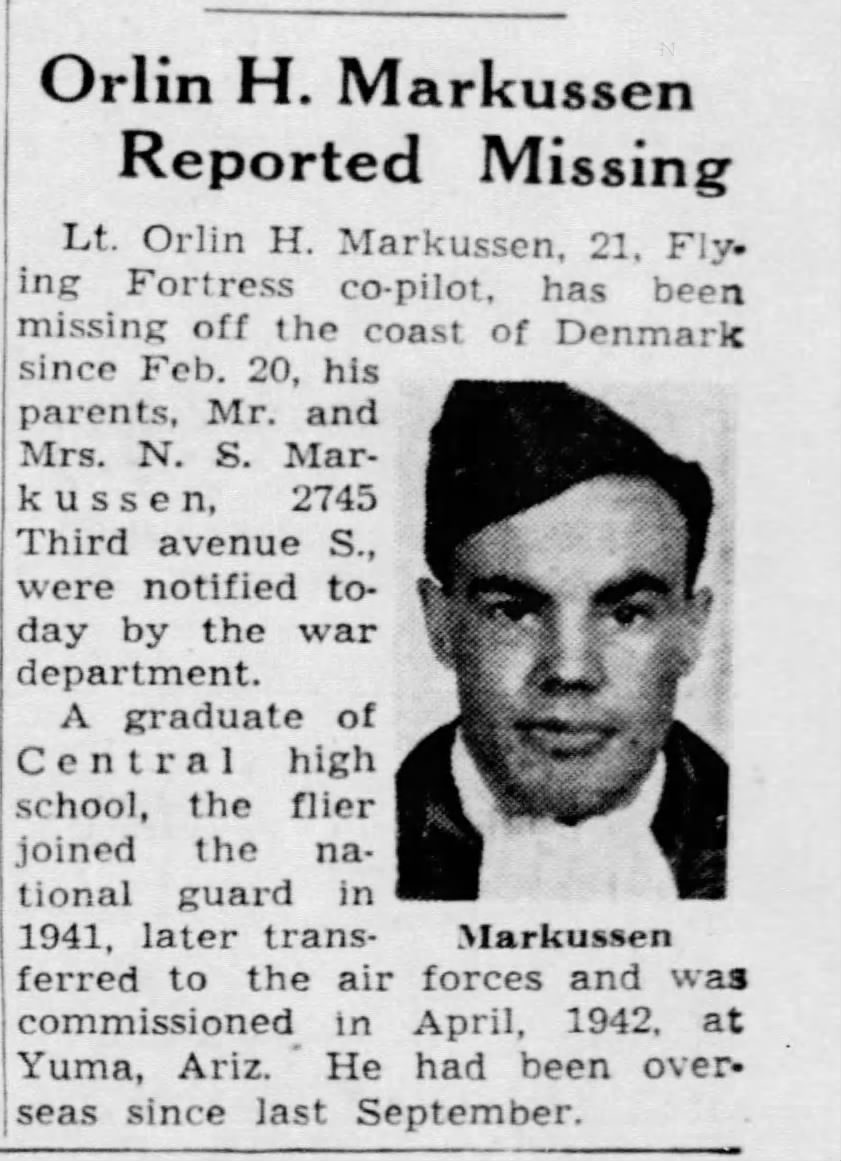
| Orlin Markussen MIA | The Minneapolis Star March 9 1944 | 12:00 am | |||||
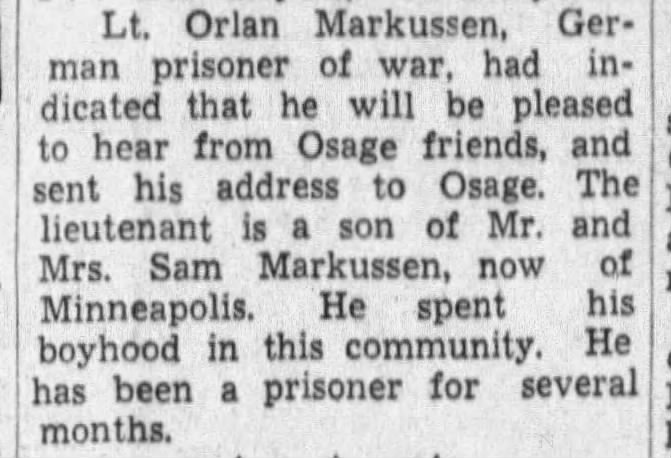
| Orlin Markussen POW | The Courier December 3 1944 | 12:00 am |
Comments and Notes
Memo 1:
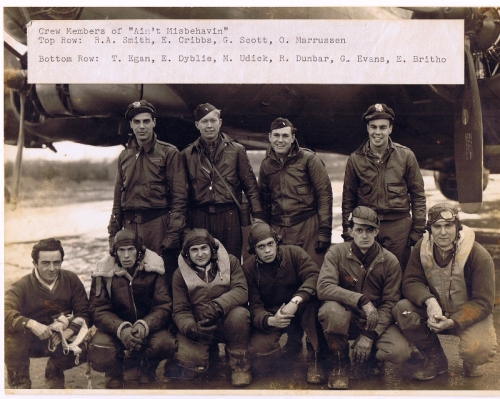
CREW


2nd Lt Reginald A. Smith   P POW 20/2/44  TAPS; 1984  TARGET WAS POSEN & SETTIN, FACTORIES

2nd Lt Orlin H. Markussen CP POW 20/2/44

2nd Lt Gerald C. Scott  N POW 20/2/44  TAPS:

2nd Lt Ernest Cribbs  B POW 20/2/44

  T/Sgt Thomas M. Egan  E POW 20/2/44  TAPS: 1977

  T/Sgt Ira G. Evans  R EVADEE 20/2/44

  S/Sgt Edward B. Dyblie  BT POW 20/2/44

  S/Sgt Edward Britko  LWG      POW 20/2/44  TAPS: 1985

  S/Sgt Robert L. Dunbar  RWG     POW 20/2/44

  S/Sgt Michael E. Udick  TG         POW 20/2/44


418th Sqdn.  A/C #42 37790 "AIN'T MIS BEHAVIN"


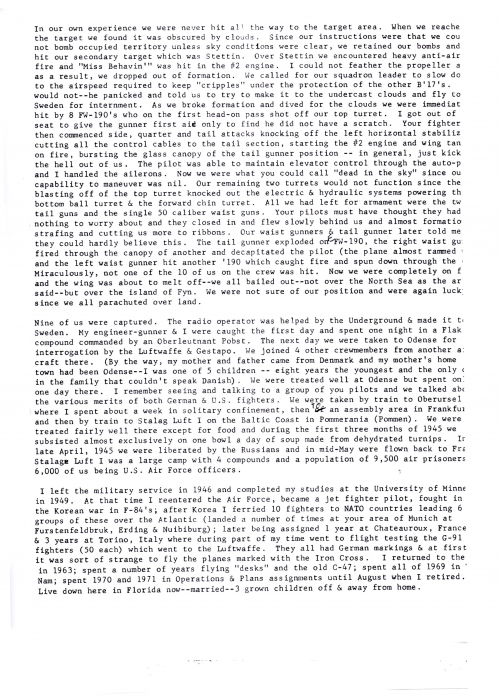
"At 1452 hours near the Danish coast Lt. Smith called over VHF saying he was going to  try and reach Sweden.  His a/c was hit over the target area by rockets and was smoking badly, but shortly after the entire crew had to parachute.  The crash was observed by the Germans at the radar station in Skovby, and some of the airmen were taken prisoner of war shortly after landing.  Some managed to hide in the forest near Fjellerup

parsonage and they were found by the farmer Mr. Rasmus Thrane, who hid them for a while. But they were anxious to reach Sweden so they went for the sea, and they were taken prisoner near Baring beach. Ira Evans hid in the forest and came in contact with the Danish resistance movement.  He reached Sweden on 7/3/44.


A/C crashed at Harslev Mark, 7 km s of Bogense town on NW part of Funen

Island.


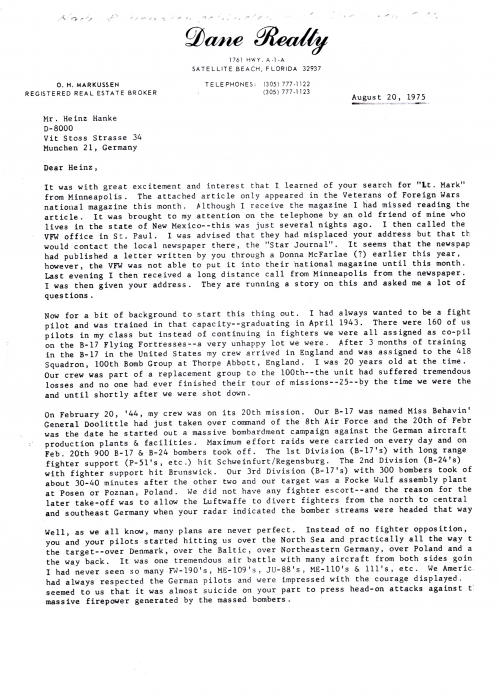
Of interest in this crew's last mission is an article in THE BLOODY HUNDREDTH   (page 141 to 147) by Horace Varian

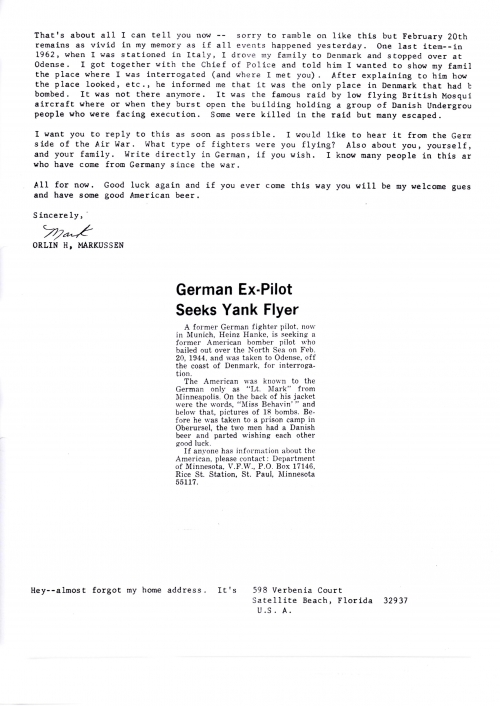
in which Orlin Markussen relates the story of how he made contact 31 years after the fact with the German fighter pilot

who shot down "AIN'T MIS BEHAVIN" Mar 20th, 1944..
Memo 2:
Recollection of German Pilot:


Memoires of a combat over Isle of Funen, Denmark


Another exponent of the Fw 190, in a home defence role was Heinz (Heino) Hanke. He served first in JG 1 but was posted to JG 11 and on 20th February 1944 he shot down a Boeing B-17 over Denmark but was himself shot down and forced to bale out from his damaged fighter. Their usual base was at Husum in Schleswig-Holstein, but on this day they were flying from Oldenburg where they had arrived the previous day. Heinz Hanke takes up the story:


“ We were at breakfast and were just waiting for the usual fried eggs when the siren howled the alarm. There were a thick ground fog outside but the bombers, nicknamed Dicke Autos by us pilots, were approaching, so a carpet alert (Teppich Alarm) was ordered and we had to run to our “mills”.


When all the fighter units from the Netherlands bases and from German Bight had linked up, we formed a defence force of 141 aircraft, including Maj Specht’s top cover Staffel from Wunstorf. It was the biggest armada of fighters I had ever seen, and we felt very potent. But things never turn out as expected! Our massed take-off had been monitored and understood in England and the bomber formation made a wide detour over the North Sea in order to delay the moment of contact until we were low on fuel. As the fighters one by one said good-bye and dived away to refuel – including our leader, Major Hackl – the bombers opened their throttles and came in over the German Bight at full speed in three massive streams. I counted 126 bombers during their approach.


My own Yellow 14 had a red band on the engine cowling, and I had three Fw 190’s on my left and three more on my right, all in radio contact. Since we were all pretty low on fuel, and expected to see the red warning light winking at us at any moment, we made a direct frontal attack on the bombers, which were flying at about 6,300 m. The unit was in ”grape” formation and we got the full benefit of their crossfire, so I then ordered a free hunt so that each pilot could attack in his own way. As I made my final run-in from astern, my red light came on. I saw that there were only two Few 190’s left, both from my own unit, including Bolt Swingman.


The others were already searching for a landing strip below the clouds. I started my dive from 7,500 m and went through the formation from the rear at maximum speed. and my attack was with four 20 mm. cannons og two heavy machine guns firing through the propeller. It was almost impossible to miss. All weapons were controlled electrically. In the process, the first hits went into your top turret. The Boeing’s tail more than filled my Revi gunfight and left the F-II float through the cone of fire from my six barrels as I came up from underneath, finishing with his left wing and engines, which started to burn. The wing surface between the engines seemed to melt and I saw five of the crew take to their parachutes.


Then I suddenly realised that my speed was carrying me into the heart of the formation, so I rolled on my back and tried to dive away. Too late! My plane shuddered and there was a smell as oily smoke and fine aluminium dust covered my flying jacket. It became very dark and suddenly the engine howled like a crazy buzz saw. Fuel lines were severed and even the armoured ring on the front of the oil cooler could not withstand the American fire from close range. Engine oil gushed out and completely obscured my forward vision, but at the side I could see my tattered ailerons and the wings riddled with bullet holes. The whole of my port wingtip had gone, either shot away or torn off by falling bits of the bomber.


I managed to bale out at the third attempt, at about 2,300 m and when I reached the ground it was covered in snow and very cold. The Danes were not very friendly, apart from one young man who was helpful with information and in carrying my parachute about a kilometre to railway station. I had landed on Funen, one of the Danish islands.” Soon a car with two men arrived and I was asked to identify myself.


They asked that I accompany them and advise what to do with my plane. They should have said, “junk”. My plane had deeply penetrated the ground and debris was widely scattered. There were about 250 people and a policemen standing next to the crater. When I looked into the hole I realized that the ammunition containers and oxygen bottles would explode any moment. I waved the people away. They ran, as fast as possible and within 4 to 5 seconds there were explosions. Fortunately, nobody was injured.

Transcript 2002.12.08 by Finn Buch, Denmark
KIA / MIA / EVA / INT Information:
Target:
Posen & Stettin
Aircraft:
"Aint Mis Behaven" (42-37790)
Date:
1944-02-20
Cause:
EAC-FLAK
Photos
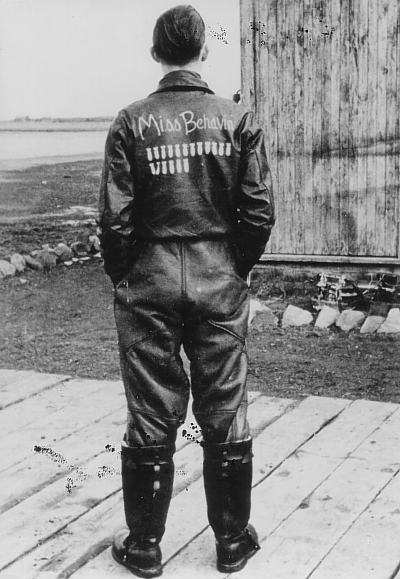
Orlin Markussen
Among these was Feltwebel Heinz Hanke of 2./JG 11 who had claimed the B 17 near Bellinge. In Odense he “claimed” Orlin Markussens A-2 jacket and proudly wore it for the next couple of months before he lost it during a allied raid on Husum.



Crew List
1st Crew List
Use your thumb to scroll through the results box below.
| Rank | Name | Pos | Status |
|---|---|---|---|
| Lt | ALF, Herbert A. | P/CP | POW |
| Capt | MINER, David L. | P | KIA |
| Lt | KINSELLA, George E. | CP | KIA |
| Lt | MARKUSSEN, Orlin H. | CP | POW |
2nd Crew List
Use your thumb to scroll through the results box below.
| Rank | Name | Pos | Status |
|---|---|---|---|
| Lt | SMITH, Reginald A. | CP/P | POW |
| Lt | MARKUSSEN, Orlin H. | CP | POW |
| Lt | SCOTT, Gerald C. | NAV | POW |
| Lt | CRIBBS, Ernest | BOM | POW |
| T/Sgt | EGAN, Thomas M. | TTE | POW |
| T/SGT | EVANS, Ira G. | ROG | EVA |
| S/Sgt | DYBLIE, Edward B. | BTG | POW |
| S/Sgt | BRITKO, Edward | WG | POW |
| S/Sgt | DUNBAR, Robert L. | WG | POW |
| S/Sgt | UDICK, Michael E. | TG | POW |