Lt
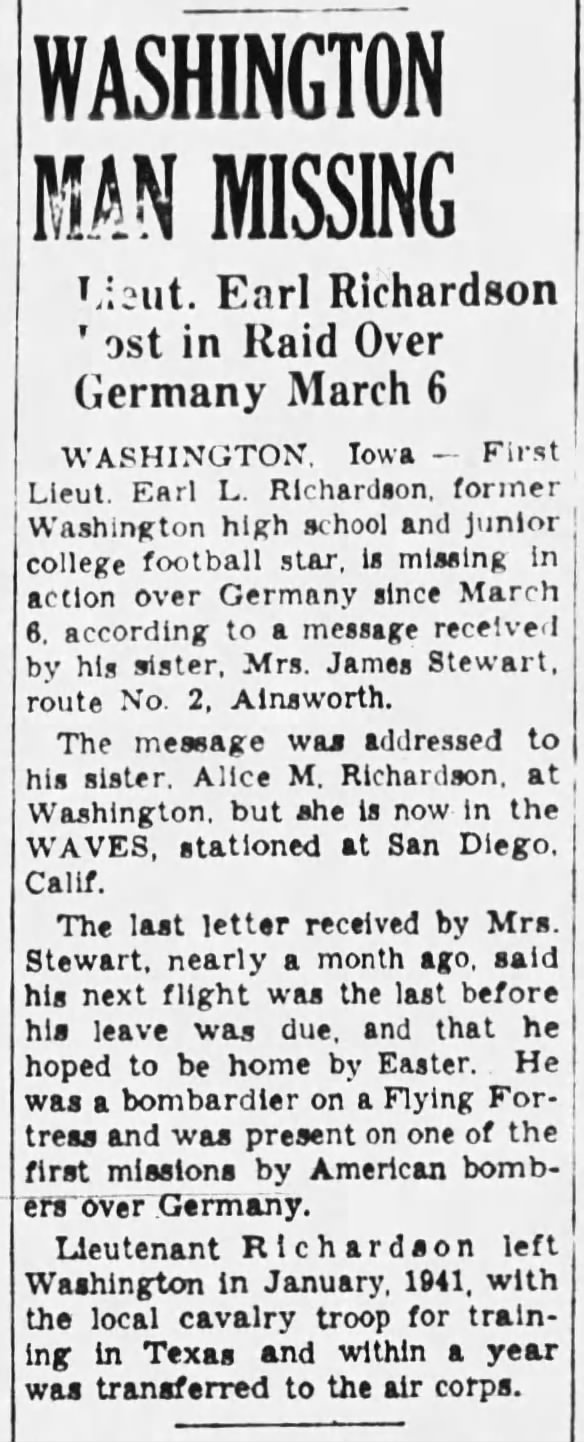
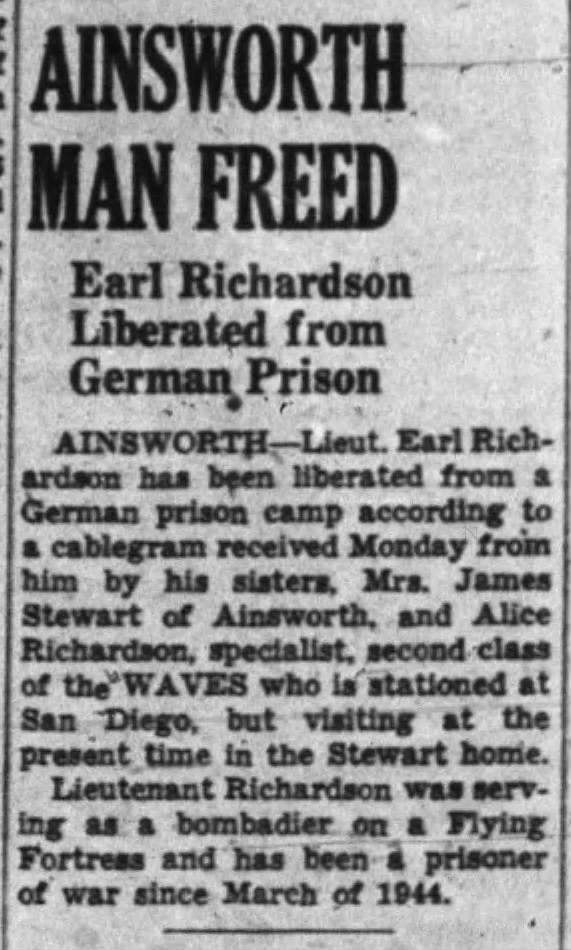
Earl L. RICHARDSON
Hometown During Time of Service: Washington, IA
Army Serial Number: O-738577
Assigned to the 100th Bombardment Group
Location:
Unit: 418th Bombardment Squadron
Rank:
Position: Bombardier
Beginning Date of 100th Service: Unknown
Time of Service at Thorpe Abbotts: Unknown - Unknown
Additional 100th Service Notes
Status: POW
MACR: 03027
CR: 03027
Comments: 6 MAR 44 BERLIN (CRASHED NEAR QUACKENBRUCK - EAC)
Media Articles
Use your thumb to scroll through the results box below.
| Media Item | Type | Page | Volume/Issue | Broadcast Source | Time | Description | File |
|---|---|---|---|---|---|---|---|
| Earl Richardson MIA | Iowa City Press Citizen March 29 1944 | 12:00 am | |||||
| Earl Richardson Freed | Iowa City Press Citizen May 22 1945 | 12:00 am |
Comments and Notes
Memo 1:
CREW


2nd Lt. John J. "Skippy" Flanigan           P  CPT      ?/2/44 Taps 1976        sn#0-797503

2nd Lt. Douglas E.Dunsdon                   CP  CPT                                        sn#0-801641

2nd Lt. Earl L.Richardson                    BOM  POW     6/3/1944 BERLIN      (with D. Miner)       See Below

2nd Lt. Rudolph Grum                      NAV  POW 10/10/1943 MUNSTER  (with J.F.Stephens) See Below

 T/Sgt. Guy M.Tuccero                     TTE  CPT

 S/Sgt. Adam E. "Rudy" Rutkowski       ROG  CPT

 S/Sgt. Guerino "Bill" Melchiorre            BTG  CPT

 S/Sgt. Frederick D."Farmer"Brown      WG  CPT

S/Sgt Salvatore J. Luistro                   WG  CPT

 S/Sgt. Jack J.Strang                           TG  CPT


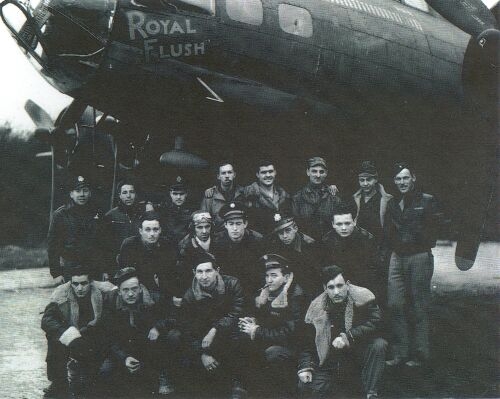
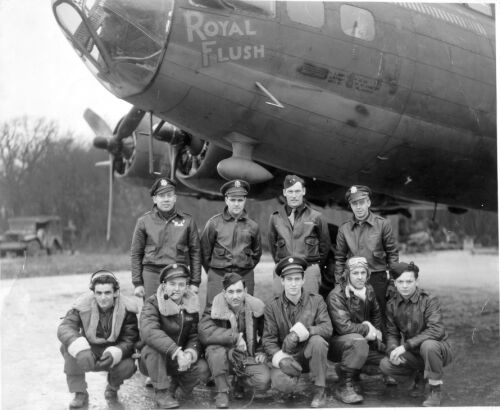
Crew,as above,joined the 100th BG (418th Sqdn.) 3/9/43. Crew flew in "Royal Flush" for 19 missions.


Sgt Carl "Rosie" Platkin, from Replacement Gunners Pool flew a few missions with this Crew


2nd Lt Richardson flew his 24th mission with Lt Riley on a makeup crew.  On March 6, 1944 2nd Lt Richardson flew his  25th mission with Lt David Miner Crew, which also included 2nd Lt George E.Kinsella (from Lt Reily"s Crew) and was shot down.  Richardson was POW and Kinsella was KIA.  See details below.


Subj: The Paddlefoot

Date: 12/12/2002 10:17:16 AM Pacific Standard Time

From: dovejoint@hotmail.com

To: mpfaley@aol.com

Sent from the Internet (Details)


Hello Mike,

    Here is the info from the report of Paddledoot's Proxy as told by Capt.

Elton:


     I took off at 1833, September 6, 1943 to slow time a new engine(no. 3).

The others aboard were 910 Pilot and Co-Pilot of a replacement crew. (2) Our

squadran line chief (engineering).

  At 1925 I attempted to contact the tower for landing instruction and found

my radio out.  I then attempted to get visual (green light) by flying over

the field gear down.  The right gear would not extend either electrically or

manually.  As darkness was approaching I knew that I hed to set it down

shortly, regardless of the full gas load ( approxamatly 1600 Gls.)  I fired

a red-red flare on those dry run approaches and dropped a note to the man on

the tower.  When I sure that all on the ground was ready, ambulances,

fire-truck, and men in asbestos suits, I landed the ship on the grass

paralleling our E-W runway.  Nothing unusual happened.


    John B. Kidd added the following:


   A report from the squadran engineering officer stated that the upper

limit switch failed to operate causing the motor to burn out, and the clutch

to freeze.  This prevented the gear from being lowered by the hand crank.

No responsibility can be placed upon the crew due to the mechanical nature

of the failure.  I witnessed the landing which was excellent.


   The report listed J.J Flannigan (CP), G.A. VanGemert (E), and D.E.

Dunsdon (CP) as the other crew members with Capt. Elton.  It also stated

that the aircraft was recovered by the 98th Service Squadran.  The accident

happened Sept. 6, 43 and the report was stamped as received by Headquarters

Flight Control Command in Winston-Salem, NC on Oct. 2, 43.   The report

totaled 9 pages…Jeff DeLong


Letter from Earl Richardson  to Jim Brown Aug.1983 says of his final rnission . . . ."The

pilot and co-pilot caught the fire of the first fighter out of the sun, directly into the

windshield.  I believe 3 gunners and myself got out.  I regained conscious,jumped thru the

nose opening and the B-17 hit the ground at the same time the chute opened. You got to have

faith!"


September 16, 1943: Bordeaux/Merignac & La Pallice (A/C 23508 - Bastard's Bungelow II)

September 23, 1943: Vannes                                    (A/C 26087 - Royal Fush)

September 27, 1943: Emden, Port                             (A/C 26087 - Royal Flush)

October 2, 1943:       Emden. Docks                          (A/C 26087 - Royal Flush)

October 4, 1943:       Saarluis & Hanau                      (A/C 26087 - Royal Flush)

October 10, 1943:     Munster                                  (A/C 26094 - No Name) REM

***********************************************************************************************************


From the Daughter of S/Sgt Guerino Melshiorre:


Subj: RE: 100thBG Feedback Form

Date: 2/26/2002 6:12:47 AM Pacific Standard Time

From: d.aubrey@att.net

To: MPFaley@aol.com

Sent from the Internet (Details)


Michael,


I spoke to my father about the war and needless to say he gave me little information. He does not have a list of the missions he and the crew flew. However, he did remember that they thought they would be the next ones down during one mission. They ran into some difficulty (what it was???) and the plane next to them left them a stray. He said that he would never forget the US plane that left. It was called the "Big Dick". He also remembered one mission where they flew to bomb a German airfield and another was in Norway. During another mission, or one of these, he remembered that all the planes disappeared and they continued to the mission destination. He does recall at one time a lead plane, right in front of them, exploding in mid-air and during another instance, a fully loaded plane crashing and exploding upon take-off at the airfield in England.


I know these are only pieces of info, but this is the best I could do at this time. Dad prefers talking about all the places he saw prior to going overseas and the fun time the crew had and what the men did when they were drunk. It appears the crew got soused to relieve a lot of the tension. He also spoke about travelling around England on bicycles since that was the only mode of transportation.


The info I have on Dad from his discharge papers and certificates is as follows:


- Inducted on Set. 9, 1942 and began service on Sept. 24, 1942, Fort Jay, NY.

- Recognition and Citations:

    American Theater - Europe-Africa-Middle Eastern with 1 Bronze Star

    Good Conduct Medal, June 15, 1945

    Air Medal, October 2, 1943

    Distinguished Flying Cross, February 26, 1944

    1st OLCAM, November 29, 1943

    2nd OLCAM, December 19, 1943

    3rd OLCAM January 19, 1944

- Badges

    AAF Tech. Badge (Ap. Mech.)

    AAF Air Crew Member Badge (Wings)

- Departed to EAMET on August 19, 1943 arriving August 22, 1943

- Returned to US on March 25, 1944 arriving April 3, 1944

- Technical Training and Certificates

    Aerial Gunnery, Kingman Arizona May 10, 1943

    AP Mech, Lincoln, Nebraska February 15, 1943

    B-17 Specialist, Long Beach, California March 23, 1943

    Altitude Training, Ephrata, Washington June 3, 1943

- Flight Engineer (he says Asst. Engineer) and operated 50 Caliber gun turrets

- Also was a military instructor in the states

- Discharged October 30, 1945


He remembers flying to Europe from New Founland to Ireland. When the crew got to Ireland, there were no military personnel to give them their orders. They had to wait a few days. Once they got their orders, he recalls that the crew was required to take additional training courses, however, he wasn't requested to do so. He doesn't know why. So as they trained, he slept and was woken up at 3:00 a.m. to fly. That was his first mission. What it was, I don't know. They were stationed in England.


I have a number of photos, certificates and some memorabilia scanned. Dad was able to identify some of the men in the photos, however, not all. One of the photos is not of his crew. It is the crew of "Bastard's Bungalow". On the back of this photo is written "Raid on Kiel", December 13, 1943, S/Sgt. Leroy E. Leist. I will send some of this info to you. Do you want it in BMP or PDF format?


I also have to apologize. My last e-mail stated that Dad met with Jack Strang in NY. It wasn't Jack he met, it was the pilot of the "Royal Flush", Flannigan. Dad said that he was already married and had kids when they flew in Europe.


I hope this info helps in identifying some of the missions. If you obtain any info, I would appreciate it if you could forward it to me. By the way, what is "OLCAM"?


Dale

************************************************************************************************************

CREW THAT FLEW  10 OCT 43 MUNSTER MISSION


1ST LT JOHN F. STEPHENS            P POW 10 OCT 43   MUNSTER

1ST LT HOYT L. SMITH             CP POW 10 OCT 43   MUNSTER

2ND LT RUDOLPH GRUM            NAV POW 10 OCT 43   MUNSTER "from Lt Flanigan Crew"

2 ND LT WILLIAM J. MOORE      BOM POW 10 OCT 43   MUNSTER

T/SGT JOHN SHAY                 TTE POW 10 OCT 43   MUNSTER

S/SGT GEORGE F. KNOLLE         WG POW 10 OCT 43   MUNSTER

T/SGT MAX U. DRUDGE            BTG POW 10 OCT 43   MUNSTER

S/SGT CARL E. BATTIN          ROG POW 10 OCT 43   MUNSTER

S/SGT CASIMIR A. RACZYNSKI   WG POW 10 OCT 43   MUNSTER

S/SGT WILLIAM F. YOUNG         TG POW 10 OCT 43   MUNSTER


************************************************************************************************************

CREW


CAPT DAVID L. MINER              P KIA  06 MAR 44 BERLIN, ELECTRICAL EQUIP

LT HERBERT A. ALF                CP POW  28 APR 44 SOTTEVAST (NOBALL)

LT EARL L. RICHARDSON       NAV POW  06 MAR 44 BERLIN, ELECTRICAL EQUIP (FROM THE JACK FLANIGAN CREW)

LT GEORGE R. JONES            BOM KIA  06 MAR 44 BERLIN, ELECTRICAL EQUIP

SGT WILLIAM C. LIBBERT       ROG POW  06 MAR 44 BERLIN, ELECTRICAL EQUIP

SGT ALBERT ZIKORUS            TTE POW  06 MAR 44 BERLIN, ELECTRICAL EQUIP

SGT VARDEN I. BUTLER          BTG KIA  06 MAR 44 BERLIN, ELECTRICAL EQUIP

SGT SAM PRY                     RWG POW/WIA 06 MAR 44 BERLIN, ELECTRICAL EQUIP

SGT LEONARD D. MALCUIT     LWG POW/WIA 06 MAR 44 BERLIN, ELECTRICAL EQUIP

SGT JUNE E. ROBERSON           TG POW  06 MAR 44 BERLIN, ELECTRICAL EQUIP


418th Sqdn.  Letter from Bertholf 8/Sep/88 : Crew joined the 100th in Sept.1943....jb

Flying a/c 42-38059 LD-A.  This A/C was leading the high squadron when attacked by fighters.The nose was shot away and other damage

occurred. It was Richardson's belief that as the ship wildly manuevered, Jones slipped or was thrown from the

nose without his chute. Malcuit & Pry both suffered burns about the face and eyes."


Lt Alf was replaced for this mission of 6/3/44 by Lt George E.Kinsella from the T.J.Reilly crew.

Kinsella was KIA.  Lt.Alf was flying with Col.Kelly and Capt.Lakin when he became a POW

Alf had arrived at the 100th Group as pilot with his own crew on 1/12/43.


Letter from E.L.Rlchardson dated 8/4/86 says that "Miner's crew was on its 25 misslon. and that he was"flying

as replacement for D.Berthlof,Nav. who was ill with a sinus infection"


Missions of Capt. David Miner (from Bill Thompson's MACR Reports, missing 4 missions from this crew...mpf 2002)


1.  2/10/43  EMDEN

2.  4/10/43  HANAU

3.  8/10/43  BREMEN

4.  9/10/43  MARIENBURG

5.  5/11/43  GELSENKIRCHEN

6. 11/11/43 MUNSTER

7. 26/11/43 PARIS

8. 30/11/43 SOLINGEN

9.   5/12/43 BORDEAUX

10. 11/12/43 EMDEN

11. 13/12/43 KIEL

12. 16/12/43 BREMEN

13. 20/12/43 BREMEN

14. 22/12/43 MUNSTER

15.   1/01/44 PARIS

16. 30/01/44 BRUNSWICK

17. 10/02/44 BRUNSWICK

18. 24/02/44 ROSTOCK

19. 25/02/44 REGENSBURG

20.  3/03/44  BERLIN

21.  6/03/44  BERLIN


Subj: RE: 100thBG Feedback Form

Date: 12/27/2003 9:25:07 PM Pacific Standard Time

From: mroe21877@comcast.net

To: MPFaley@aol.com

Sent from the Internet (Details)


There are three pictures.


On the 418th link 2nd page of pics 22nd down with the subtitle “Eighteen mostly unidentified airmen pose with ROYAL FLUSH”

The first person on the left in the middle row is my grandfather William Groenendaal.  (to the left of the person in the goggles)

This same pic is under the aircraft link with the subtitle “ROYAL FLUSH

418th aircraft”

Also on page 4 of pics under 418th with subtitle “John J. Flanigan crew with ground crew “


 NEXT PIC


On page 5 of pics under the 418th

4rd pic from bottom with subtitle “Photograph identified as, Gronendyle, Peal, Roach and Burns, April 1944.    (100th Photo Archives)

 upper left is William Groenendaal   (close)


Thanks


Mike


****************************************************************************************************************

My Twenty-Fourth Mission With The Hundredth Bomb Group

Earl L. Richardson ~ Major USAF Retired


It was an early and dark March 4, 1944 at Thorpe Abbots, England. Day of the first Eighth Air Force maximum-effort bombing mission to Berlin. The ships were taking off one by one into the snowy morning gliding over the runway wet and slick. Pilot Reilly and crew craned their necks as the thirty-ton monster lifted into the air. The clouds formed a canopy at twenty-five thousand feet and the temperature was fifty-six below.


The Eighth Air Force was recalled. A few missed the recall and went on to Berlin. The Ninety-Fifth Bomb Group was leading with twelve B-17s of the “Bloody Hundredth” for a total of thirty-one planes. This was my 24th mission, the first without Jack Flanigan’s crew and without my lucky charm “Royal Flush.” Fortunately, the pathfinder mission to Berlin went uneventful for our plane. The flak was heavy for there were over four hundred anti-aircraft guns. The Hundredth lost one plane, the Ninety-Fifth lost four. The group received its second Presidential Citation for this mission.


Here we go again March 6, 1944. Talk about Blue Monday. Over eight hundred bombers of the Eighth Air Force formed over England. The flight plan was a straight line to “Big B” and back—maybe. Bucky Elton was leading the Hundredth’s “A” Group consisting of twenty-one planes. Swarthout was leading the “B” group of 21 planes. I was replacing the navigator on Dave Miner’s crew, leading the high squadron of the “B” Group. Miner’s crew and Flanigan’s crew lived together and this mission would finish our tour of duty.


We were fifty miles into German territory and somehow missed the fighter escort. The time was high noon and the area south of Bremen near Dummer Lake was a major checkpoint. The fighters hit the lead and low squadron from eleven o’clock. They were sufficient to completely wipe out or scatter the two lower squadrons. They charged in twelve at a time, over forty of them. Jones (Miner’s Bombardier) and I had a box seat while shooting at the enemy: fires, explosions, and gyration of the planes being shot down and thinking how lucky we were to be high and dry.


One amazing thing stays in my mind about Swarthout’s plane. Its vertical fin collided into a German Fighter, but somehow he managed to make his back to England. Out of the “B” group, fifteen bombers were shot down, and out of the Eighth Air Force a total of sixty nine were lost, the most ever in World War II.


The first enemy fighter I saw shooting at us was coming in on the high squadron less than five hundred yards straight out. I remember wishing I had Royal Flush’s manual nose guns because this plane was fitted with slow moving electric operated sights, which never had time to catch up with the target. As it turned out, this could have saved my life. By hitting the FW190 with rounds from our nose guns, we may have had a head-on collision. I am sure it was this first pass that killed Miner and copilot Kinsella. The FW held level and split off at less than fifty yards. The twenty-millimeter shells went into the windshield. We couldn’t hear a thing on the intercom after several loud explosions.


Several following passes came in higher, out of the sun, at one o’clock and further out, it seemed like they never stopped coming at us. Our right engines were on fire, I called this to Jones’ attention and said we had better get the hell out while stripping off my flak suit and looking for my chest-pack parachute. Jones answered that he had all the confidence in his pilot and crew, so we went back to firing the fifty-caliber machine guns. The last I remember (no oxygen) was the plane going into a sharp turning climb. Luckily, I regained consciousness just above lightly scattered clouds, we were briefed that scattered clouds would be at approximately four thousand feet.


Out of the clouds the B-17 was heading earthward in a straight gliding dive. Everything had occurred so rapidly that the natural fear one has approaching death hadn’t been felt. Time slowed down. The one thought which absorbed my mind was to find and get my parachute pack attached to my harness. I attached one hook, which proved sufficient. I could see the earth moving at a blurring speed. I dove out through the nose as the plastic cone had been completely shot out, pulled the ripcord, and the chute made a loud pop and at the same time the B-17 hit the ground with a thunderous explosion (over two thousand gallons of fuel on board). I was sure to go back to 25,000 feet when the bombs went off.


I landed less than a hundred yards of the burning plane. I could feel the tremendous heat, unhooked the chute, and ran for a ditch and hedgerow. I hit the ground several times, thinking that I was being shot at—turned out to be my ears clearing from the altitude. A FW190 hovered overhead while I was in the ditch taking off my shredded flying suit. The suit was denim and new for this mission but now it was a bundle of rags. Miraculously, I hardly had a scratch. The FW left the area and the B-17s bombs never exploded.


With my escape map, candy bar, etc. I started walking down the hedgerow toward a timber growth. The home guard was coming across the field, so I just kept on walking. They called “Hite.” I waved at them and kept on walking. Their second shout brought rifles to the shoulders of two soldiers and my hands to high heaven. While I was being searched I looked up and could maybe eighty or ninety parachutes floating down. The soldiers kept the civilians at bay for they were mostly from bombed-out Bremen and were carrying pitchforks, clubs, etc. They paraded me up a little one-way street of a village named Addrup.


I was glad I wasn’t wearing my Royal Flush flight jacket with the picture of Hitler, Tito, and Mussolini in a toilet bowl being flushed. The number of Germans that spoke English surprised me, and most all had the same question: why did America want to bomb Germany? I would say, “Democracy” and they would yell “Jew-lover” and spit in my face. Two soldiers put me in a wire closure. Later, at dark about fifteen Russians showed up, they were working as forced labor in the farm fields. The Russians would say, “You Roosevelt, me Stalin.” Later, a truck took me to an airfield where in a gymnasium there were well over a hundred US Airmen. We were put on a train to Frankfurt.


How did I bale out of the nose section of a fortress in a dive? Easy. The plexiglass nose cone was gone and all I had to do was miss the vertical fin, wings, props, stabilizers, etc. What happened to Jones the bombardier? I later discovered the German’s found his body without a parachute. The side fuselage door was the other escape exit being used. Gas and fire had been flowing past it and the first and third gunners were burned, but survived. I later saw them at La Havre, France on our way home.


At Frankfurt I was stripped and searched. My clothes were returned to me minus my shoes. I was led to a 3X6 foot cell with a wood platform for a bunk and no covers, but at least the room was warm. During the night they tuned the heat off and I woke up freezing. I began pounding on the door and the guard who spoke some English opened it. I was delighted to see my shoes by the side of my door. I asked him about the heat and he showed me a thermostat and instructed me not to pound on the door for attention but to pull a rope and a wooden arm would rise just above my shoes in the hallway.


After four days of this, plus a bowl of cabbage and potato soup each day, a soldier took me to be interviewed. There I received my first demonstration of a “Heil Hitler Salute” and heel clicking. This German officer acted like he was overjoyed to meet me. He offered me chocolates, cigarettes, his version of “real” friendship. Almost starved, I popped those chocolates as fast as I could. He showed me pictures of B-17s on the ground in England. He knew our squadron leader Blakely just made Major, but what he wanted to know from me was why I was flying with Miner’s crew on their last mission, and what was the target. They were very well informed; he showed me a file that included information on most members of Flanigan’s crew.


He kept asking me again about the target so I pointed to a section of Berlin. He blew his top and yelled for the soldiers to take me back to my holding area. The next day brought the same routine without the goodies. I stuck with my story and he yelled that this area couldn’t possible be our target because it was a residential area and was where his family lived. Out again I went, only to have him come to my cell to inform me that I had been telling the truth. He was just informed that he lost his family in one of the raids. Our target on March 6th was a factory about ten miles outside of Berlin.


On the eighth day they released me to the compound. I had my first cold shower and shave. In the mirror, I realized why everyone noticed me. The whites of my eyes were fire red from broken blood veins from the wind rushing through the open nose section. It took almost nine months for my eyes to clear up.


We rode crowded boxcars from Frankfurt to Barth and Stalagluft I. This was on the Baltic Sea, it was freezing cold and snow on the ground. Small world, I was greeted at the barbwire gate by a fellow from my hometown, Washington, Iowa and my ole sidekick Scottie who had been with me off and on since Santa Ana, California. At prison camp I was issued two blankets, a GI overcoat, a mattress cover to be filled with straw, the top bed on a double bunk with boards for springs, and fifteen more roommates in a 12X14 room. The blankets, coat, straw, and I were pretty thin fifteen months later when the Russians liberated us during May, 1945. It was like a dream come true when B-17s arrived to fly us to Reims, France for our first good meal and freedom, although our stomachs could only hold about 4-ounces of food.


My crew began flying the Royal Flush in early September of 1943. The Flush was shot down on its seventy-fifth mission, while flying with its third crew.


I was recalled for Korean Service May of 1951. Separated from the Air Force for the second time September 1953, served in the Air Force reserves and retired as a Major in 1959.


Mindy Goorchenko

The grandkid

mindygoorchenko@gmail.com

*************************************************************************************************************
Memo 2:
POW/KIA notes: Replaced D. Berthlof who was sick with sinus infection.
KIA / MIA / EVA / INT Information:
Target:
Berlin
Aircraft:
(43-38601)
Date:
1944-12-31
Cause:
EAC
Photos

Crew List
1st Crew List
Use your thumb to scroll through the results box below.
| Rank | Name | Pos | Status |
|---|---|---|---|
| CAPT | FLANIGAN, John J. | P | CPT |
| LT | DUNSDON, Douglas E. | CP | CPT |
| Lt | GRUM, Rudolph | NAV | POW |
| Lt | RICHARDSON, Earl L. | BOM | POW |
| T/SGT | TUCCERO, Guy M. | TTE | CPT |
| T/Sgt | RUTKOWSKI, Adam E. | ROG | CPT |
| S/Sgt | MELCHIORRE, Guerino | BTG | CPT |
| S/SGT | BROWN, Frederick D. | WG | CPT |
| S/Sgt | LUISTRO, Salvatore J. | WG | CPT |
| S/SGT | STRANG, Jack J. | TG | CPT |