Lt
James D. WILLIAMS
Army Serial Number: O-757605
Assigned to the 100th Bombardment Group
Location:
Unit: 349th Bombardment Squadron
Rank:
Position: Pilot
Beginning Date of 100th Service: Unknown
Time of Service at Thorpe Abbotts: Unknown - Unknown
Additional 100th Service Notes
Status: CPT
Comments: MULESHOE, TX (PATHFINDER CREW)
Media Articles
Use your thumb to scroll through the results box below.
| Media Item | Type | Page | Volume/Issue | Broadcast Source | Time | Description | File |
|---|---|---|---|---|---|---|---|
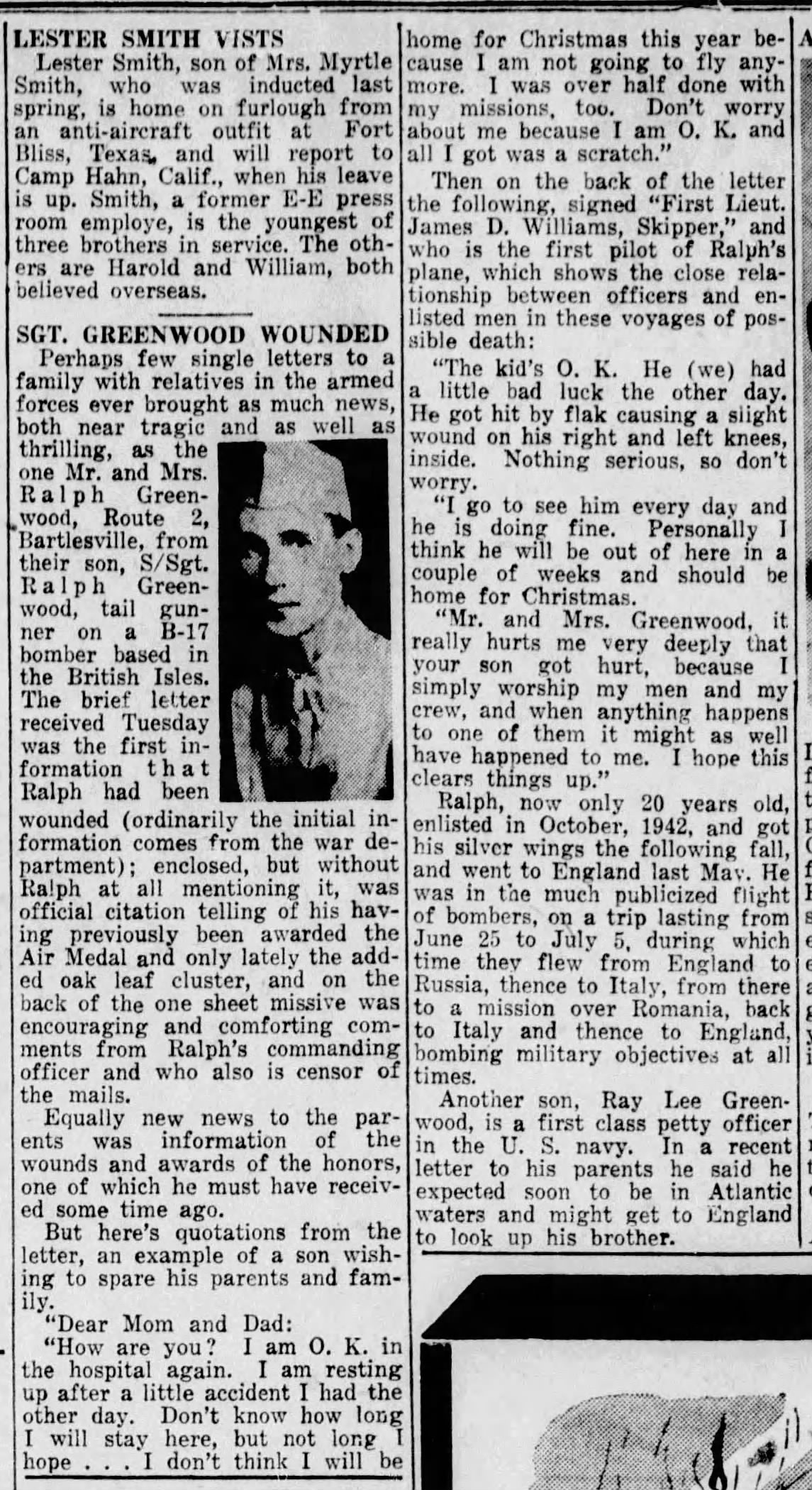
| Ralph Greenwood WIA with quotes from James Williams | Morning Examiner Aug 18 1944 | 12:00 am |
Comments and Notes
Memo 1:
CREW


2nd Lt James D. Williams                             P CPT

2nd Lt John W. Wearne                          CP CPT

2nd Lt James T. Miller                           NAV CPT 13/9/44 SINDELFINGEN, MOTOR WORKS

    F/O Jonathan P. Laverick                     BOM CPT 15/10/44 COLOGNE, MY

  S/Sgt Clarence A. Peterson                    R0G CPT

  S/Sgt Jack A. Fowler                           TTE CPT 13/9/44 SINDELFINGEN, MOTOR WORKS

    Sgt William T."Sonny Boy" Fessier           WG CPT

    Sgt Gospodin Gospodinoff                     BTG CPT

    Sgt Jerome Goshin                             WG CPT

    Sgt Ralph M. Greenwood                        TG WIA Wounded 5/8/44 and in 65th general hospital for 43 days. Sn# 18162220


349th Sqdn.  Crew, as above, joined the 100th Group on 29/5/44.

"SKIPPER II"  See S.O.C. p. 67/68.  18/8/44 Gospodinoff to Central Medical Board for flying tests (2 days).

Crew flew "987" SHILAYLEE/THE LITTLE SKIPPER

This  became a Pathfinder Crew (PFF).


Believe most of crew completed their tour with missions listed below execpt Laverick and Greenwood.


 MISSIONS OF T/SGT JACK A. FOWLER sn# 39120644 (mpf nov 2000)


1.   4/6/44  BOULOGNE

2.   5/6/44  BOULOGNE

3.   6/6/44  D-DAY-OUISTREHAM

4. 11/6/44  BERCK sur MER

5. 18/6/44  BRUNSBUTTELKOOG

6. 19/6/44  CORME ECLUSE

7. 20/6/44  FALLERSLEBEN

8. 21/6/44  RUHLAND-START OF 1ST RUSSIAN SHUTTLE MISSION  (Sgt Don Allen, 4th Fighter Group Crew Chief, flew as WG)

9. 26/6/44  DROHOBYCZ, POLAND

10.   3/7/44  ARAD, ROMANIA

11.   5/7/44  BEZIERS

12.   7/7/44  BOHLEN

13. 11/7/44  MUNICH

14. 13/7/44  MUNICH

15. 14/7/44  MAQUIS SUPPLY DROP

16. 18/7/44  KIEL

17. 19/7/44  SCHWEINFURT

18. 20/7/44  MERSEBURG

19. 24/7/44  ST LO

20. 29/7/44  MERSEBURG

21. 31/7/44  MUNICH

22.   2/8/44  LA FERE

23.   4/8/44  HAMBURG

24.   5/8/44  MAGDEBURG-TG INJURED

25. 24/8/44  RUHLAND

26. 25/8/44  POLITZ

27. 26/8/44  BREST

28. 27/8/44  BERLIN (RECALL)

29.   1/9/44  MAINZ (RECALL, WEATHER)

30.   3/9/44  CROZON

31.   5/9/44  STUTTGART

32.   8/9/44  MAINZ

33. 12/9/44  MAGDEBURG

34. 13/9/44  SINDELFINGEN


Mission Memories of S/Sgt Ralph Greenwood

Serial number: 18162220

349th Bomb Squadron

Tail Gunner on Aircraft # 987  “SHILAYLEE”


Bombing Shuttle Mission:

 Ruhland, Germany June 21, 1944


After the Bombing mission, the crew dropped the plane down to a lower altitude, but ran into a thunderstorm and had to fly over it.  The plane was running low on fuel, couldn’t make it to any base and force landed the plane in a wheat field in Poltava Russia.  The force landing was suppose to be a wheels up landing, but the pilot decided to put the wheels down.  They were about 15 miles from the U.S. base in Poltava.  Russian peasants were around when the plane landed and the ball turret operator could speak a little bit of Russian.  The people were happy they were Americans.  It rained and they had to wait until it was dry enough for the plane to take off again.  There were a couple of Russians guarding the airplane while it was in the wheat field.


When they were ready to take off, one of the Americans stationed in Russia told the pilot that someone needed to have a drink with the Russians, as was the custom.  Lt Williams told  “Greenwood” to have the drink.  They poured a large canteen of Vodka and Ralph looked for a chaser.  The chaser happened to be a green onion and a can of butter.  This was the only shuttle run that I was assigned.  When we flew from Russia to Foggia, Italy and were there during the 4th of July.  The next day they picked up a target in Germany, while they were going to the target, they could see the Vatican from the Plane.


August 5, 1944

Magdeburg, Germany


The crew left the base in England to go on a bombing run in Germany.  The target was a Tiger tank factory (synthetic Oil).  The flak was heavy, intense and accurate.  It was very bad that day.  One of our planes pulled up and dropped their bombs, it hit another B-17 and it exploded.  A few moments later I was hit by a piece of anti-aircraft shrapnel.  The plane was still operational and continued on its mission.  I was hit just before the bombs were released. The pilot came back and took me up to the radio room and gave me first aid and stopped the bleeding.  Once back at the base in England, he stayed in the 65th general hospital for 43 days.  To this day, Ralph Greenwood has a piece of shrapnel in his knee but does not walk with any type of limp.


Base Memories:

He used to carry a lucky charm and on the day he was hit it, was sitting on the bed.  From that point on, he  said to never have a lucky charm and never had one since. His Daughter said they were never allowed to have one either.


S/Sgt Greenwood was discharged from the military at Sheppard Field, Texas Oct 21, 1945.


COMMENTS = I'm looking for information for a friend of mine who flew on the Russia Shuttle Mission with the 100th. His name is S/Sgt Don Allen, crewchief belonging to the 4th Fighter Group. He would like to know the crew he flew with and which aircraft he was in. I believe he flew 4 of the missions with the 100th on this Shuttle as a gunner.

If you could help I would appreciate it. Thank you.


Dear Bruce,

Was Don's middle initial "E".  If so I have the answer for you. He flew with the Crew of Lt J.D. Williams, 349th Bomb Squadron, 100th Bomb Group as Right Waist Gunner.  The plane they flew was Called Varga Venus, 2102621 and he is correct about the 4 missions flown during that Russian Shuttle Mission.


6/21/44  Ruhland

6/26/44  DROHOBYCZ, OIL REF

7/3/44    ARAD, MY (RUMANIA)

7/5/44    BEZIERS, (FROM ITALY)
Memo 2:
FRIENDSHIP

Friendship is the inexpressible comfort of feeling safe with a person, having neither to weigh thoughts nor measure words

By George Eliot


WHAT MAKES A DAD

        God took the strength of a mountain,

The majesty of a tree,

The warmth of a summer sun,

The calm of a quiet sea,

The generous soul of nature,

The comforting arm of night,

The wisdom of the ages,

The power of the eagles in flight,

The joy of a morning in spring,

The faith of a mustard seed,

The patience of eternity,

The depth of a family need,

Then God combined these qualities,

And then there was nothing more to add,

He knew His masterpiece was complete,

And so, He called it        DAD.

Author Unknown

                                  GRANDFATHERS

Grandpa is a Kid's best friend

Author Unknown

PREAMBLE OF LIFE

Life is but a bed of thorns with a few scattered roses,

Love, cherish and protect with all your might,


Those few scattered roses.

                            By Mary Edgar Williams  Pop’s Mother.

All of our lives we are surrounded by dangers of one nature or another (the thorns) but the things that are close and dearest are your loved ones (the roses).


                                                                     WILLIAMS FAMILY

	                                                              ================

The Williams Family has been traced through the Library of Congress in Washington D.C., and historic archives in London, Brussels and Paris.  As to the Lowry (Mema’s) family they can be traced only back into Kentucky and Tennessee.  Somewhere along the line their last names were changed and all records lost.Mema's maiden name was Imogene Lee Lowry the daughter of Hollie Lee and Rocxie Lowry.  She had two brothers Boyd Neal and Royce. Boyd Neal is a retired high school teacher and lives in Stevensville, Texas and has two children, one boy and one girl and one grand son. Royce was a Lieutenant in the Air Force as a Navigator and Bombardier and was killed in a crash in Nebraska at the age of 23.

Mema's grand parents came from Arkansas to the Indian Territory,  now Oklahoma, then to the Panhandle of Texas by wagon train. Her parents were in the grocery business and in farming. Mema graduated from Muleshoe High School in Muleshoe, Texas and went to Business College in Lubbock, Texas where she made the fatal mistake of meeting an Air Force Sergeant pilot and was married two months later. That was 51 years ago and it is too late to get unhooked now.


Pop's Grand Parents were from Missouri and Virginia. His parents were ranchers. Both Mema and Pop's parents went through the great depression. Pop graduated from Keytesville High School Keytesville, Missouri and then went to Arkansas State College at Jonesboro, Ark.. This was in 1939 and when war broke out he joined the service and was stationed in Hawaii and was there during the bombing attack on Pearl Harbor on December 7, 1941. At that time he was a 1st Sergeant of the 4th Fighter Squadron, Wheeler Field Hawaii. He signed up for flying school and was shipped back to the States for pilot training. Graduated from flying school in 1943 and also graduated from Glider School the same year. This allowed him to wear both pilot wings and glider pilot wings. There were only 12 in the Air Force that were authorized to wear both wings.


He was assigned to heavy bombers as 1st pilot and went to England and flew 33 missions. This included the Russian to Italy to England shuttle bombing runs. From England to Russia we bombed an Aircraft factory at Wiesbaden Germany and from Russia to Italy we bombed Drohibits, Poland and from Italy we bombed Mount Casino and then on the second mission out of Italy bombed in front of our troops in southern France. Made 2 bombing missions on D day Northern France.  Upon returning to the U.S was assigned as Group Operations Officer at Yuma, Arizona.

He went back to Germany during the Berlin Air Lift. I flew 202 trips from the English sector to Berlin. We flew the Air Force C-54 a 4 engine transport. All except one of our trips we flew 10 to 12 tons of coal. There was a plane landing ever 4 minutes 24 hours a day. The coal was essential to keep the factories, electrical power plants and the homes warm for the people in Berlin. When he was returned to the US he resigned his commission and started up a business. This was in 1949 and sold out in 1960 and moved to Sacramento, Ca. and went into business here retiring in 1985. He stayed in the Air Force Reserve and was permanently retired in 1963 as a Lt. Colonel. Mema worked for the State of California and retired from the state in 1986.

Imogene and James Williams (Mema & Pop) had 3 children, Venetta, Richard (Rick) and James D (Muggs) II. Venetta married Larry Hoplkins and had two boys, Mark and James D.. Mark was married but had no children and divorced. James D. married and has 3 children one set of twins. Richard married 4 times and having one daughter. (I hope that the 4th time will be a charm. They both have been married before and so far (after 7 years) it looks pretty good. (I hope so). James II married divorced and has two sons James D.III and Justin.  That is a thumb nail sketch of the clan.Venetta is working for the State of California and will be retiring in 2 more years. Richard works for the GoodYear Tire and Rubber Co. and James (Muggs) works for the State. Venetta is 50, Richard 45 and James 40.


                                                                 PREFACE

                                                                  -=======-

It was a cold winter night in the early morning hours of January 12, 1920, in a big two story house set on a hill, in the bottom land of the Grand River, 4 miles west of Triplett, Missouri, that twin boys were born.

The twins James David and John Peter Williams were the sixth and seventh children of Mary Edgar and Boyd Taylor Williams.

Mary and Boyd Williams were united in marriage in the year of 1901.  From this marriage, eight children were born.  Edward, Mary, Ralph, Allen, Elizabeth, James, John and Margaret.

The Williams and Rucker lineage can be traced through the Library of Congress, Washington D.C., archives in London and Brussels. The lineage can be traced to the Crown Heads of Europe.

Edward Williams , Father of Boyd, was a successful Farmer in the County of Chariton, Missouri and was very influential in the Democratic Political Party. John P. Williams, the father of Edward, was a very prominent and highly respected Civil Engineer. He was commissioned to survey the boundary of the State of Missouri and such boundaries were accepted when Missouri was accepted and made part of the Union.Kathern Haskins, Mother of Boyd, was a member of a  very prominent farming family. Kathern was very active, in the State and National Women Suffragette Movement.

Edward and Kathern Williams had 7 children of which Boyd was the oldest child.

Clifton and Emma Rucker were the parents Mary. Clifton Rucker was successful merchant in Brunswick and Keytesville, Missouri.Within the two families, there were many prominent persons consisting of State Representatives, Senators, Judges, Chief of Staff of the Arm Forces and Generals in both Armies during the Civil 'War.

The Williams family lineage consists of Ranchers, Farmers, and Engineers.

The Rucker family Lineage consists of merchants, senators, judges and generals in both armies during the civil war.


                                                                 LIFE AND TIMES OF

                                                              JAMES DAVID WILLIAMS

                                                                -==================-

                                                                  by Harry Lewis


My earliest recollections and experiences occurred 1925.  We had a red mule that all of the kids rode.  Kids would be stacked from his ears to his tail and when he had enough he would gently walk under the clothes line and sweep us off and after all were off he would stop and just look down at us and sometimes bray. When ever he would accidentally step on one of our feet he would lower his head and we would hug his neck and have our cry.


During this summer all we wore was some cutoff pants and go barefoot.  It was that summer that there was an epidemic of whooping cough in the country and all of us kids had it at one time.  You would get to coughing and that would cause you to vomit.

Mother put down mattresses on the floor around a big wash tub so all we had to do was hang our head over the side of the tub and let it fly. It was during this time that a big thunder and lightning storm came up in the night and our house was struck by lightning. It struck the roof of the house and came down the roof, down the side of the house through a big double window and doors and out the windows on the other side of the house.

Mother’s sewing machine was right in front of the windows when the lightning struck. It wrapped the button box in the drapes carrying the glass out of the windows and buttons right through the house across all 5 of us children and out the other side of the house. We found the button box and glass from the window wadded up in the drapes about 200 ft. from the house. Not one of us had as much as a scratch. Where the lightning hit the roof and came down the side of the house it looked like someone had taken a big sledge hammer and beat the shingles off and caved in the side of the of the house between the studs.

In 1926 my Twin Brother and I started school in the first grade, in a country one room school house. They taught from the first grade through the 8th grade with only one teacher.  We had to walk to school which was 4 miles through the woods and fields.


By now we were big enough to work on the farm and do chores. In the fall we shucked corn. In the fall we cut wood to heat the house. In the summer we helped with putting up hay, shocking wheat, oats and corn and help with the thrashing of the grain. In the winter we would cut ice from the pond and put it in the ice house. In those days they didn't have refrigerators so in order to have ice during the summer you went to the pond and cut the ice with a big saw into blocks and take it to the ice house.

The Ice House was a big hole in the ground that was 25 ft. across at the top and tapered to 20 ft. at the base and was 20 ft. deep. They would line the bottom of the pit with 2 ft. of wheat straw and lay down a layer of ice then use rock salt to salt it down then another layer of ice until it was filled to the top and then they put 3 ft. of straw on top.  Usually 4 or 5 neighbors would go together and put up the ice for the summer.


            In 1928 a tornado struck our big barn which was 250 ft. long and 15,00 ft. wide and along one side was the corn bin which had over 15,000 bushels of corn stored in the bin.  The tornado lifted the barn up and set it over about 10 ft.  The barn was about 200 ft. from the house and there wasn’t even a breeze at the house.  We just watched the funnel go by.


In 1929 when they had a very big flood, it flooded out all of our property except the house and barn on top of this knoll.  It was over a half of a mile to the cliff so we were completely surrounded by water.  The only way we could get out was by boat.


	When the big levee broke on the Grand River and the flood water flooded the property you could watch the wall of water coming.  It was about one foot thick rolling across everything.  All of the wild animals were swept in front of the oncoming water.  All in all there were over 200 rabbits. Several coon, foxes, dogs, skunks and many other species of animal.


	The flood waters lasted for about 2 weeks and since we couldn’t go to school we would pen up the rabbits one day and let out the dogs and reverse the process the next day.  This gave us plenty to do with our spare time.


One just can’t imagine how many and how big snakes get.  Going through the trees there would be several snakes in each tree.  Snakes that you would never see otherwise were seeking safety in the trees.  Some of the snakes were over 7 ft. long and were over 4 inches in width.


	There was a heavy loss of animals that was swept away by the flood waters along with houses, barns and out buildings.  We were very fortunate to get all of our stock to high ground.


We had just begun to harvest the corn crop when the heavy rains hit and then the flood. The corn crop that year was very good and was averaging better than 70 bushels per acre which gave an estimated loss of over 14,000 bushels left in the field and was a complete loss.


The real shock came in the fall of 1929 when the stock market crashed. All banks and money institutions closed.   The only hard cash you had was what was in your pocket or hidden in a sock or jar. Those that had investments in stocks, bonds or in bank deposits were wiped out completely.


The banks lost no time in foreclosing on property and possessions. One day you were driving nice cars and had hired help. The next day nothing! You couldn't sell anything because there was no money. The "Great Depression" was politically contrived.  At that time we had a Republican President Hoover and the Democrats had gotten majority in the House. President Hoover wanted to enact strict banking regulations, Federal Reserve to prevent the closing of banks and the depositors losing all of their accounts.


People were going wild playing the stock market, plunging and borrowing everything that they could thinking that they were going to get rich. The only people that got rich were the Morgans, Goulds, Rockefellers and about 6 more who sold out a couple of days before the crash. By selling out they started the run on the market. It took less than 24 hours to destroy the entire monetary structure of the United State.


The Democrats got into office alright. They were set with their salaries and dozens of other privileges. They were about the only people that got paid. Most things were bartered for. To give an example of the cost of items;


Commodity		Farmer Sold		Consumer Price

Eggs			$ 0.03 /Dozen		$0.05 /Dozen Pork.

Pork			           0.04 / Lb.		0.07 /Lb.

Beef			           0.03 / Lb		0.05 /Lb.

Hamburger		0.05/Ea.

Coke			0.05 /Ea.


Wages, if you could find a job, paid $0.10 per hour. This is generally how it was in most of the country.   Some places better but most were worse.


You were considered fortunate to have one pair of shoes per year.  Very lucky to have two pairs of pants and shorts.  After a couple of years all of your clothes and wearing apparel was worn out.  There was no such thing as being poor everybody was in the same boat. The whole society was turned upside down as far as wealth was concerned. About the only thing you had left was your pride. Fortunately living on the farm we were able to survive off of the land.


By 1932 Roosevelt had gotten in office and the first thing that he did was put into effect the majority of the policies that President Hoover had been trying to get Congress to act on for 3 years.


This was the beginning of the social engineering. It was the beginning of freeloaders on the handouts of the Government. As time has passed more give away programs have been enacted by our government. The grand scheme behind most Social Engineering is to buy votes.


The only recreation during this period of time was ice skating in the winter, playing cards, having dances at different people’s homes or barn dances and hunting with killing clubs for rabbits. Ammunition for the guns was too expensive.  During the winter we would have trap lines for coon, muskrat, skunk and occasional fox or weasel.


During the summer on weekends and holidays there were always ball games, picnics and horse back riding to the river or pond to go swimming, always in the nude.


	The year I lost my mother I was in the freshman class in high school. Working one or two jobs and going to school left no time for growing up. From the time I was 10 years old I had to work hard just to survive and have at least two meals a day. We were very fortunate because a lot of people did good to have one small meal a day.


From the time I was 12 I worked in the fields until wheat harvest time came, in the last week of June or the first week of July. Cutting wheat, oats and barley most generally started about the middle of June. In those days the combine had not come into use the crop was cut with a binder and you would pick up the bundles and stack them in a stack so the grain could finish drying for thrashing. When they thrashed the crops all of the neighbors would pitch in to help with bundle wagons or grain wagons. Those that didn't have wagons would walk along and pitch the bundles on to the wagon to be taken to the thrashing machine where the bundles would be tossed into the machine and the machine would knock the grain out of the head and auger the grain into a wagon or truck to take to the granary or storage silos for feed or seed for the next year.


In high school I played the tuba in the high school band and the ensemble. I also sang in the school choir and church choir. I sang 1st tenor in the vocal quartet which we won 2nd place in the state. I won first place in state for tenor solo.  I was also a member of the State Future Farmers of America Band. There were over 400 musicians in the band from all over the state of Missouri.


I graduated from High School with an "A" average and went Arkansas State College at Jonesboro Arkansas. I was working toward an Engineering Degree in hydraulics. The war in Europe and in the Pacific was really getting nasty and I could see no out for the United States so I enlisted  in the Field Artillery at Ft. Leavenworth, Kansas and was shipped to Hawaii May of 1940.  I had taken two years typing in High School and kept in practice in college, I was able to keep up my words per minute speed, exceeding 100 words per minute, I was assigned to Headquarters Hawaiian Division as a clerk typist and steno operator for court marshals. In those days they did not have copy machines and all single copy documents had to be duplicated by typing the document over for the files in Headquarters.


I was transferred in September 1939, from the 8th Field Artillery, to the 19th Infantry Division for the purpose of making rank of corporal but still worked in Headquarters.


By this time, the Armed Services began building up their forces and a lot of promotion slots opened up. In January 1940 I was transferred again and promoted to Sergeant and still assigned to Headquarters Hawaiian Division.


In June of 1940 the services decided that all clerk typists had to pass a typing test of not less than 40 words per minute. Also all personnel were required to take an IQ test. In typing on an electric typewriter I grossed 107 words per minute and netted 105 words per minute. On the IQ test I scored a 168.


The IQ score qualified me for any schooling I desired. In September 1940, since we had duty only half a day, I signed up for classes at the University of Hawaii and carried 12 units.

`

In June 1941 I applied for West Point, but before the papers could be processed, December 7, 1941 became history. They were accepting applications for flyng sergeant training. I applied and in less than a month I was on the USS Grant, a Troop Transport, headed back to the United States.


When on a military transport, all enlisted personnel are classified as "salt water privates”, and pulled duties such as KP, Guard Duty and any other details that may be required to maintain ship operations.

I was assigned to the ship’s store room down in the hole of the ship. This was the last deck on the ship. Below this level was water ballast and main drive shaft for the ship’s propeller.

They had assigned me a helper, who was being sent back to the mainland hospital as a mental case. The cargo hole was right over the open port which was about 4 ft. square. In the process of loading the hoist my mental case got over balanced and was falling toward the opening above the shaft. I threw myself across the opening and saved him from falling down on the drive shaft coupling. Had I not caught him, he would have been killed in seconds and shredded to pieces.

In keeping him from falling down on the shaft, his 200 pounds of weight crashing down on my back and broke the cartilage in both shoulders. This idiot was so scared that he escaped to the upper decks as fast as he could leaving me hanging on by my fingers. It took me more than an hour to pull myself out of that hole. I did not report this to the doctor because had I done so it would have disqualified me for pilot training.We were on the high sea 5 days before we arrived in San Francisco and were sent by ferry to Fort Mc Dowell, an island in San Francisco bay.After Pearl Harbor attack we never stood reveille where it was customary to play the National Anthem and fire one round of cannon. In combat you never have roll call or any type of formation other than combat. It was an ideal time for snipers to work over the troops.The first formation we had when we got on Fort Mc Dowell was retreat. There were 68 of us that had come back on the ship right out of combat and when the cannon went off the formation scattered like a bunch of quail.


We stayed at Ft. Mc Dowell only one week before being shipped to Santa Ana Air Base, which was just being built and is now John Wayne Airport. Santa Ana was a staging and processing area. While there we were given a 10 day leave to go home.

Of course the only means of travel in 1941 was by car or        train.  It took 3 days and 2 nights to go by train from Los Angeles to Kansas City. This left me only 4 days that I could spend with my family before heading back to Santa Ana.When I got back to Santa Ana my orders for flying school were ready and next morning I boarded a train for Hemit, California for primary pilots training. Hemit Field was brand new and we were the first class of Aviation Students to be trained there. Only two other classes of Cadets had gone through the school there.When we arrived they had us in formation at attention, the usual military way of doing things. We had as squad leaders cadets that had washed out of flying training and waiting for assignment to some base. Next to me was an old friend of mine, Sergeant Travis, who had been assigned to Guam and was there through the bombings and strafing by the Japanese and had picked up two purple hearts. We both had the rank of Staff Sergeant.


We had not been issued summer clothing and it was hot as hell and we all were sweating up a storm. To top that off this cadet who had only been in the service a couple of months was standing there shooting off his mouth about anything and everything of which he knew nothing. My friend Travis was standing right beside me. That idiot of a cadet had us carrying our luggage while standing there instead of allowing us to set it on the ground. We had been standing there for about 30 minutes when Travis sat his duffel bag down on the ground and had a tennis racquet handle sticking out of the top. The cadet platoon leader spotted the bag immediately and came charging over to Travis, who was 6'4" and weighed 200 pounds while the cadet was a dusty butt about 5'4" and did good to weigh 115 pounds, looked up at Travis and hollered, hit a brace mister. Travis just stood there and looked down at him like he thought that he was a complete nut. The cadet took Travis' tennis racquet from his duffel bag and in a screaming voice said "mister I told you to hit a brace" and with that whacked Travis on the shin with the racquet. Travis just reached down and grabbed the racquet and brought it down over the cadets head, breaking the strings and the racquet up around his neck.


Travis just held him up with the racquet at eye height and proceeded to read the cadet a few military regulations. First, I am not a mister I am a sergeant in the United States Army Air Force. Second, you will address me in a military voice and manner not like some spoilt rich brat. Third, you never touch or strike an enlisted person; fourth, you do not, under any circumstances, touch another person’s equipment or private property. Five, you take the comfort of your troops into consideration at all times and you don't have them standing at attention holding 60 or more pounds of baggage in 100+ weather. Last, but not least, I out rank the hell out of you. By now the Cadet was about ready to pass out and all he could do was nod his head. Travis just let him crash to the ground and took his racket from around the Cadet’s head and calmly placed the racket back in his duffel bag.


About that time the base commander showed up, who was a Captain. He dismissed the cadet who went staggering off. The Captain walked up to Travis and informed him that while here in training his rank would be aviation student but would be paid according to his enlisted rank. He was informed that a cadet out ranked a aviation student since when the cadet graduated he would become an officer and that the aviation student would still be just an enlisted man. He also informed Travis that he could not understand why they sent a bunch of enlisted Men to train with Cadets. We were the first class of aviation students to be trained there.In our class 42-I there were a total of 120 students consisting of 62 cadets and 68 aviation students When the class graduated 2 months later 64 aviation students 11 cadets for a total of 75.  51 cadets and 4 students washed out. The Commander just couldn't understand how that happened. He found out, when he went to Headquarters and spoke to Major General Davidson, Commandant of Aviation Training Command on the West Coast.


Most of the aviation students were in the General's command in the South Pacific and he was the type of commander that took great pride in knowing the name of every man in his command.

The Commander must have really teed the General off. Before the Commander got back to the base a new commander had arrived. The Commander was shipped out next day to the bomber training command and upon completion of his training was shipped to North Africa. We heard that he was shot down over Italy.

The crew of his B-17 bomber consisted of 3 officers and 6 Airmen. The real irony of his attitude related to the difference between officers and enlisted men. Enlisted men were inferior and no more than trash. Although his enlisted crew members saved his life when they crashed in Italy, even his enlisted crew respected his life although he was a snobby snooty bastard.

Before our class arrived at Hemit, the general order was that the upper classmen hazed the new cadets. But when we arrived, most of us had already had quite a bit of combat under our belts and we were there to be trained to fly airplanes and return to the battle front. Man, we sure didn't cater to that childish play and needless to say that there were a lot of cadets that got their butts kicked. The first week end pass we got, over 5O of us headed for General Davidson’s office and laid the chips on the table that we were there to train and get back in the action. By the time we got back to the base there was a General Order signed by General Davidson that there would be no more hazing. The Commander was really pissed off but he was smart enough to keep his mouth shut.


The Commander called a meeting of all the aviation students and came right out and said that this was a military base and that he was going to run it like he wanted to and that a bunch of GI's was not going to dictate to him how to run the base. What the Commander didn't know was the General was sitting in the back. Normally the General would first notify the base commander that he was on base. But since the Commander was in his quarters before coming to the meeting, he missed the General. Travis got up and reminded the Commander that he had stated that this was a Military Base. He told the Commander that all we asked was that the base be run like a military installation and not like some boy’s military school.

The Commander was red as a beat and jumped to the mike, but before he could say anything the General was coming down the isle holding his hand up for silence. The General took the mike and summarily dismissed the Commander. The new Commander was there next day and took command. At the very first meeting he let it be known that henceforth this was a military base and its sole purpose was to train men for defense of our nation and it sure wasn't a preppie school. He let it be known that as far as he was concerned while the students were here in training they would be treated equally. Hemit Field was to set the pattern for all flying schools in the US.Before December 7, 1941 the pilot training program required 2 years of training before graduating as a qualified pilot. Now the program was sped up to 6 months to qualify students as pilots. Where it used to take 7 months to complete each of the three phases, primary, basic and advance training, this was pushed forward to 2 months per each phase.  Yet we received the same training as before.


Instead of having a 4 hour workday, (2 hours flying 2 hours of ground school in the morning with the rest of the day for recreation, sack time and special lectures once and a while) the normal day started for them with up at 6:30 AM, breakfast at 7, and flying at 8 for 2 hours and 10:30 to 12:30 class with lunch at 12::45 But the accelerated pilot training was rigorous and demanding.  Reveille was at 04:30, breakfast at 05:00, flying from 6:00 until 12:00, lunch 12:15, ground school at 13::00 until 18:00, dinner at 18:30 and one hour of calisthenics from 20:00 to 21:00 and lights out at 21:30. Where as before with the extended training program their training was on a 5 day week. With the accelerated program the training was on a 6 day week. Needless to say, with this schedule it separated the boys from men. That was why the wash out rate was, on an average, 50% of each class. This wash out rate carried through the basic training and by the time they got to advance training about the only wash out was for physical reasons, usually caused by the pressure applied during the primary and basic training.

It was interesting that the wash out rate between the aviation cadets and the Aviation Students was very lopsided. The wash out rate of the cadets ran close to 75% while the aviation students wash out rate was less than 10%.  95% of the cadets came from college and university applicants with 5% coming from the enlisted ranks. This of course really chafed the butts of the regular officer corps which was made up of graduates of the military academy. It was their stupid ideas (that had been pumped into them in the Military Schools) that the enlisted man was a necessity in time of war and was expendable equipment and beneath the station and dignity of an officer. In other words an officer was a gentleman and the enlisted man was scum not to be of the same social standing. In other words they were almost slaves to the officer corps. There were a lot of officers during the war that were dispensed with or suddenly disappeared to never return or was returned in a pine box.


The main reason for the low washout rate of the aviation student was the fact that the great majority of them had some combat under their belt and they were trained under combat conditions. The majority of them were already tough as nails and mentally adjusted to combat conditions. They sure were not in the mood to be playing college games. Their sole aim and purpose was to get back to the dirty business of war better equipped.

 The graduating class of 42-H graduated on a Friday and boarded a train for Basic Training at Bakersfield, Ca. We arrived in Bakersfield on Saturday and were assigned quarters on Sunday and started School on Monday morning.  Our Squadron commander was another one of those who thought that cadets and aviation students should not be housed in the same barracks because the cadets were gentlemen and the students were trash. We were the first class of aviation students in the pilot training program at Bakersfield. The commanding officer was a ROTC reserve officer who really did not have the experience or intelligence to be a commander. He called the aviation students together and informed us that he was going to do every thing possible to see that we were washed out of the flying training program because we were being put on the same plane as the cadets.

He started out by having us field strip our beds and we were not allowed to make our bunks until 10 PM at which time he made an inspection to make sure that we did not touch our bunks until that time.

His next move was to have a surprise inspection between 1 AM and 2 AM and have roll call at 4 AM and barracks inspection at 5 AM; Breakfast at 5:30; and flight line at 6AM. Flew until 12 then lunch followed by ground school until 5PM., Usually a lecture until 9:50 and then lights out at 10. The commander had managed to separate the cadets in another barracks and their schedule was just opposite of ours; if we flew in the morning the cadets would fly in the afternoon.

The Cadets lights out was at 9:30 PM and they had no midnight inspections and had roll call at 6AM.

The Commander decided to have a touch football game between the cadets and the students. His whole purpose was to show the students that the cadets were superior to them. This was the chance for the aviation students to tear some asses up. It only took about 20 minutes for the students to wipe out the cadets and the game was called off. The cadets looked like they had been caught and stomped and rightfully so. They had been stomped all right by the students. The Commander was so pissed off wipe out the cadets and the game was called off. The cadets looked like they had been caught in stomped and rightfully so. They had been stomped all right by the students. The Commander was so pissed off that he tried every which way to get us washed out.


It was then that 24 of us aviation students requested transfer to the newly formed Glider Corp and we were shipped to Albuquerque, New Mexico with assignment to a Glider School for training as instructors. We stayed in the assignment pool for over a month and during that time all we did was make model planes.We were shipped to 29 Palms California for the instructor raining. This training took 2 months and we were then shipped to Fort Morgan Colorado to set up a pre-glider school. Pre-glider school consisted of flying light aircraft, Piper Cubs. It consisted mainly of dead stick landings. That is where you would be flying at 5,000 feet and cut the engine off and glide in for a landing. This included night flying also. They did not have lights of any kind on the Cubs. The only light you had to fly by was a flashlight, the seat of your pants, your head on a swivel.Twelve of us were shipped to Fort Sumner New Mexico to set up another pre-glider school. We were there for about 30 days and then shipped to Lubbock, Texas as instructors in the big CG-4 combat glider. We were there from August 1942 to January 18, 1943.


It was at Lubbock that I had the good fortune of a blind date where I met Imogene Lee Lowry. This was November13, 1942.  On January 14, 1943 I called Imogene; she lived in Muleshoe Texas. She had planned to come to Lubbock on Saturday, but I told her to not come down on Saturday but to come down on Friday that we were going to get married on Sunday January 17, 1941 at the Base Chapel. We had discussed getting married but after the war. Then we moved it up to within 3 months. Then I received orders to be shipped out to Victorville, Ca. to train Glider Pilots in the CG-4 cargo glider that was used in the invasion of Italy, Barnio, Germany. I was to be shipped out on January 18, 1943 at 8AM. Of course Imogene was so stunned at my orders all she could say was a meek OK

The train trip to California, in the dead of winter sure wasn't a very pleasurable trip. From Clovis New Mexico we had only one steam engine pulling us and there wasn't enough steam to keep us moving and to keep the coaches warm. The results were that going over the high plains of New Mexico they cut off the steam to the cars. The temperature had dropped to -10 degrees and all of metal inside the coaches were frosted over from the moisture of our breathing. When we got to Albuquerque, New Mexico, since I was the Troop Commander, I forced the railroad to put on two additional engines. They were going to argue with me about it and said that they didn't have any spare engines. By now there was over a 100 cold service men backing me up and it didn't take them very long to get two more engines hooked to our train. This really pissed the engineer and conductor off to have been forced to put on more engines by a bunch of GI's. They cut down the heat to the coaches to where the temperature was sitting at 32 degrees. When we got to the first watering stop, several of the boys cornered the conductor and the engineer and flat told them that they had 20 minutes to get the heat up in the coaches or the next time they had to come back there would be no excuses and that their good health would be in danger. In 20 minutes the heat was coming up in the coaches and by the time we pulled on to the main line the temperature was up to 70 degrees and was maintained at that until we came down into Barstow California.


I had a 1939 Buick Special that I left with my new bride which she was going to drive to California with 3 other GI's wives. By the time they got to El Paso, Texas they  had blown 2 tires. So they put the car in a garage and rode the train on in to Los Angeles.While being stationed at Victorville we trained Glider Pilots and loading crews on how to secure a load on the CG-4 Glider. In order to accustom the pilots to flying a loaded glider we weighted down the glider with 5,000 pounds of sandbags. This represented the weight of a Jeep with 12 men and their equipment.

After we had trained the first 100 men, the Army Air Corp deter-mined that they could not send enlisted pilots into combat. They came up with the rank of flight officer. The flight officer’s status granted the officer the privilege of a commissioned officer except command.   Only when he was at the control of his aircraft could he have command status.

After being made flight officer, I made application to return to power flight. I was sent to Bakersfield again and completed my basic flight training and was sent to advance pilot training at Stockton, California. In primary and basic training we flew single engine airplanes but in advance we flew twin engine planes.

I graduated from advance flying school and was assigned to a bomber training base at Roswell New Mexico and had 10 days to report. I stopped off and got my car out of storage in El Paso and drove on to Muleshoe where Imogene had gone on home when I was transferred to 1st pilot training on the B-17 bomber.

While in training in Roswell, Imogene was able to be with me. We were able to rent a small house across from the Roswell Military School. Having my beloved with me took a lot of stress and strain off of me just having a few hours of peace and quiet from the rigorous activities at the base.

The first pilot training had been condensed from a normal course of 120 day to 60 days. We were flying 8 hours, ground school 4 hours and calisthenics took up another hour. This was a 6 day routine. The requirements for 1st pilot in bombers was, critical considering that the loss of pilots was very heavy in all of the war zones.

When I completed the training at Roswell I was transferred to the crew assignment pool at Salt Lake City where I would be assigned my crew of copilot, bombardier, navigator, radio operator, armament NCO, ball turret gunner, tail gunner, top turret gunner and 2 side gunners.We had to stay there for 3 week waiting for our gunners to finish gunnery school. We were housed in the gym on the University of Utah campus.Other than having to report in once a day all we did most of the time was play black jack. Another lieutenant from Tennessee and I pared up. One would deal and the other would handle bank. We did all right as a pair and I was able to send money home.


It was in December and very cold. There was lots of snow and of course the quarters weren't exactly over heated and the showers were frozen up so a couple of time a week we would go into town and rent a room so we could bathe. One would rent the room and about 20 or more would "drop by" to visit and while “visiting” would shower. Two days before our assignment, I had gotten a room in town and about 10 came to my room to clean up and shower. In this group was one “Officer and a Gentleman" who was from a rich family from Boston and was a Harvard graduate. Lt. Spears was one of those officers who thought that enlisted personnel were far beneath his social standing and were nothing more than trash and were expendable.

After about half an hour of him expressing his opinion of the enlisted men and the thought of having to be that confined with him; he even elaborated on his opinion of the services even allowing GIs to become officers because it would impossible to make them anything but gentlemen. They had no social graces background or breeding to enable them to associate with regular officers.

After about a half an hour of listening to this, I asked for a show of hands of how many of them were former GI's or Reserve Officers from some ROTC program. There was a total silence for a minute then all raised their hands except it Spears. Lt. Spears went as white as a sheet and started to get up and a couple of the men grabbed him and slammed him back in the chair.


I guess, because it was my room, they all looked to me to answer the Lieutenant's remarks. I was the only person that had been in combat and at the time I was wearing six campaign ribbons with 3 battle stars and pilot wings above the ribbons on my left breast, and on the right breast was the presidential citation with one oak leaf cluster and glider pilot wings above.

I just sat there for a minute or two trying to calm my temper. All through my military career I had run into this type of attitude. This was the first opportunity I had to really cut down one of these snobs. He started to get up and I shoved him back in the chair and told him to sit there until I dismissed him. I instructed him to not even open his stupid mouth or utter one word or he would have to have a complete dental overhaul. Mr. - - -- if you want to get through this war alive and return home you had better hear what we have to say and heed the warning or you will get you damn fool head shot off and it won't be the Germans. Mr.- - - you are very ignorant. I know that you are not stupid or you would never have gotten through flying school and I am very surprised that you haven't had your teeth kicked in and your butt kicked up around your shoulders before now


All you have going for you is somebody else’s efforts and a warped ego. All you have done all of your life is sponged off of your family. You haven't had one responsible job in your miserable life. You have no idea of what leadership means. If you don't change your attitude. and damn fast, from this moment on you are not going to see your beloved sheltered home life again, because your enlisted men will not tolerate this type of treatment. For your information there are a hell of a lot of "GI's" that will compare "Social Status" with you and they will make you look about 2 inches tall. With your present attitude, that is really too tall. I would value your height as being able to walk under a snakes belly without bending.

Remember one thing from this night if you remember nothing else. It is this "Your men do not serve you.  It is you who serve your men". Another thing your enlisted personnel can make or break you as their officer is their spokesman. They in turn are the ones that will be protecting your butt. Whether or not you survive this war will depend on your leadership ability.  You lead them and you will survive but I must warn you, that you had better leave in this room the stupid self concept and that two bit ego you are carrying around. With that I dismissed him and two of the boys escorted him to the door and shoved him out into the snow. Two days later I received my crew listing assigning me all of my crew except my Navigator. I rounded up my crew and went to the Post Exchange and had coffee and we got acquainted with each other telling the others a little about their home, school and military training. Their service records hadn't caught up with them. Officers carry their military records with them when they are transferred to another station. But enlisted men's are mailed to their next assignment. Lots of times their records are months behind them


I had been lucky in black jack and had over $1,000 on me. I gave each of my enlisted crew members an advance of $200 each. The crew hadn't been paid in over two months and they were flat broke. It was at this meeting that they started calling me "Skipper" and gave my wife, Imogene, the title of "Little Skipper". When we got our B-17 assigned to us it was dubbed the "Little Skipper". From that day forward, my crew never addressed me by my rank. It was always Skipper. Even to this day I am still their skipper.

We were assigned to Ardmore Oklahoma for crew training. During this time Imogene, my wife, stayed at home with her parents in Muleshoe, Texas.


Our training consisted of cross country flights, gunnery range, and formation flying, both day and night.

It was my last week in training at Ardmore that my daughter was born, March 15, 1944. Something told me to get home so I hitch hiked from Ardmore to Muleshoe. I was able to get a ride to Mexico, New Mexico, which was 22 miles south of Muleshoe. I ran and walked that 22 miles in freezing weather and got to the hospital about an hour before my daughter was born. Aunt Mary was with me in the observation room where we watched my daughter being born. She was a breech baby, coming butt first, The birthing was very difficult.I had to return to base next day and upon arrival my overseas orders were waiting for us. We were to be shipped out in three days to Omaha, Nebraska where we were to pickup our ship for flight overseas. We waited for a week and finally were told that our ship wouldn't be ready for us and that we would have to go to England via ship and that our ship would be there by the time we got arrive there.	We shipped out two days later to Ft. Kilmer, New Jersey. We were at Ft. Kilmer for 5 days and then boarded the ship for England. We were placed aboard an English tub, a refrigerator ship. When I say that it was a tub it really was. poor ventilation below deck and being such a small ship when at sea it was like a cork bobbing up and down. We sailed for Newfoundland to meet up with the convoy to England. There were over 100 ships in the convoy consisting of every kind of transport you could imagine lying under the flags of all of the different allied nations.


Living down in the hole of the ship was almost impossible, with almost everyone sea sick. There was 100 bombercCrews, one company of communications group. Two companies of field artillery. This was a total of 2,000 men on board not including the ship’s crew.After the first day, about the only ones that ate were the bomber crews, the rest were too sea sick to eat. As usual the airmen and smrvice Men were billeted in the bowels of the ship and had to double shift the bunks. This included the officers also but at least the officers had only 12 men to a room. The bunks were stacked 3 high.Food supplies for the Americans were taken on board in New York. The ship's crew had their own mess hall and food supplies.  But, when we got to sea, the ships cooks swapped their menu with our menu. Their menu for breakfast was stewed tomatoes and boiled fish with hard tack for bread.  The coffee was putrid. The English never could make a decent cup of coffee. Always present was the orange marmalade and their butter was so rancid that you couldn't even eat it.


Again I drew the job of being troop ship commander. Being commander gave me some additional privileges as far as quarters were concerned.  We were lucky because our quarters were two decks above the water line and we had port holes. There were only 6 assigned to our room.

The ships crew was using our food supplies and trying to feed us their slop. On the third day, as troop commander, I had a firm talk with the ship’s captain concerning the food preparation aboard ship. I had canvassed the troops and found that there several professional cooks and 3 qualified chef's. We threw the ships cooks out and our personnel took over the cooking using our supply. The ships personnel did the kitchen police duty and serving. We fed two meals a day in order to get everybody fed. Even at that we had to feed in shifts and that meant that the mess was open 24 hours a day.

The convoy was on a zig zag course to try to evade the German U boats. After we left Newfoundland for the north of England, around the north tip of Ireland, the weather was very treacherous with very high winds and waves. The bow of the ship would be completely submerged and washed up to the pilot house. About 150 miles from Ireland we ran into a Wolf Pack of U boats. Man it was one hell of a feeling bobbing around like a cork and no way to protect ourselves. All you could do was just sit there with your butt chewing holes in your shorts. We ran into this condition only once but that sure was enough. We lost 20 ships out of our convoy. We watched ships being hit in front of us and both sides of us.

The ship on the port side received two hits with torpedoes that were meant for our ship but they barely missed us by less than 20 yards. Were we scared? Hell no - our mouths tasted like the sewer had backed up. It didn't take imagination to figure out where it came from. The last 4 days on the ocean was really rough and since we were on a zig zag course the captain had to take the waves regardless of the direction of swells. We had some heavy equipment lashed to the deck and in the worst part of the storm about half of the equipment broke loose and was swept over the side.


We had on board one Lt. Col. that never made it to England. He was one of those bastards that climbed over anybody and everybody to get promotions. He treated the enlisted personnel like so much dirt. Two days out of England in the Irish Channel the Lt. Col. could not be found on board the ship„ There was no doubt that he "accidently" fell over the side during the night before. During the voyage as troop commander, I had the authority to promote enlisted personnel. I took advantage of that little technicality and promoted all of my Airmen to master sergeant. In my opinion they deserved the promotion. I wasn't too sure that the promotions would stick but they did.


We received our group assignments when we got off the ship and they had transportation waiting for us to take us to our assigned bomber group. We were assigned to the 100th Heavy Bomb Group at station 139. The station’s location was 20 miles south west of Norwich England on the east coast. For the next 4 days we were briefed on combat conditions and flew a tour of England to orient us with the outlay. We all got settled into our quarters. It was cold and damp all of the time there in that it usually rained at nigh and was misty during the day. Just to keep warm you were weighted down with clothing. On the 5th day we were assigned our aircraft and the crew promptly painted "LITTLE SKIPPER" on the nose of our B-17.	Each crew was assigned their own aircraft along with a 6 man ground crew. Our ground crew sweated us out as hard as we sweated the mission. I saw ground crew work around the clock to get the "LITTLE SKIPPER" ready for the next mission. I saw ground crews actually break down and cry when their ship did not return from the mission and was reported lost.


The 10th day we were there we flew our first mission deep into Germany.  I must say that my crew came through with flying colors.  We got our bombs right on target. The flak and German fighters were very heavy but we did not lose any aircraft and sustained only minor damage to the "LITTLE SKIPPER"

Most of the heavy industrial targets in the west of Germany had been pretty well knocked out. We began to pulverize the railroads, bridges and highways. By the first of June our targets were concentrated in Northern and Southern France and consisted of anything that moved and any roads or rails going to the front that might be used as routs to get supplies to the invasion fronts in North and Southern France.

Our Fighters and Bombers had a field day inflicting great damage on the Germans; both men and equipment, that was stacked up clear back to the Rhine River, trying to get to their fronts.  All but one bridge across the Rhine River into Germany were cut off so the German Army was trapped.

Missions were hot and heavy and we sustained a lot of losses.  We got badly shot up several times but were able to make it home.


On one mission to southern France there were only 4 bursts of flak after we left the target and our ship caught all 4 bursts. One burst blew our No.3 engine completely off of the aircraft and also the flak destroyed our instrument panel except for the cylinder head pressure on No 1 engine and the tack on No 4 engine.

We were flying at 27 thousand feet when we got hit and I knew that there was no way we could maintain formation much less altitude. We were flying above the cloud deck and without instruments. To descend through the cloud deck, which extended to within 5 thousand feet of the ground, would have been impossible. I put it to the crew the options we had. One we could destroy the bombsight and bail out. Second; head for Northern France before bailing out. Third: lighten the aircraft by jettisoning everything we could get loose except the parachutes and head for the west coast of France and try to get to the ocean before we entered the cloud deck and could be picked up by air rescue. The fourth option we had was to glide through the cloud deck with minimum power and ditch. My engineer reminded me that I was also a glider pilot and I could  fly the plane through 13 thousand feet of solid cloud deck. This was the fifth option. I held out and wanted my crew’s input on our decision. Every one of them opted for option number five.


We threw everything out we could tear off including all but one parachute and the life rafts. My Engineer got a 2" nut somewhere and a 2 ft. string. Hanging the nut in the center of the cockpit and this made me an instrument that I could tell if I had my wings level also at what angle I was gliding. Having flown gliders I was used to the sound of the wind passing by my open window on my side of the plane so from the feel of the stick, the sound of the air passing the open window and the string with the nut I was able to glide. I was able to establish my rate of descent and not stall go into a steep dive. It also allowed me to fly straight and level. When we broke out of the clouds we were right over a big harbor and there was docked the biggest battleship I had even seen. Her guns looked like there were as big as trash cans. We could see the people looking up at us but the Germans didn't fire one single shot.


We were heading due west now and I had only limited power from the No1 and No 4 engines. Listening to my engines I judged that I was getting 90% output on No 1 and about 80% on No. 4. I put the ship in a very slow descent so as to get as much distance out into the ocean as possible to give the air rescue boys as much time as possible. We kept gradually losing altitude and when we got down to 300 ft. I had the crew in crash landing position. I was going to milk as much distance as I could. When we got down to about 100 ft. of the water the "Little Skipper" began to hold and by the time we were skimming the waves with the spray hitting the wind shield held her own. I judged that my props weren't over 10 ft. above the waves.


Our navigator had done a good job of plotting our course all this time. I kept on the course for another 5 minutes and decided that "Little Sipper" was going to hold her own so I eased her toward home.We were really sweating out the cliff's of Dover. I knew that we had to get at least 400 ft. to get over them. I very gently eased her up one foot at a time and by the time we reached Dover we had just enough altitude to clear the cliff by 50 ft. The base had given us up as “shot down” or at least captured by the Germans. In lightening the weight of the air craft over France we had thrown out all of the radio equipment but the flight identification indicator and this was all that kept us from getting shot down by our own Allies. We limped into an English landing field about 3 miles after we passed over Dover.


The first thing they asked was "did you get your bombs on the target". They were not interested whether I had any of my crew injured. In war time you were valuable property until you got rid of your bomb load over the target and from there on you were on your own to get back the best way you could.I called our base as soon as I cou1d, The operations officer had a hard time believing that we had made it back. Being 4 hours late, I should have been out of fuel over an hour before I landed. What they were not aware of was that I was coming home on 2 sick engines and I had the fuel in No 2 and 3 main tanks. I will admit there wasn't enough fuel left to brag about but the "Little Skipper" brought us home.


Going deep into Germany was really rough until our P-51 fighters came into use. Until the P-51 got into the action we had escort for the first 500 miles and then the fighters had to turn back for the lack of fuel.My crew flew 33 missions over Europe. My crew was the only crew in the 100th Bomb Group that completed their tours and came back without losing a single member of my crew. My tail gunner and I were the only ones that received any body damage. My tail gunner got his left knee ripped open by a piece of flak. I had a lot of splinters from a 20 mm cannon shell that came over the wind shield and exploded on the armor plate at my back and filled my back with fine slivers of steel. For years the flak kept working out of my back and Imogene would pick it out of my back. When they first got the metal detectors in the Airports I would set them off and had to be physically searched. But eventually the pieces worked out or my body absorbed them.

After our tour was complete we were shipped home aboard the Queen Mary. We left Scotland with an escort until we were on the high seas and then they opened her up and ran off from the escort. We were due to come into New York but were detoured to Boston because the docks at New York were filled.


We stayed in Boston until our leave papers and new station assignment were completed. This gave us a couple of days to look around. After the first night out we quit wearing our combat ribbons. Too many people would bother us with questions and you also had a few draft rejects that would try to cause trouble and we sure weren’t in any mood to put up with that type of activity. My crew split up the last day at Camp Miles Standish and never got together again. I was shipped to Lackland Air Base in San Antonio, Texas and was given 2 weeks of leave and then had to report to the Rest and Recouping Center in Miami Beach Florida for 10 days.I sure was glad to get home to my wife and daughter. The last time I saw my daughter she was one day old and now she was walking and jabbering up a storm. I sure hated to leave them and go to Miami. To me that was a total waste of my time and the tax payer’s money. I received transfer orders in Miami to report to San Antonio for reassignment. I reported to San Antonio and was assigned to Yuma Arizona as operations Officer in a B-17 Bomber Gunnery School.


I was then assigned to Alexandrea, Louisiana for training as First Pilot on B-29 Bomber. Before I got into training they cut off the training program and I was shipped to Dyesberg, Tenn as a Squadron Commander. I was there for about 9 months and helped close the base and was transferred Macdill field Tampa, Florida and the base ordnance officer.

I held that position until World War II  was over. They released me from the Air Corp as a Captain and I enlisted as a master sergeant and was sent to lBM maintenance school in Denver Colorado. Upon completion of the school I was assigned to the Headquarters of the Air Corp in Washington D.C. After a year I applied for recall as an officer and was assigned to Sheppard Air Force Base, Wichita Falls, Texas as squadron commander of a basic training squadron.

The base had been closed down for 4 years and we had the problem basic airmen as a detail to clean up and put the base in operation within 30 days.


I was stationed there for about 7 months and the Berlin air lift became a reality. The call for pilots with at least 1000 hours as pilot with 600 hours instrument hours as first pilot in 1 engine aircraft to be assigned to the Berlin airlift duty.  I was assigned to the troop carrier training base at Great Falls. Montana for C-54 orientation and check out. We were billeted in tar paper shacks with a little potbelly stove which roasted your balls and froze your butt or the other way around. The stoves barely kept the temperature above freezing. This was February and the weather there would get down to as low as 40 degrees below.


I was flown directly to Frankfort Germany and assigned to the Berlin air lift operational base at Celli Germany. This was in the English zone of occupation and was run by the British forces. As usual dear old Uncle Sam took it in the shorts when ever the English were involved. Dear Uncle Sam had to pay the English all kinds of fees to operate from the base.

The British ran the base general operations and maintenance. As usual Uncle Sam supplied all of the food and civilian help on the base. The English would replace the regiment that maintained the base each month. When the new regiment of men would come in they looked like they were very under fed. But by the end of the month they were as fat and arrogant as ever.The base at Celi Germany was a former German fighter and training base. The accommodations were very good and had full facilities for complete operations. We had Germans working in all positions other than flying. They did not have enough quarters in the main barracks to house all of the pilots, since the English personnel occupied over half of the permanent quarters, so they had constructed quonset huts placing four in a "H" pattern with the cross as the latrine, which was wide open. Each quonset was divided into 3 rooms and accommodated 2 officers per room.

Each room had their own maid and bat boy. It was the bat boy’s job to sweep, mop and keep the fire going. The maid’s job was making the bed, picking up and putting away all clothes, doing the laundry and changing sheets twice a week.


The maids were running back and forth through the latrine all of the time. They would smile and giggle knowing full well that most Americans weren't used to having females in the latrine while you were on the thunder jug or using the urinal and be cleaning bowls right next to you while you were occupied.The shower facilities were in a separate hut along with laundry facilities. The showers occupied the back one third of the hut while the front two thirds were used as laundry facilities. There were no partitions between the rows of showers or between the showers and the laundry. It was wide open.If you wanted privacy while showering you would have to shower after midnight and before 6am in the morning, other wise you would have about 10 women laughing, giggling and pointing fingers at you and making gestures and exposing the lower half of their body. Flying the Berlin airlift was a very precision flying operation. All of the pilots including co-pilots were experienced pilots with at least 1000 hours as pilot time and a minimum of 500 hours instrument time.


The usual routine was to fly two trips a day for 7 days. The schedule was so arranged that it was divided into three 8 hour shifts per 24hr 4pm to midnight and from midnight to 8am. Every 7 days you would have 2 days off and move to the next shift.  After about a month of this your body clock was so screwed up you didn't know whether you were going or coming. Needless to say the bar was well occupied every night and most of the people got soused to the gills.

The lift was flown around the clock regardless of the weather. In good weather, when you could see the end of the runway, we took off at 2 minute intervals. But if the weather was bad  the pilot took off on instruments and the co-pilot watched the runway lights go by and would press on the pilots hand as to which way to move to stay on the runway until lift off. We would climb to our assigned altitude of 3500 ft. and cruise at 160 mph. The flight was about 1 1/2 hours. The corridor that we had to fly in was only 5 miles wide. Each base flying in the corridor was assigned to a very given altitude and that altitude had to be maintained along with the air speed. So it was strictly instrument flying all the way.

When we got to within 30 minutes of Berlin we would contact the ground control approach (GCA) and make a right turn of 45 degrees for one minute then turn left 90 degrees for 30 seconds then turn right back on course to Berlin. This was to make positive identification and location and to position you in the landing patterns. The airfield we landed in Berlin was in the English zone of occupation on the North West part of Berlin in the village of Gatow. On the approach to the air strip we had to pass right over King Wilhelm’s monument which was over 600 ft. high and right in the middle of the flight path about 3/4 of a mile off of the end of the runway. If you were right on the glide path on the approach you had about 400 ft clearance between you and the tower.


There was one airplane on the approach, one on landing and one on take off around the clock 24 hours a day. We had one plane, number was 222, that was coming in right in front of us. The fog was so thick you couldn't even see the clearance lights on the wing tip. When they turned on final approach they radioed in saying “full house on final.” After a minute the GCA controller came in and told triple deuce that he was 200 ft below the glide path and to go back on glide path. A minute passed and the controller came back on and told triple deuce that if he didn't, Wilhelm’s monument would be up his ass he had better pull up. In about 30 seconds the operator came on and told him that that was better and that in another minute that full house would be only triple deuce since they would have lost two asses.


I flew 202 trips into Berlin, hauling coal to keep the homes warm and the industry running. Each plane carried 22,000 pounds of coal packed in 80 lb. sacks. Before we even got stopped they would be backing up to the cargo door and the second we stopped they were throwing sacks of coal out of the plane.  It would take 8 men or women about 6 minutes to unload 11 tons of coal.

If it hadn't been for the airlift the Russians would have starved and froze Berlin out and would have taken over. That was their intentions when they blockaded all roads and barge traffic in and out of Berlin.

General George Patton wanted to take a division of tanks and blow a path through the Russians and open the roads to Berlin. Under the treaty dividing Germany into four occupational zones all access routes into and out of Berlin were to always remain open.I had the opportunity to go into Berlin, and see all of the damage that was done to that city. The main city was totally in ruins with very few original building standing. In West Berlin the people were beginning to put the city back into a livable condition.


But in East Berlin very little had been done to bring the city back to normal condition. Most of their time and effort were spent trying to keep the East Germans from escaping to West Germany. If they had spent as much money on restoring East Germany as West Germany had done instead of building concrete walls and high barbed wire fences and guard towers, East Germany would not have been the hell hole of Eastern Europe. Even to this day after over 45 years, East Germany is still 40 years behind West Germany. This is a true example of socialism, communism, liberals or what ever other name you want to call them. This type of government has never been successful down through time and will never be successful because the big ingredient in a success in government, business or individual life is that there is nothing to gain. There is no incentive to achieve. I had made arrangements for my family to come over and join me in Germany and they had to have different shots for different diseases but before they could complete the series of shots the Russians caved in and lifted the road and canal blocks. The Berlin air lift was then a part of the cold war history.


The air lift was huge success for the United States and their allies. In spite of the flying and living conditions at the time the allies succeeded in supplying Berlin with millions of tons of food and fuel. As far as the Air Corps was concerned this monumental task was accomplished with only 26 accidents. This included blown tires, wheels stuck in the up position, engine fires and personnel accidents. The total results of thousand and thousand of hours flown there was only 2 fatal accidents during this operation. We lost only two men.


I came back to the States and was assigned to Carswell Air Force Base, Fort Worth, Texas. After 3 month I was released from the service in December 1949. I stayed in the active Air Force Reserves and maintained my flying skills in C-45, C-46 and C47 Cargo Planes and in the T-33 jet trainer and the P-80 fighter. When I left the service I had 17 citations including the Distinguished Flying Cross, the 4th highest award in the nation, 4 battle stars. 4 bronze clusters, 1 silver cluster, 1 enlisted rope, 1 air lift device and several commendations.


Time:   	June 6, 1944


Location:	100Th. Heavy Bomber Group 349 Bomb Squadron Station 139 8th U.S. Air Force,  England


Time:			02:30 hours


The night before we were notified that there would be a mission the next day. At 02:30 hours the lights went on and the orderly rousted us out of our pads.On days that we flew missions the crew members were fed fresh eggs, bacon or ham and hash brown potato. Those who were not flying missions and ground personnel were fed dried eggs, spam and dried potatoes.Assembly in the briefing room was at 04:00. The officers of the crew, consisting of the pilot, co-pilot, navigator and bombardier, were briefed separately from the rest of the crew which consisted of the flight engineer, radio operator, 2 side gunners, tail gunner and ball turret gunner.

This was not a point of segregation but to brief each member of the crew and to their duties on this particular mission and by briefing the two separate members cut down on the briefing times which in any case was usually 1 hour long.


In the pilot’s briefing the pilot was given the time of take off, position in the squadron flight, A flight consisted of a 9 plane formation, it took 3 flights to make a squadron and it took 3 squadrons to make a group. It took 3 groups to make a wing. This would make a group formation of 214 planes. If they were going on an all out raid they would put another plane in the diamond position of each flight giving the flight of 12 planes instead of the 9 plane formation.

In the briefing they would give the rendezvous position and flight path in to and out of the target. They would be given the AA batteries (anti air craft guns) which were referred to as flak areas, along the flight path and possible number of fighters to be encountered air rescue procedures and emergency landing fields.

For the bombardier they would give the target, the approach altitude and air speed, the number of bombs and type of bombs.For the navigator they were briefed on the routes, altitudes, winds, emergency landing fields and flight time of the mission.Each member of the crew had a very given job to perform during the mission which was essential to the completion of the mission and the safety of the crew. The combat crew members were very close both during the mission and when on the ground. The crew was give leave as a crew which was usually 3 days every 7 missions and a 7 day leave after 14 missions.After the briefing each member of the crew drew their parachute and escape kit. The escape kits consisted of escape documents, French and German money and maps of Europe printed on silk and rubberized for protection.After the briefing the crew would assemble and go to their aircraft. (Each crew had their own aircraft assigned to them and they alone flew that craft).


The ground crew, consisting of 7 persons, maintained the aircraft and kept the plane in top flight condition or as near as possible. Some times they would work day and night to see that the plane was ready for the next mission. The Ground Crew was always there when the Flight Crew arrived at the plane for the mission to brief the crew on the condition of the plane and any potential problems we may have with the engines and etc. Each member of the crew went over their stations with full attention as to the condition of their equipment etc.  This usually took at least one hour before starting engines and taxiing out to their assigned take off position. A last final check was made of the aircraft to the check out of the control surfaces and engines. When the mission was signaled a "GO" the control tower would fire a green flair in the air and the first plane would start his take off role. There never was much anxiety until the engines were revved up for take off. It was then that you knew that your chances of coming back, depending on the mission, were less than 50 percent. By the time we got into formation every thing had settled down to the business of getting our bombs on the target. We also knew that until our bombs were delivered we were considered non expendable but once the bombs were dropped we were expendable and if we got back, OK, but if we didn't then we were a casualty of war. If you got shot up and was a straggler getting back, the first thing they would ask you, "DID YOU HIT THE TARGET" Then they wanted to know about the condition of the plane and how soon could it be turned around for another mission. The last thing they wanted to know was any casualties.


The flight on "D" Day was 1 1/2 hours to the target, which was Normandy Beach, France and 2 hours to return to base. In our briefing we were instructed that once we passed London, and if something went wrong with on your plane, you would abort the mission straight away. Any aircraft headed away from France after passing London would be shot down. There would be no exception.We were very heavily loaded for this mission we had 1 2000 lb bomb under each wing and 20 500 lb. bombs in the bomb bay. We normally had 1000 rounds of ammo per gun issued on each mission but for this mission we had 1500 rounds. The B-17 had 13 50 caliber machine guns on board.


Our crew was scheduled to go in at an altitude of 15,000 ft. By the time we had formed up and passed over London the sky was full of planes from 1,000 Ft. up to 30,000 ft. and as far as you could see forward, side ways and behind there were over 9,000 fighters and bombers on that raid and over 500 troop carriers and gliders this was the largest air armada ever assembled. When we reached the White Cliffs of Dover and looking south over the English Channel all you could see were ships of every size, shape and fashion. There were over 900 ships of all types that took part in that attack and the overall number troops both in the air and on the ground exceeded 500,000 with another 1,000,000 back up troops.

As we approached the beach, our target time was 07:25 and we dropped right on schedule just 5 minutes ahead of our troops. We were expecting heavy fighter and AA attack but there wasn't any AA and we saw only 2 German aircraft in the air and they were right in the middle of our formations and trying like hell go get out of the way. I really felt sorry for them because there wasn't any way in hell for them to escape.


After dropping our bombs we had to fly south into France for 30 minutes before we could get into the designated corridor for return to our base in England.When we landed at our base we were informed that we may have to fly more missions. They would give us shots to keep us awake for at least 24 hours so if required we would fly as many as 4 additional missions. if necessary. But we only flew two missions that day.

A half a century later a ghost mission was flown with the same personnel with the exception that on this ghost mission we had an additional member Walter Tanner. I hope that he has enjoyed his historical flight of that happened 50 years. BJ's ghost crew completed 33 missions in the European combat zone. The pilot brought back the same crew that he took into combat on his first mission.The youngest crew member was 18 and the oldest member was 24 who was the pilot. The crew had named our ship "Little Skipper" after the daughter of the pilot who they called Skipper, never addressing him by his rank.I had a brass safety match cover with a picture of "Mema and a lock of "Little Skippers" hair that was considered good luck charm by the entire crew and they would not get in the plane until they were certain that their lucky charm was on board. Evidently it was a good charm because "The Little Skipper" crew was the only crew that came back with the same crew that first went to England. Out of over 120 crews that had rotated through the 100th bomb squadron during the war the “Little Skipper's" crew was the original unit.


Date:			June 28, 1944


Location:			100th Heavy Bomber Group

                                 349th Bomb Squadron Station 139

                                 8th U.S. Air Force, England


Time:		         03:00 Hours


Mission Station	Russian shuttle run – First leg from England to Poltova Russia

                                Second Leg: From Russia to Foggia Italy,

                                Third  Leg from Foggia Italy to Station 39, England


In the afternoon of June 28th after returning from a mission my crew was given 7 different kinds of shots for a mission next day.The orderly woke us on the morning of June 29, 1944 for the mission. My entire crew was feeling like HELL from all the shots they gave us the day before. All of us were running a fever and sure didn't feel like flying high altitude on oxygen for hours much less being rousted out at 02:30 hours.

We were assembled in the briefing room at 04:30 hours. It was then that we were told of the missions that we would be going on. We were not allowed to take even a change of underwear with us; not even a tooth brush. When they pulled the curtain and showed us the bombing routes and targets for round robin bombing mission all over Central Europe there was total silence. We knew that the first leg would be a long flight that would take over 14 hours at high altitude and a total flight time of 15 1/2 hours. We also knew that we had only 16 hrs. of fuel in our tanks. This would be the longest bombing mission ever flown by a B-17.

About half of the crews were so sick that they didn't even eat breakfast and that meant that they wouldn't get anything to eat for 24 hours. The one thing that they did allow us to take was puke sacks and man were they ever used. During the briefing they briefed us on just the first leg of the mission, pointing out the expected flak and fighter areas and expect to encounter the first German jet fighters south of Berlin.

Our take off time for the mission was set for 05:30. We were briefed on getting into formation on the way out over the North Sea and English Channel instead of forming up over the east coast of England. Then we were to proceed on the mission. This was to conserve as much fuel as possible. Normally it would take 45 minutes to get the formation together and in the proper position in their bombing formation.

We entered Europe over the coast of Holland between Amsterdam and Rotterdam. This was to evade the heavy flak areas. As it was we encountered medium anti aircraft fire and this continued clear across Germany.

Just as we were leaving Holland and entering Germany we met our first German fighters which were the ME-109 and FW-190. The Germans didn't put up much fight because our own fighter cover had shown up. The P-51s and P-38s sure were nice to see. The Germans, by now due to the destruction of their fuel and aircraft plants, couldn't put up much of a show of strength. The   P-51s and the P-38s could out maneuver the German fighters. By now the Germans had lost most of their seasoned pilots and for the green horns to come up against our fighters with better trained pilots weren't much of a match.

It was about 40 miles south of Berlin that we hit the roughest flak. The flak was so thick it made a very dark cloud on a bright sunny day. The Germans wouldn't try to fire on a single plane. They fired a box pattern where our formation would have to fly through it. Fortunately we took a few hits but we did not lose a single plane.


By this time the Germans had figured out that the formation was not returning to England but had to be going on to Russia and they really tried hard to gun us out of the sky. We couldn't do much about the flak but our fighters kept the German fighters away from us. When ever possible the Germans would put up a barrage of flak that was so thick that you couldn't see through the smoke from the exploding shells.Sitting in the pilot’s or co pilot’s seat you can hear every piece of flak or bullet that hits the ship. Just south of Warsaw Poland we ran into some very heavy flak and it was there that my number 4 main gas tank had a shell explode just under the wing and blow a hole that was over 12" in diameter and ripped the gas tank causing me to lose over 400 gallons of fuel. This put my ship in a very bad position because of fuel shortage. I could keep the number 4 engine running by cross feeding from the other tanks.It was during this attack that a piece of flak about 3" long and 1/2" wide and 3/8" thick came through the floor of the plane passing right between my legs going through the bill of my cap and lodging in the instrument panel above my head. When the flak went through my legs I felt it tear my flying suit right at my crotch. I was afraid to look to see if I was actually hit or it had missed. Had that piece of spinning piece of shrapnel been 2" closer to my body it would have wiped out my manhood!

Losing all that fuel, I knew that we would never make the designated landing field at Megarade. When we were 60 miles from Megarade the No 2 and 3 engines ran out of fuel that left me with the two outboard engines, No. 1 and 4. I throttled back immediately and went into a glide to save fuel for the attempted landing. There was a big wheat field directly in front of me.


At this point I had to make a decision whether to force land “wheel up” or attempt a “wheel down” landing in a wet soggy wheat field. Since I was also a glider pilot I chose to go in wheels down.  It would be just another glider landing. Of course what I did not know it was very soft and that there was a pond directly in my path. I knew that I had to drag it in under as much power as I had so as to land as slow as possible. Just before touch down I gave full power on No. 1 & 4 engines. This enabled me to drag the tail of the aircraft in the wheat and ground thus allowing me to use every bit of lift from the engines and wings before the main gear hits the ground. About 400 ft. from the point of my main gear touching down I  plowed through the pond and came to a stop about 200 ft. on the other side of the pond. I shut down the engines immediately to save what gas I had left in the tanks so we could run our on board generator to radio the flight to let them know that we were down safely and that no one was hurt and that the plane, after fixing the gas tank, would be in flying condition.

When we got out of the aircraft I was amazed that the main landing gear was barely showing out of the mud and the tail wheel was completely buried and the tail of the plane was resting on the ground. We had to get fuel for the generator and the only place we could find any fuel was in the drain sumps on the engine. All sumps, the lowest point in the fuel system, were dry. I had used every drop of fuel. We found that other than the big hole in the wing and gas tank that the plane was air worthy if I could get it out of the wheat field.


Russian troops came out to the field and took us into a little town about 5 miles from the field where our fighter escort landed. We were not aware that the field was there since we had not been briefed on its location.

Next day my crew and I went back to the plane and with the help of some Russian mechanics we were able to repair the hole in the tank and wing. Most of the repair materials came from a downed German plane.

The next day we put only 200 gallons in each main tank and while they were doing that the crew dug a long sloping trench in front of each main wheel and placed pierced planking for a run way for the wheels.

With full flaps and my crew packed into the tail end of the ship along with 10 Russians to hold the tail down to keep the tail from rising up and digging my props into the ground.  I gave the engines full power and was able to walk the plane out of the mud. We let the air out of the main landing gear until they were 2/3 flat to give more ground surface to keep from sinking back in the mud while taxiing. I had to taxi about a 1/2 mile to get in a position to get enough room to take off and to be into the wind. I taxied the plane as fast as I could and swung into the wind and when we hit 40 miles per hour the engineer let full flaps down and we were off in 500 Ft.. I set it down on the fighter strip and we went to work checking the plane real good and making final repairs.


We took off the next day and joined our group and prepared for the next leg of the mission to Italy.

We spent the next day getting ready for the next leg of our mission which was to bomb DROHOBYCZ, Poland and fly on to Foggia Italy. We did not lose any ships to enemy action in the air but we did lose 4 attempting emergency landings. Six crew members were also lost. Yet I got a royal reaming for landing my ship in a wheat field much less taking it off and joining the group because it just wasn't possible to land such a heavy aircraft in a field. Yet I did and completed our tour.Although that feat had never been accomplished before or since, the fact that I saved my ship and brought my crew through unscratched did not demonstrate distinguished flying skills!I was not recommended for the distinguished flying cross. The reason was that it wasn't any distinguished flying ability I demonstrated. 3 years later I saw "THE LITTLE SKIPPER " in a scrap yard in Jonesboros, Ark.


Date:                                 July 2, 1944

Location:                           Poltova Russia 2nd leg

                                           from Russia to Foggia Italy.


The night before we had been bombed and strafed by the Germans .  The bombing and strafing lasted for about 30 minutes. Fortunately no one was hurt and none of the planes had been damaged.

We had our breakfast while we were being briefed for our mission which was Drohibits Poland and proceed across Czechoslovakia, Hungary, and Yugoslavia and across the Adriatic Sea to Fogi Italy which was down on the boot and on the Adriatic Sea.

	Each of our planes in the formation had a Russian airman on board as an observer. We didn't run into too much flak on the leg but we did run into a lot of fighters over Hungary and Yugoslavia.

Our fighter escort did a fine job of helping us out in the air battle. Our escort was the 99th Fighter Group out of Italy. This was the famous Negro Fighter Group and man what a job they did protecting our formation from the German fighters. They succeeded in destroying over 12 German fighters in air that day.

My radio operator monitored the fighter bomber radio channel and we were able to listen to the chatter between the fighters and the bombers. The biggest dog fight was over Sarajovia Yugoslavia where our fighter protection, flying P-51's, whipped the pants off the Germans and it was during the dog fight when we heard one fighter pilot call out "Man I've got a Jerry on my ass and I can't shake him. Please someone give me some help." In about a minute the flight leader came on the air "Man you got him on your ass so you get him off".

The German fighters had problems turning sharp to the left where the  P-51 had no problem at all. It was about that time that a P-51 came diving through our formation with a Jerry right on his tail headed right for the mountain. I watched them and when it looked like that the P-51 was going to crash he pulled up sharp to the left; the Jerry couldn't make it and plowed into the mountain side.

It was quite a relief when we hit the Adriatic Sea so we could let down from high altitude and get off oxygen.  We were flying at 30,000 ft.  At that altitude you are breathing almost pure oxygen which is very dry and makes your throat burn from being so dried out. We had been flying at high altitude for over 11 hours.

It really felt good getting into that warm weather after the cold damp weather of England and Russia. It gave us a chance to swim in the Adriatic Sea and relax. We were able to do some sight seeing and visiting some of the museums and other places of interest. The most interesting sign we saw was the sign directing sexual pleasure seekers to its location which was depicted by the male genitals pointed in the right direction.

We had a “stand down” on the 3 and 4 of July and on the 6th we flew a mission to bomb the Monti Casino Abby. We encountered very little flak and no fighters. Upon returning to Fogi we began preparing for the last leg back to England. By evening our plane had been gone over with a fine tooth comb and was ready to go.

In Italy you could get any liquor you wanted and all of the American beer. Each member of the crew bought back a big bottle of sherry brandy to take back to England with us.


Date:				    July 8, 1944

Location:                              Foggia Italy to England

			            .

It was at the briefing that we found out that we were going to bomb the coast of France in preparation of the invasion of "D" day southern France. This was going to be another 14 hour flight at high altitude.

We didn't hit any interference from the Germans until we were within 15 minutes of the target and then we were hit with flak and fighters. Our fighter escort made quick work of dispatching the Jerry.

All the way across France we ran into flak but very few Jerry fighters. By now we had destroyed the true effectiveness of the German aircraft. We had destroyed their manufacturing plants, oil fields, rail roads, bridges, air fields and the bulk of their fighters and pilots.

After we passed Paris France we did not encounter German fighters and only token anti aircraft artillery. By the time we got over our own lines in France we all were so dry that we were spitting cotton. My engineer got the bright idea to have a couple of swigs' on the brandy that all of us had brought back. So he broke out a bottle and passed it around and toast was made for our successful mission.

We did not realize that being on oxygen for over 12 hours that our systems would really be charged up and that just the alcohol in a couple of shots of brandy was enough to put you in orbit.

When coming in for a landing I could barley make out which runway to land on although there was only one landing runway. When your body is fully charged on oxygen the effects of alcohol on your system is about 5 times greater than normal. Needless to say the whole crew was well oiled by the time we landed.

We all had been through a lot as well as our beloved "LITTLE SKIPPER" that brought us through without single scratch on any of her crew but she took many battle scars.

The shuttle run was one of the most important air strikes in the European conflict. It clearly left the Germans with no sanctuary to hide in and the ability to produce war materials and equipment. It brought their transportation facilities to a stand still. Without supplies and manpower replacement they had no choice but to retreat as the best they could back into Germany where they had hoped they could negotiate a peace and save Germany from total destruction.The Allies were determined to show the German people what a destructive force war was and what the German forces had inflicted on half of the world.


Date::	July 14, 1944


Location:	100th Heavy Bomber Group

                 349th Bomb Squadron Station 139,

                 8th US Air Force, England


Mission:	   Bastille Day

Time:	   04:00 Hours

Bastille Day in France is equivalent to the 4th of July in the United States. July 14. 1798 the French revolutionaries over threw the notorious prisons. The notorious prisons were known as bastilles and had been in use since 1350. The prisoners were very savagely treated under the cruelest of condition. Today prisons are often referred to as the Bastille. It was the beginning of the overthrow of the French Monarch. For the next quarter of a century the revolutionary ruling force was about a cruel and unjust as was the Monarch ruling was. As typical Revolutionaries, Liberals, Socialist, Communist or what ever you want to label them their theories, platitudes or dreams are all the same. They sound wonderful but never have been tried and those that have been tried have failed.

Example: Russia, Socialized Medicine in Canada, Sweden, Norway and many other countries all have been a total dismal failure.

During the briefing we were given our flight positions, altitudes and routes to and from the target.

Instead of carrying bombs we were carrying canisters of guns, ammunition, medical supplies, food, counterfeit German money as well as French money.

50 miles from our drop zone we dropped down from 25,000 ft. to 500 ft. and formed into a 3 ship "V" formation in trail, giving us an 18, 3 ship formation in trail.  This type of formation was essential due to the

terrain and location of the drop zone which was in box canyon and once we were in the canyon we dropped down to 50 ft. and as soon a we dropped the canisters we had to make a sharp turn to the left. I was on the outside left and when we turned my wing tip brushed the tree tops and shrubs. When we got back I had straw lodge in my flaps. During the maneuver my co-pilot flew the ship while I watched the round to be sure that we did not crash.We were so close to the Marque, French Underground Freedom Fighters, that we could see their teeth when they smiled. One Frenchman tried to catch a canister before it hit the ground and it knocked him a good 100 ft. It didn't seem to hurt him because he got right up and got the canister. Two other groups followed us in to the drop area.Between the 3 groups we delivered over 72 tons of supplies that day. We did not encounter any opposition on this mission.  By now we had dominated the air and the German AA batteries were afraid to fire because it would give away their position and our P-51's, P-38's and P-47's would pick them off.


                                             PEARL HARBOR DECEMBER 7, 1941

                                          ____________________________________


The eventful and tragic day of December 7, 1941 as recalled by James D. Williams who was stationed with Army Air Corp at Wheeler Field, Oahu, Hawaii, TH.The world was at war except the United States and South America. All of the British Commonwealth was fighting the war with Germany.The President of the United States was doing his best to get this country involved. We were already in clandestine shipment of Aircraft to England VIA Canada. The aircraft were flown to within a few feet of the Canadian border and then towed across the border and flown away by Canadian Pilots. The general attitude of the American People was fast changing from isolationism to getting involved to help the Allies with such things as selling then surplus war ships, aircraft, military hardware along with food and clothing.


Over the past year diplomatic condition between the United States and Japan had been steadily deteriorating.

In the spring and summer of 1941, training of all branches of the services went from peace time footing, duty only in the morning and the rest of the day off, to full time duty and intensive training. By the first of December, 1941, the world wide news was not good and it began to look as if the United States would get involved very soon. In June they had constructed bunkers for the aircraft all around the edge of the air field. The day after Thanksgiving the Army Air Corp in the Islands was put on "YELLOW ALERT".


All aircraft were dispersed in the bunkers and fully armed. All defensive positions were armed and manned. Lectures were given on aerial and ground warfare. Movie pictures of war front action in Europe and China were shown over and over to mentally condition the personnel as to the condition that they would be encountering.

Wheeler Field hand been on "Yellow" alert with all of the operational aircraft, which consisted of P-40, P-6, dispersed in bunkers around the perimeter of the field. There was a couple of B-10 and B- 12 on the ramp with a couple of training planes. At the time there were 5 hanger spaces on the  flight line. Hanger No.1 had ammunition and ordnance stored in it and also was used as a supply parts depot. Hanger 2, 4 and 5 were used for aircraft maintenance hangers. Hanger No.3 had not been built and the space was used for Airmen quarters in tents.


The Air Group had 90 P-40, 6 P-6, 1 B-10, 1 B-12 and 4 trainer planes. We had received orders on Friday to remove all of the planes from the bunkers remove all of the ammunition and place them in a tail to tail positions on the flight line. All of the planes, except, 6 P-40's and 2 P-6's were stationed at the Halieva Beach air strip and were used for training purposes. The removal of the aircraft from a "Yellow" alert status to "Green" or stand down was ordered by Headquarters so that a parade could be held for the then Secretary of Agriculture who was touring the Islands at the time, scheduled for 8AM  December 8.


A weather front had just passed through the Islands and it was very humid and hot. December 7th was a Sunday and it was very unusual that a bunch of GI's would get up for breakfast on a Sunday morning. I had gotten up about 6 AM and went to chow. I was going to go play tennis with another friend and was getting ready when I heard the drone of aircraft approaching the field. I knew that we were not expecting a flight of aircraft as I worked in Air Operations. We were quartered in long medical tents right on the flight line between two hangers until our new quarters could be constructed. I ran to the door of the tent to see what was happening. It was just then that first plane made a pass at the no. 1 hanger and I could see the big red ball on the side of the plane.  I stood there for a few seconds completely nude before I realized that it was an air attack.


I ran back to my bunk and grabbed a pair of overalls from the bed of my friend and jumped into them. Slipping on a pair of shoes, I then headed for the door and away from the flight line. I had just gotten out of the tent area when they strafed the tent area. I had hit the dirt and looked at the line of bullets kicking up the dirt coming straight at me. I turned over and was on my back when the bullets stitched holes in my coveralls right down both sides. I was sure that I was hit but fortunately the 6 bullets had missed me by a faction of an inch. Of course I was so scared that I couldn't even spit. It was as if I had a mouth full of cotton. There was a terrace right in front of me about 50 ft. away and I jumped up and hit the bank of the terrace just as the plane dropped a bomb and it struck on the top of the terrace and blew me up into a palm tree. I fell to the side walk below. The only injury I received was the nerves shattered in my right eye and a piece of shrapnel in my left knee.


By the time I collected my wits and could get up the first wave was over. The first thing I saw, when I finally collected my wits, was the friend that I was going to play tennis with, coming toward me holding his mid section with both hands. As he got to me he fell and rolled over on his back. When he turned over on his back his arms and hands fell to his side, I just stood there for a few seconds looking down at him,  He had been bent over running away from the flight line when the bomb that rattled my cage exploded about 100 ft from him. A piece of shrapnel had nicked his chin and entered his body at the chest bone, ripping him open clear to his pelvis and lodged in his pelvis. If the shrapnel had gone 4" further it would have wiped out his genitals. I put his intestines back in his body cavity and got him on a stretcher. I never saw him again but heard that although he had lost half of his intestines he survived and was sent home.


After I got him in the ambulance I headed for the flight line and tent quarters. The 98 planes that were parked on the flight line, tail to tail, for the parade the next day were either on fire or blown apart. Had we still been on alert, with the planes in their bunkers loaded, the history of Pearl Harbor would have been different.  Schofield Barracks was only about 1/2 mile from Wheeler Field. Schofield Barrack housed 4 infantry companies, 2 field artillery battalions, 1 division of engineers, 1 company of pack mules and Hawaii Headquarters for the army was strafed by a couple of planes with no casualties. When I got back to quarters and got on some clothes I worked my way along the flight line surveying the damage. The day before, they had moved all of the ammunition from hanger No. 1 to hanger No. 4. According to the Japanese intelligence hanger No. 1 was being used as ammo storage and should have been full of ammunition so they bombed that hanger and the only thing in the hanger was a trainer.


On Friday before December 7th all of the ammo and parts supply had been moved to hanger No. 4. Hanger No 1 had been allocated for usage by a new squadron of A-20s that were due to come in the middle of December.

I was on my way back to the supply hut to get a helmet, rifle and ammunition when the second wave came in. The supply sergeant wasn't going to let anybody have ammo, fire arms or helmets with out proper requisition order for them. It took about one minute to stomp him in the ground and get the equipment. During this time we were being strafed all up and down the flight line.

By now we had several 50 caliber machine guns set up along the flight line and when the second flight of Japanese planes came in we were better prepared for then and we were able to down two more planes and 2 left smoking. Two of our pilots, Lt. Welsh and Dyer, jumped in my car, which was a brand new Buick that I had just gotten off of the boat the day before, and went hell bent for election to Halieva Beach and got in their P-4O and became the first two American aces of the war. They had parked my car on the beach and the only bomb that hit Halieva Beach hit my car on the windward side and blew it out to sea. The only thing left of my car was part of a tire. We were able to knock down a couple of planes with ground fire. The report of injuries and death among the services was very grossly misrepresented by Washington. All of the blame for the damage that incurred on the 7th was blamed on Admiral Kimbell and General Short. They were nothing but scape goats. Some body had to be blamed by Washington.


The two Commanders were never informed of the immediate possibilities of conflict with Japan. Such things as ordering a "Stand Down" for the Air Force instead of being on "Red" alert point in case. All of this was just so some two bit politician could review the troops. One question: "Just what in hell does the Secretary Agriculture have to do with military operations?” Civilian interference in military decisions and operations was the major problems in the Korean and Vietnam conflicts which cost the lives of thousands of American service personnel and millions of dollars in equipment not to mention the prestige of our nation. Not to mention the grief and humiliation our service men had to endure for the next 30 years.


That afternoon I had to take some documents to the head quarters command at Fort Shafter in Honolulu.  The damage to Pearl Harbor was unbelievable. There was nothing left afloat and only those half operational was a couple of destroyers and that was about it as far as war ships were concerned. It was a disheartening sight to look out over Pearl Harbor Battle Ship Row burning.  Our big battle ships lying on their sides; some turned over with their bottoms up and some setting flat on the bottom with their decks awash.


Hickham Air Field was right next to Pearl Harbor and what a mess. Airplanes half burnt and other planes completely burnt along with the hangers, equipment and even the barracks and 2OOO man mess hall.

Right in the middle of the attack a flight of B-17s was being flown in from the mainland. A few tried to land or attempted to land at Hickham Field and got shot up pretty bad. A couple landed on a golf course, wheels up, while a few landed at Wheeler Field. The B-17s that landed on Wheeler Field escaped damage from the Japanese fighters.


The B-17's that were flyable were serviced, armed and were sent out on search missions hunting for the Japanese fleet. Although they flew 1O hour missions they did not find the Japanese fleet.

We were extremely fortunate that our air craft carriers were out of port at Pearl Harbor at the time of the raid. Even if we had located the Japanese fleet we could not have attacked them because Congress had not declared war on Japan.  The United States declared war on Japan on December 8. 1941.

I reported back to my unit and we were preparing for the possibility of invasion by the Japanese. Had they attacked the Islands they would have had very little trouble taking the Hawaiian Island chain.

There were rumors all over the place. Such as out in the cane fields, fires set in a row pointing to the installation; that roads were blocked by trucks and cars to shut down the transportation arteries of the island; that the water supply for Island, which was a large reservoir, had been poisoned and many more rumors

It wasn't safe to be out of your quarters at night. Everybody had an itchy finger and scared spitless from the rumors and they would fire at any noise of shadow. We really had our work cut out cleaning up the field and salvaging as much as we could from the wreckage to be used as spare parts.

I had made application for flying school and was shipped out to the States in February 1942 on board the troop ship USS Grant which used to be a cruise ship running through the Islands. A lot of young boys my age made up the bulk of the personnel in the unit ages from 18 to 20 years old. One thing it did do was turned a bunch of boys into men over night.


You found out in a hurry just who you could depend on to protect your back. We also found out that the tough boys weren't so tough when facing real danger of getting your balls blown off.We had one big 6'4" bully in the squadron that was always getting into fights in town and raising hell in general. After the raid was over we couldn't find hide nor hair of him. Next day we found him down in a storm drain so scared that he couldn't even talk and had messed all over himself. He was put in the mental ward at Schofield Barracks Hospital.

Another example was a little 5'4" kid that didn't weigh over 100 lbs. naked wet. He had grabbed a machine gun and set it up on the flight line and was responsible for the downing one plane and another cleared the area smoking.


The most important lesson was that you could not tell by looking just how someone was going to stand up under combat when the going got tough.Any person that has been in combat, facing the enemy, and having bullets, hand grenades and all kinds of fire says they weren't scared is one of two things; they are lying or insane .
Photos
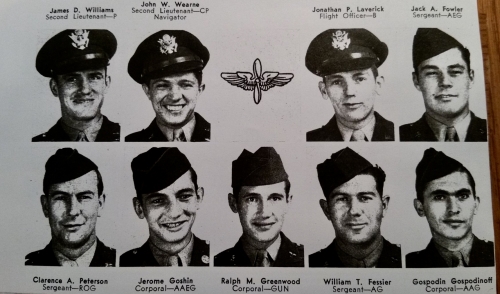
James D. Williams Crew
Lt James D. Williams Crew
Crew List
1st Crew List
Use your thumb to scroll through the results box below.
| Rank | Name | Pos | Status |
|---|---|---|---|
| Lt | WILLIAMS, James D. | P | CPT |
| Lt | WEARNE, John W. | CP | CPT |
| Lt | MILLER, James T. | NAV | CPT |
| Lt | LAVERICK, Jonathan P. | BOM | CPT |
| T/Sgt | FOWLER, James A. | TTE | CPT |
| S/Sgt | PETERSEN, Clarence A. | ROG | CPT |
| S/Sgt | GOSPODINOFF, Gospodin D. | BTG | CPT |
| Sgt | FESSIER, William T. | WG | CPT |
| S/Sgt | GOSHIN, Jerome | WG | CPT |
| S/Sgt | GREENWOOD, Ralph M. | TG | WIA |