Lt
Donald E. CIELEWICH
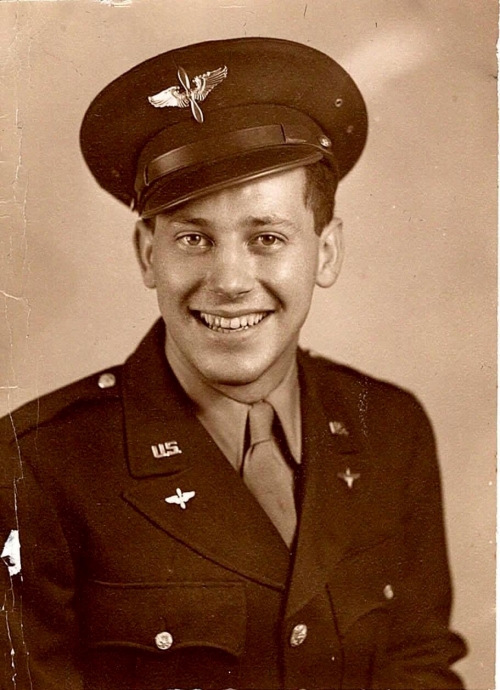
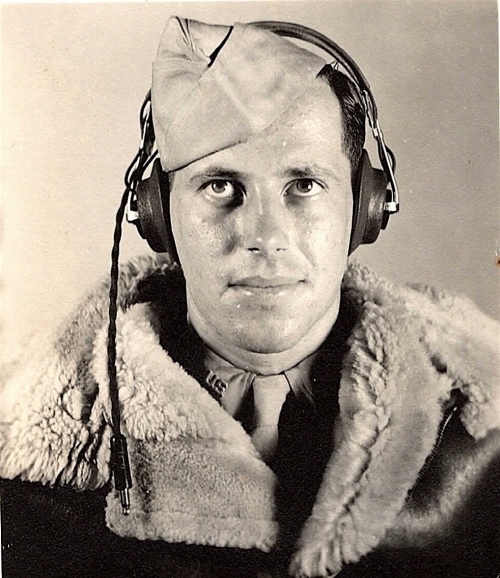
Army Serial Number: O-818603
Assigned to the 100th Bombardment Group
Location:
Unit: 350th Bombardment Squadron
Rank:
Position: Pilot
Beginning Date of 100th Service: Unknown
Time of Service at Thorpe Abbotts: Unknown - Unknown
Additional 100th Service Notes
Status: POW
MACR: 07899
CR: 07899
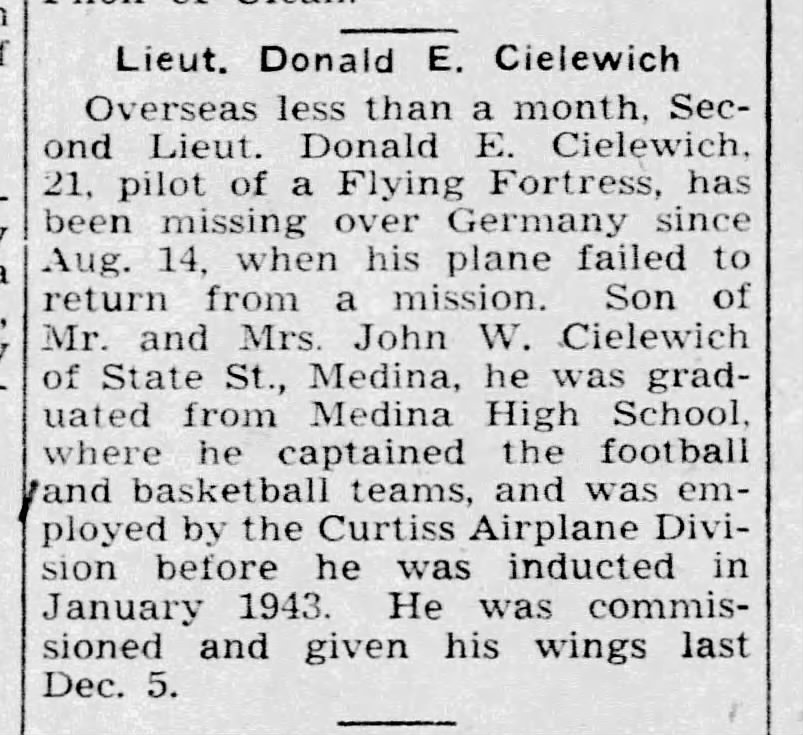
Comments: 14 AUG 44 LUDWIGSHAFEN (FLAK)
Media Articles
Use your thumb to scroll through the results box below.
| Media Item | Type | Page | Volume/Issue | Broadcast Source | Time | Description | File |
|---|---|---|---|---|---|---|---|
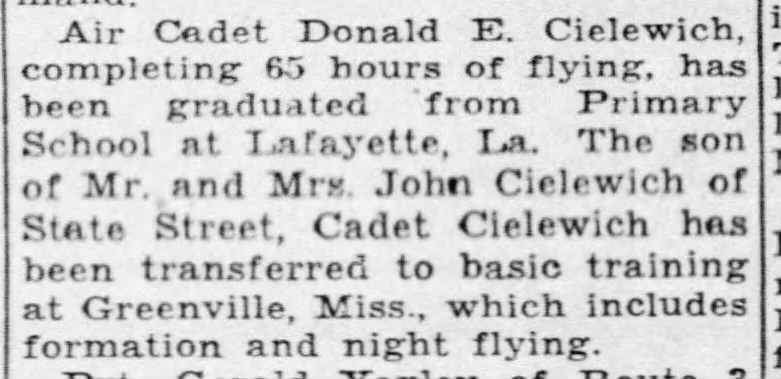
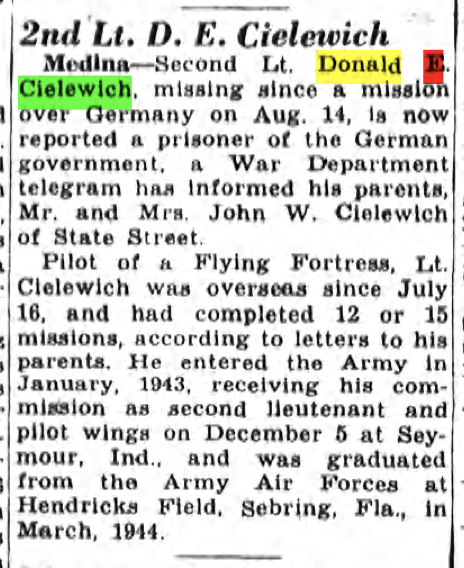
| Donald Cielewich training | Democrat and Chronicle | 12:00 am | |||||
| Donald Cielewich MIA | The Buffalo News August 31 1944 | 12:00 am | |||||
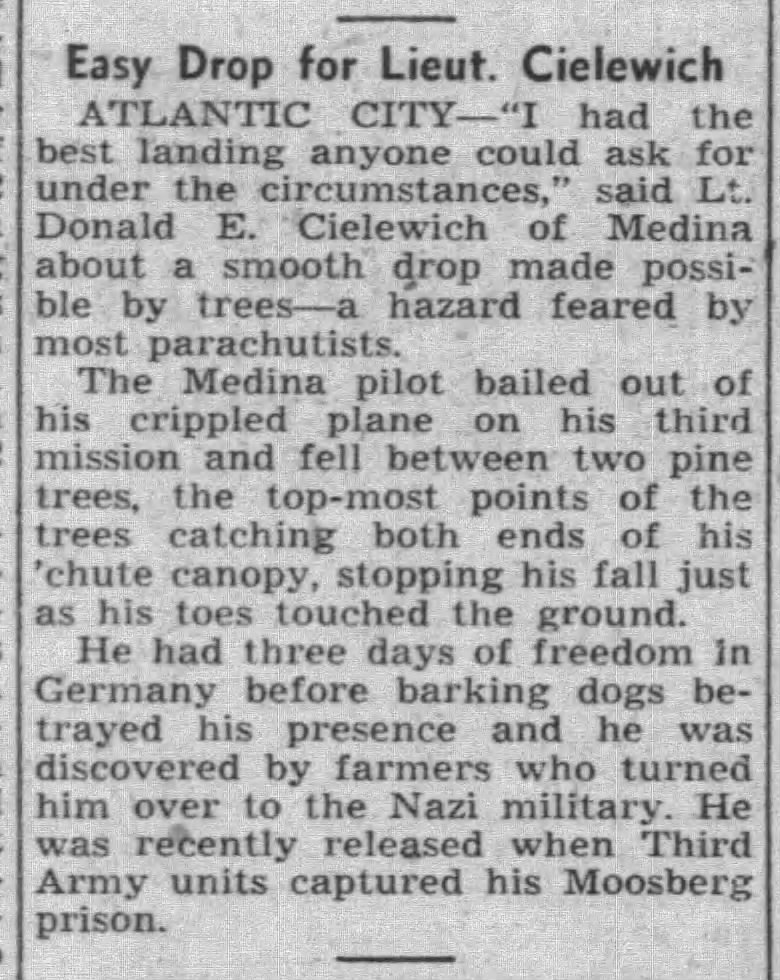
| Donald Cielewich Bailout | The Buffalo News Aug 15 1945 | 12:00 am | |||||
| Donald Cielewich now POW | Rochester Times Union Oct 10 1944 | 12:00 am | |||||
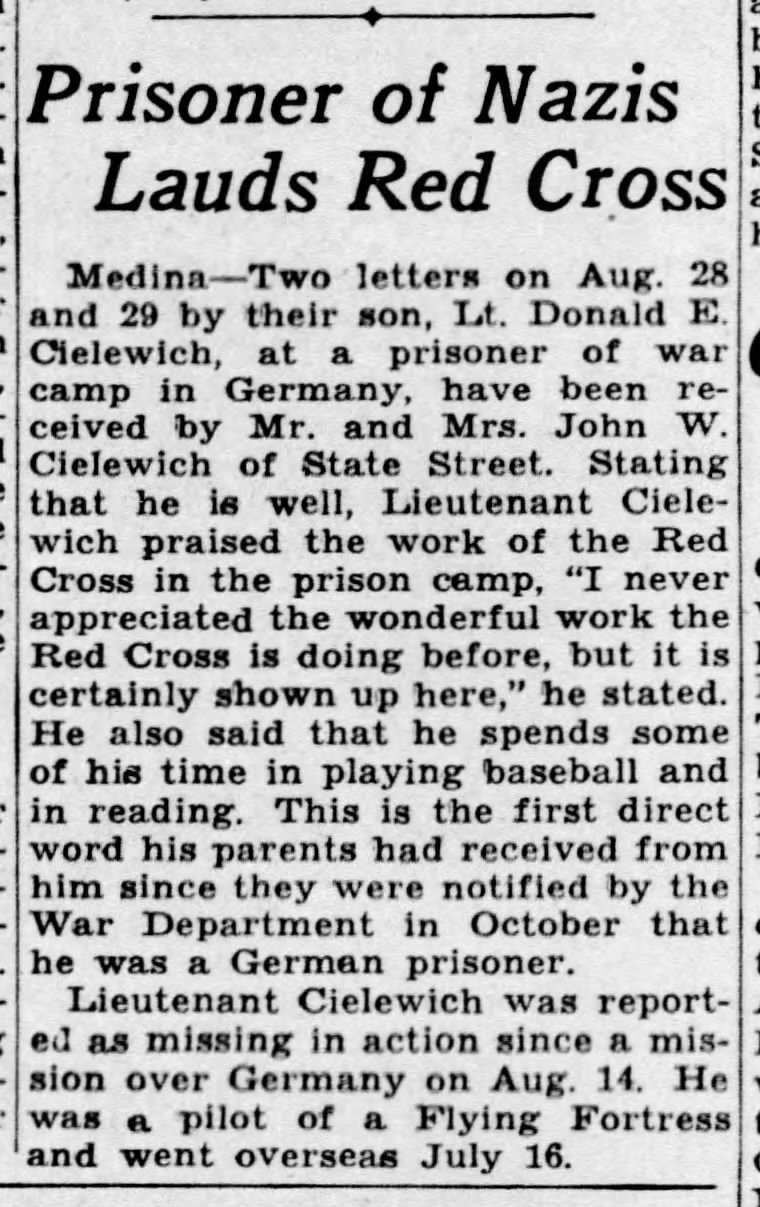
| Donald Cielewich POW letters | Democrat and Chronicle December 10 1944 | 12:00 am | |||||
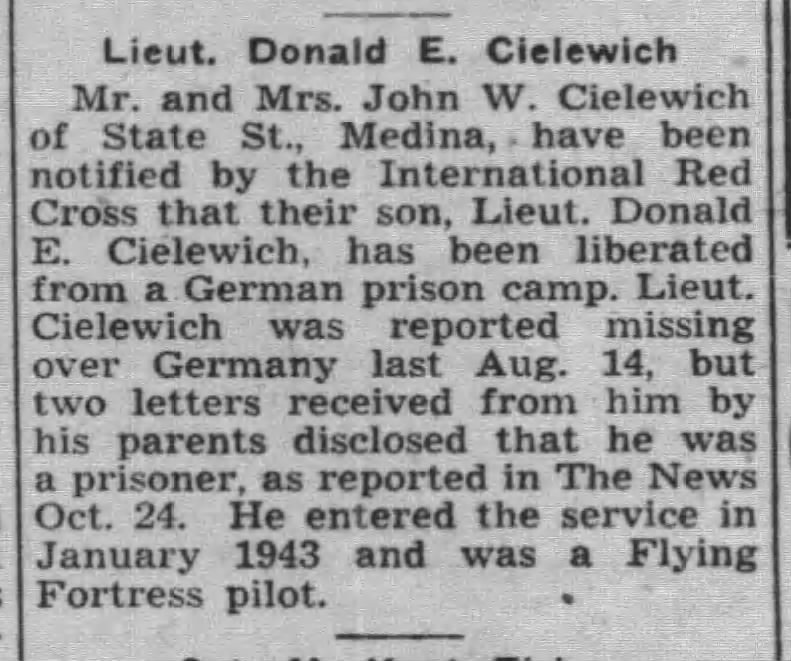
| Donald Cielewich liberated POW | The Buffalo News May 17 1945 | 12:00 am | |||||
| Donald Cielewich home | Democrat and Chronicle March 4 1947 | 12:00 am |
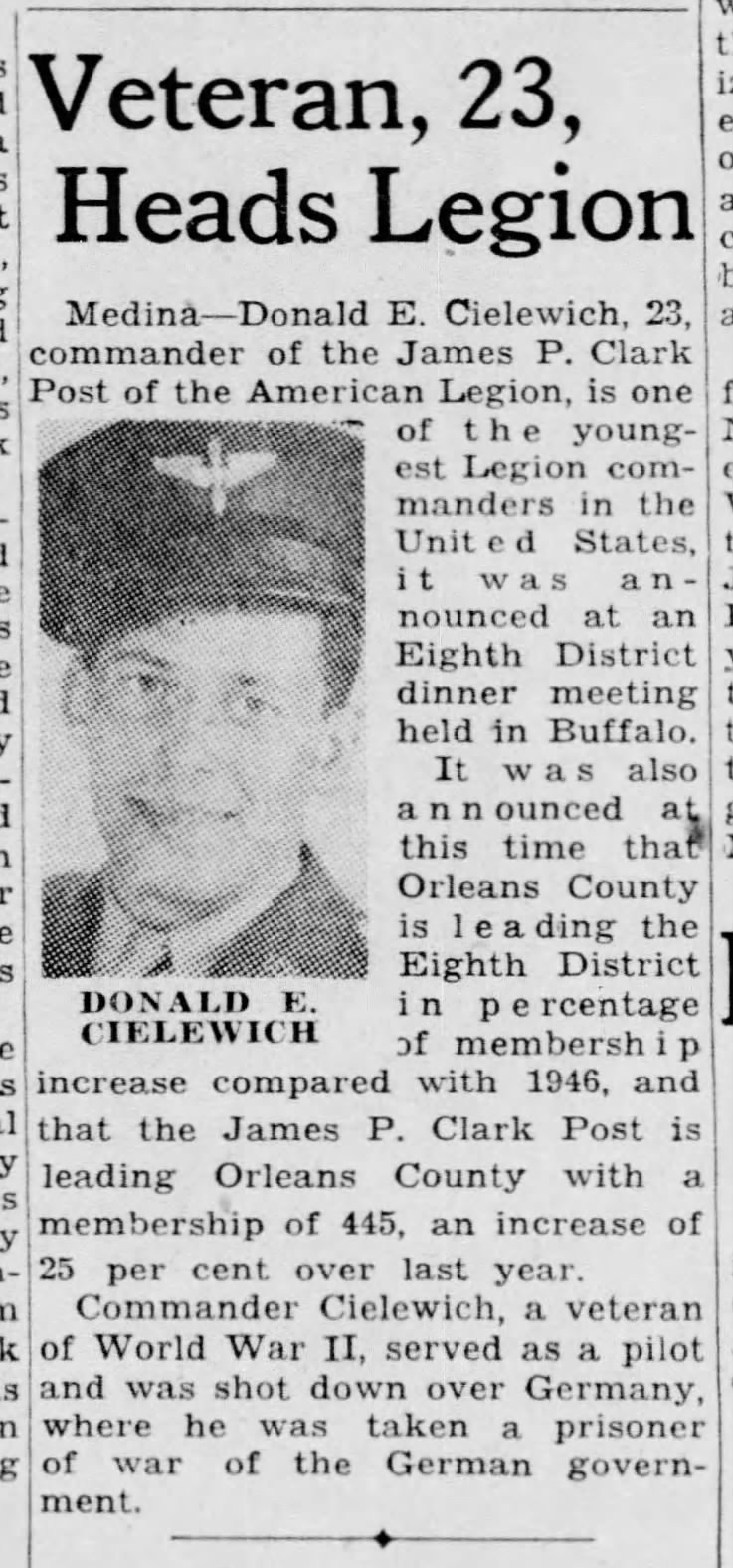
Comments and Notes
Memo 1:
CREW


2ND LT DONALD E. CIELEWICH         P POW  14 AUG 44 LUDWIGSHAFEN (FLAK)

2ND LT LENARD E. MOEN                CP POW  14 AUG 44 LUDWIGSHAFEN (FLAK)

1ST LT CLIFFORD J. BROWN         NAV POW  14 AUG 44 LUDWIGSHAFEN (FLAK)

2ND LT JOHN C. COCHRAN           BOM POW  14 AUG 44 LUDWIGSHAFEN (FLAK)

T/SGT  BENJAMIN M. BALDASANO  ROG POW  14 AUG 44 LUDWIGSHAFEN (FLAK)

T/SGT CYRENNE L. ROPSON          TTE POW  14 AUG 44 LUDWIGSHAFEN (FLAK)

S/SGT JOHN L. FUNKHAUSER         BTG POW  14 AUG 44 LUDWIGSHAFEN (FLAK)

S/SGT HERBERT G. KLEPP              WG POW  14 AUG 44 LUDWIGSHAFEN (FLAK)

S/SGT HENRY J. SYTNIK                 TG POW  14 AUG 44 LUDWIGSHAFEN (FLAK)


350th Sqdn. Arrived at Thorpe Abbotts in late July 1944.   Crew, as above, taken from mico-film casualty report; it is proably some of the above were evadees.stated C.L. Ropson in July 1990. None of this crew evaded, all were POW( mpf 2012)


MISSIONS OF LT CIELEWICH CREW

Date         Crew Nbr    Mission Nbr Last Name     Initial         Rank         Position      Aircraft Nbr         Target

8/11/1944         37         178         KLEPP         H.G.         S/SGT          RWG        37882         VILLACOUBLAY

8/13/1944         37         179         KLEPP         H.G.         S/SGT         RWG         6297         NANTES - GASSICOURT

8/14/1944         37         180         KLEPP         H.G.         S/SGT         RWG         3413         LUDWIGSHAVEN (OIL)


A/C #42-3413 "HARD LUCK"

MACR #7899

Microfiche #2902


EYEWITNESS:  "Just before we reached the I.P., A/C #413 salvoed it's bombs and dived away from

the 100th "B" Group.  It was last seen  with one engine smoking, low and to the right of

the 100th "C" Group just prior to reaching the  target.  No chutes were seen."

                      (The eyewitness is not indentified in the MACR....pw)


We arrived in Scotland with our crew, via the Aquatania, on July 25,1944. They moved us south to the 100th BG by train and army truck. During the first two weeks we made a couple practice flights with the crew to become familiar with the landscape. The last week in England included our first two missions whose targets were highway intersections leading from Germany to Patton's landing in southern France. We flew in temporarily assigned, late model B-17's on these first two missions. They had electrical controlled superchargers and other up to date instrumentation. These missions only into France (one north and one south of Paris) were uneventful and eased a new crew deceivingly into the war. The deception of these two uneventful missions was soon to be unmasked.To this point we never knew what plane would be assigned until Don came out of briefing with the info. That morning we were assigned what was to be our permanent plane, "Hard Luck." We never saw it before or had opportunity to test it. All we had time to do was hand pull the props to clear any oil accumulation in the lower cylinders, jump in and start the engines. The mission turned out to be a tribute to its name. It was the oldest and most shot up plane left on the base.


As you read the prior 100th log of events it doesn't take much intelligence to understand the pressure that was on the ground crews to keep that miserable machine flying. They worked ungodly hours day and night to salvage the thing. Can you imagine Hard Luck coming back many times crippled, to haunt them? That day it was loaded with fifty 100 # bombs and the target was Mannheim/Ludwigshaven. The route was to fly east past the target, do a 180-degree left turn, and fly straight and level eight minutes west to the target. It took about thirty seconds for an anti aircraft shell to reach our altitude after the visible red glare from the guns below. This translates into about 16 opportunities to zero in on the group at a predictable level, direction, and speed. The Bible says, "Man makes his plans, but God directs his steps!" Little did we know or anticipate where those steps would take us.


Your Dad taxied off the ramp and into lineup on the taxi strip. The practice was to kick the tail sideways to avoid blasting the plane behind, then rev up the engines for checkout. The magneto switch had three positions, "Left-Both-Right." The running position was "Both." Two sets of plugs operating properly produced maximum horsepower. The only way to insure you had maximum HP was by checking the L & R set of plug separately. At 1,000 RPM switching from "Both" to L or R would cause a 100 drop in RPM. That day each engine suffered a dramatic drop in RPM's when switched from "Both." It was obvious that the engines were absolutely shot and not maintained in contradiction to that book you read. This was event #1. More to follow-Don knew we were in trouble and radioed the lead plane (Commander), which we were not supposed to do because of radio silence restrictions. The command plane refused to let us abort the mission. Finally it was our turn to takeoff. Don revved up the engines with full throttle, released the brakes and we started moving up the runway. Yes, I said "UP." Airfields were built on farmland that is hilly and the first half of the runway was uphill, making the opposite end of the runway only visible when you reached the top of the hill. Don was sweating bullets because we were faltering in speed. I had increased the turbo pressure into the RED but Don kept saying MORE MORE MORE. At a point like this you quickly count the risks. Do we blow the engines or crack up at the runway end? We went for the engines and just cleared the fence at the runway end.


Event #2.We had taken off and landed at that field at least half a dozen times and were somewhat oblivious to a forest about a mile from the end of the runway. This time we noticed. Because of a lack of power, we were not able to climb at 400 feet per minute, the normal rate. If Don attempted to climb too fast we could stall and it would all be over. I hadn't learned to pray, and I'm not sure whether Don was or not. We didn't discuss those issues then and things happen so fast you don't have time to reflect on a bible study you had. We could have reached out and touched the top of those trees.


Event #3 The schedule allowed 1 1/4 hour to climb to 30,000 feet and an additional 3/4 hour to rendezvous with our group and into the assigned formation position. Our climb rate required a full two hours to get us close enough to spot the group. They had assembled and were headed east across the channel. We were still climbing and following till waters edge. Finally we made it in the very outboard position of the twelve-plane squadron flying in the high right wing position of the forty-eight-plane group. Don was exhausted and I took the controls for about 6 minutes before the next event. I forgot to mention our concern for gas consumption, among other concerns. Don and I knew that with increased manifold pressure, we were consuming much more fuel than normal. As we crossed the channel, I had checked fuel levels by moving a selector switch to each of the four positions representing our four tanks. We had been told that the wing tanks had been shot-up and were all replaced. It became evident that they messed up the sensors so that we could not get an accurate reading. We got erratic readings in subsequent monitoring, so had no choice but to ignore the gage.


Event #4 The right outboard engine started loosing RPM. Don took the controls again and I increased the supercharger pressure on that engine to keep the RPM constant. Don only used the other three throttle controls to maintain formation position. With the supercharger control in a new fixed position we thought we were OK but the engine started to increase in RPM and the supper charger control was non-responsive. We used the throttle to slow the RPM having already reduced the super charger. Then the RPM started to decrease again that meant someone had to jockey the throttle and supercharger control the balance of the flight. We knew this old model had hydraulic S. Charger controls and it became apparent that the ace ground crew had allowed moisture to contaminate the control system. At 30,000 feet elevation the temperature was about 15-20 degrees below zero F. The moisture had frozen, allowing only a pinhead of fluid flow and thus the poor control response. The remainder of the mission I had one hand on a throttle and the other on the S. CH. Control. Don was incredibly hanging on the wing of the plane to our left.


Event #5 As we winged somewhere over Northern France toward the turn point, our glorious command leader who would not let us abort, must have been praying with his eyes closed. A frontal view of 48 planes in formation gives the appearance of one leg of an X. If two groups were to meet "head on," the appearance would complete the X shape. You guessed it! We met another anxious group on their way home---HEAD ON. A perfect X (for a moment). Ninety-six planes, forty-eight with bombs, all over the sky. The Germans should have given our glorious leaders a dingle berry cluster. A new way to destroy the enemy. Russian Roulette. Somehow our group got back together and apparently no one hit. It was like the space in an atom between the nucleus, protons, and neutrons. Only God can avoid a collision. This maneuver caused our weak kneed plane to be about 1/2 mile behind and below the group. It was remarkable that no German fighter planes were in the area. We would have been easy picking.


Event #6 As we made an attempt to catch up with the group we were soon to be introduced to a mime quartet. That's what you have when all four engines die and you feather the props. Yup, we ran out of gas-literally and physically. Brown, our Navigator gave us a heading for the base. As you know, there are only four bases, first, second, third, and home. We never did find first! If you throw a rock at 180 miles per hour at 30,000 feet elevation, how far do you think it would go? Well, that's about how far we went. We had conveniently dumped the bombs after the first engine conked. That poor farmer never dreamed of finding a tree big enough to plant in those holes we so evenly spaced.


Event #7 As we descended there was a cloud cover at 8,000 feet, so Don instructed the rest of the crew to bail out the rear side door as we began to see ground. The crew chief, navigator, and bombardier had to carry their parachutes through the bomb bay and put them back on before jumping. I later found out you could not get through with them on. Don set the controls on auto (Flintstone Glide Pilot) and told me to scram. We were over the mountainous area three days walk north east of Heidelberg Germany. After trying the bomb bay route to no avail, I decided on the nose hatch. We had never been instructed on how to bail out in flight from a nose hatch. I operated the handle, expecting the door to fly open. Instead, the wind stream held it firmly at four inches open. I couldn't close it or force it further open. There was a "T" handle attached to hinge pins, so I yanked on it with all my strength and nothing happened. By this time Don was on my back saying, "let's get out of here." I put my feet on a rib for better leverage and gave another terrific yank. The door left and I went with it. Don was right behind me but we never were able to find each other when on the ground. Later he told me the altimeter was reading 1,400 feet when he left the cockpit, and we were over mountains-another close one. Event #8 Neither Don or I were injured when we landed, which was fortunate, considering the landscape. I chose to walk through the mountains southwest and was captured three days later in a potato patch near Heidelberg. Don later told me he hitched a ride on a freight train before capture. We both ended up at an interrogation center in Frankfurt Germany. The German officer that interviewed me had a complete history of your father, where he attended schools, at home and in the service. He also showed me a loose-leaf book on the 100th Bomb Group with pictures of the base, planes, officers, etc. He knew more about Don than I did! He also had a picture of what was left of "Hard Luck." I must confess that I felt it was a very deserving fate. The only regret I have is that they didn't require the ground crew to go over and clean up the mess. We were in solitary confinement for three days and then joined with several other POW officers and moved by train to Wetzlar, north of Frankfurt, where they took our flying clothes and issued Red Cross furnished regular army clothing. It was at Wetzlar that I saw Don for the first time after coming down. We both marveled that we had survived and eventually heard the same for the other crew members. We were separated again and sent to different camps. Don and I did make contact again in Mooseberg after the Germans had moved us a few times. I don't recall where he spent the winter but it was cold and the food became scarce.The preceding story is from very vivid recollections. The events seem like it was just yesterday but other aspects of the war have completely escaped my memory. Don was muscular and persevering. I marveled at his stamina. He was personable in spite of the military rules for officers and enlisted men. He was a dedicated no nonsense soldier that got the job done but was a fun person to know and have as a friend. He was in command and a capable leader. He was someone you trusted with your life and the lives of your friends but was determined to contribute to the defeat of a tyrant, called Hitler. It was a privilege to know him and serve with him. I regret that I didn't maintain communication with him after the war, but as I said, we have been pursuing a dream and I trust he was able to achieve much of that dream.Scott, it is obvious there is much more to the story of our past, starting in Tampa, Fla. Perhaps if you visit Calif. we could reminisce. We have a large home with three extra bedrooms, so you are welcome to come visit and stay with us at your pleasure. God has been good to the family and me. I did spend about two weeks in the hospital with a heart attack a year ago today, but have recovered and feel restored except for too many pills. My middle son, Earl, went to be with the Lord in March of 1989. The other four are all busy at various jobs in Calif. and Oregon.I trust your mother is doing OK. Give her our regards.


Finally; we were not hit by flak, we were not smoking, and we did not dive away from the formation. The engines all died within seconds of each other as the tanks ran dry. That happened while we were still a half mile behind the formation and as we took a 180 degree turn heading for home the group also made a large 180 degree sweeping turn toward Ludwigshaven on an 8 minute bomb run.  The crew bailed out and Hard Luck glided to it's death in a mountainous forest. There was nothing left to burn upon crashing, so the picture the German interogator showed me of the crumpled mess did not set the forrest on fire. In a war, following orders is essential, men and equipment are expendable, and that fact will never change.


Best wishes,

Lenard and Evelyn Moen

7914 Michigan Ave.

Whittier, Ca 90602

562-696-5433
Memo 2:
WWII pilot from Medina survived being prisoner of war after bailing out of plane


By Ginny Kropf, correspondent Posted 23 January 2025 at 10:06 am


Editor’s note: This is the second part of a three-part series about Medina native Don Cielewich and his family.


MEDINA – Don Cielewich enlisted in the Army July 1, 1943 and became part of the Army Air Corps. He went to Transition Flying School in Sebring, Fla. and Advanced Flight School in Seymour, Ind., before eventually joining the 100th Bomb Group in Scotland as a lieutenant.


The mission which changed his life began on Aug. 14, 1944, when he was assigned to pilot the B-17 Hard Luck. Their target in Germany was Mannheim/Ludwigshaven. This was his first time flying that plane and on runup for takeoff, he realized it was aptly named. He reported to his commander the engines were shot, but he refused to let Don abort


News accounts of the mission say Hard Luck was shot down, but his co-pilot Lenard Moen of Whittier, Calif., who Don’s son Scott visited in later years, said that wasn’t true. They ran out of gas.


“When they took off, the plane was struggling,” Scott said. “Lenard said dad was a strong guy and he was struggling to get the plane over a grove of trees at the end of the runway. He was pulling with all he had and just touched the tops of the trees. As they were turning for the bombing run, the engines quit.”


Moen said they had realized with the increased manifold pressure, they were consuming way too much fuel, and Don dumped the bombs when the first engine quit. He gave orders for the crew to bail out the rear side door and set the plane on autopilot.


Don and Moen tried to bail out the nose hatch, but had trouble getting it open. They were at 1,400 feet over mountains when the hatch finally gave way. The plane was at 500 feet when Don bailed out and his chute didn’t fully open. He landed in a tree and was hurt.


The men were separated and Moen walked for three days through the mountains until he was captured. Don attempted to make his way to France, following a railroad line. He traveled at night and found shelter during the day. Both men were taken in by German farmers who discovered them and then turned them over to German officers.


Fritz Rey was the farmer who found Don and fed him a raw egg and a glass of home brew. They cooked another for him to take with him, but it was taken by the authorities to whom he was turned over. They next took him to a large Gestapo interrogation center outside Frankfort, where he spent six days and nights in solitary confinement before being moved to Stalag Luft III, 90 miles southeast of Berlin.


In January 1945, Don and 10,000 American officers were forced to walk for 11 days, covering 110 miles, before being loaded into boxcars for transport to Moosburg. Here, he spent the remainder of his confinement until being liberated April 29, 1945 when General George Patton’s tanks rolled through the front gates.


Don was home from the war about a year when a letter arrived from Fritz Rey, inquiring how he fared during imprisonment and if he ever thought of the egg Fritz gave him. He went on to tell Don because he had given him that egg, he was reported to the circuit prison. But he said his concern for Don was because he had spent four years as a prisoner of war in France during World War I and could put himself in Don’s plight.


MEDINA – By 2000, Don Cielewich’s son Scott’s interest in his dad’s service during World War II had peaked and he and his wife Jamie set out to find some answers.


He had tracked down Don’s co-pilot Leonard Moen in California and called him. Scott and Jamie were invited to visit him in California, and they spent several days there. The man owned a machine shop and took Scott and Jamie there. Then he went through the entire story of their mission.


“It was like it was yesterday,” Scott said. “The details were amazing. Later, he sent me an e-mail, so I had that for reference. I’ve kept it with all of dad’s memorabilia.”


Then he began thinking about what he was going to do with all the stuff, and that’s when the idea hit him about retracing his father’s last mission.


In 2018, Scott and Jamie left Orlando and flew to London, where a bus tour awaited them. One of the places they visited was Thorpe-Abbotts field, where his dad had flown out of. It was also the same place featured in the Tom Hanks/Steven Spielberg series, “Masters of the Air.” Thorpe-Abbotts was a regular Air Force base when Don was there. The Corps of Engineers had built it out of farmland, and it had kind of reverted back, except for the runway and a World War II Museum.


The Bloody 100th Bomb Group flew out of there and were involved in all the big bombing missions of 1942, ’43 and ’44.


“They lost a lot of men and planes,” Scott said. “Leonard said when you were assigned there, it was a death sentence.”


As Scott and Jamie were getting off the bus, a man came up and asked if he was related to Don Cielewich.


“I told him that was my dad, and he said he wanted to show me something,” Scott said. “The English were so grateful for American support and intervention and what we did for their country. They still do archeological digs and find all kinds of things soldiers lost. At the end of the tour, we went in a control tower where there were little offices in back, and over one doorway was Dad’s and Mr. Moen’s names, with ‘Hard Luck’ burned into the wood. It was like a miracle.”


The men had leather jackets with a lamb’s wool collar and “Hard Luck” on the back.


“I am having one made now just like it,” Scott said.


Scott said he couldn’t believe the things that happened during their trip. They flew from England to Germany, where they discovered the tour agent had got in touch with a retired German officer who was a military historian.


“We went to the town where Dad’s plane went down, and we learned it didn’t just land in the forest, it hit a barn and exploded, killing 10 people,” Scott said.


With the help of the historian, they located kin of some of the deceased and met them.


“They opened their houses to us,” Scott said. “We weren’t sure how they’d welcome us. The community has a remembrance ceremony in the cemetery every year on the anniversary of the plane going down, and we send flowers every year.”


From there, Scott and Jamie were taken to the spot where his dad was captured by the German farmer, then to where he was interrogated. Moen told Scott that was where he and Don were reunited. Next they went to Stalag Luft III, which was Germany then, but it is Poland today. They visited the prison where Don was a POW. They have a museum there and Scott saw his father’s ID cards, with his picture and fingerprints.


“The guide took us on an extensive tour, including where the march started in January 1945. It was snowing and there were little provisions for the prisoners,” Scott said. “The first night the prisoners stayed in a church and we were taken there.”


They next flew to Munich, where they got to go to Moosburg and learned the full story of what happened there.


“The prison camp was built for 10,000, but by the time Dad got there, they had more than 70,000,” Scott said.


During their trip, they were interviewed by a German newspaper.


“What shocked me most during the trip was the fact Dad’s plane crashed into that barn, and meeting the families of those killed,” Scott said. “The lady of the house we met and I both cried, and Jamie gave her her scarf.”


Scott has since donated all his memorabilia to the World War II Museum in New Orleans.


He and Jamie collect antique automobiles and they have consigned a 1955 MG TF1500 to be sold and the proceeds donated to the World War II Museum, to pay for the two hotel rooms there which they have dedicated to the memory of their fathers.


In addition to Don’s service flying B-17s in World War II, Jamie’s father was a bombardier on B-24s in North Africa and Italy. He flew 50 combat missions and received the Distinguished Flying Cross. Instead of returning home, he volunteered to become a B-51 pilot and completed his training as the war ended.


The rooms at the Higgins Hotel, part of the World War II Museum, each have a plaque with a picture of the men in uniform and a second plaque with a summary of their war service.


“My wife and I have made it our mission to keep the stories of these brave men alive to remind future generations of the debt we all owe that generation for responding to the call of service at our nation’s most vulnerable moment,” Scott said.


Click here to see the first part of the series: “The last ‘smithy’ in Medina served in World War I”


Click here to see the second part of the series: “WWII pilot from Medina survived being prisoner of war after bailing out of plane”
KIA / MIA / EVA / INT Information:
Target:
Ludwigshaven
Aircraft:
"Hard Luck" (42-3413)
Date:
1944-08-14
Cause:
FLAK
Photos
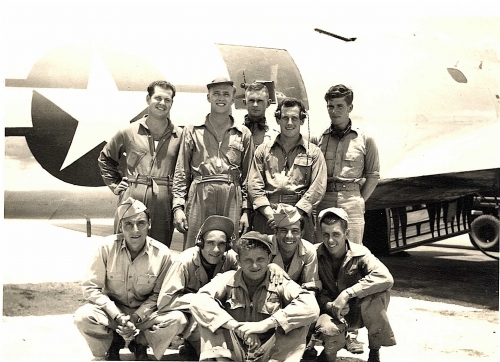
Donald Cielewich Crew Stateside
Lt Donald E. Ceilewich Crew Stateside. Photo courtesy of son Scot Ceilewich.
Crew List
1st Crew List
Use your thumb to scroll through the results box below.
| Rank | Name | Pos | Status |
|---|---|---|---|
| Lt | CIELEWICH, Donald E. | P | POW |
| Lt | MOEN, Lenard E. | CP | POW |
| LT | BROWN, Clifford J. | NAV | POW |
| Lt | COCHRAN, John C. | BOM | POW |
| T/Sgt | ROPSON, Cyrenne L. | TTE | POW |
| T/Sgt | BALDASANO, Benjamin | ROG | POW |
| S/SGT | FUNKHAUSER, John L. | BTG | POW |
| S/SGT | KLEPP, Herbert G. | WG | POW |
| S/Sgt | SYTNIK, Henry J. | TG | POW |