Capt
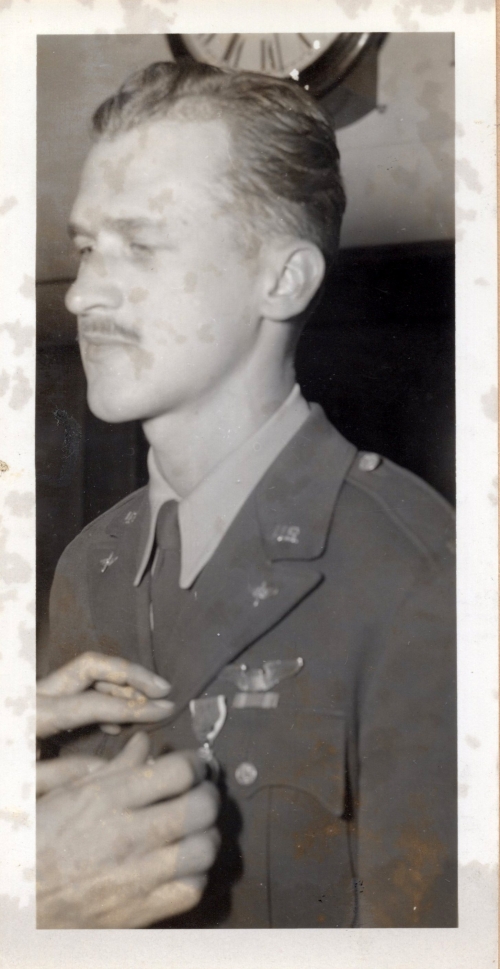
James R. DOUGLASS

James Douglass
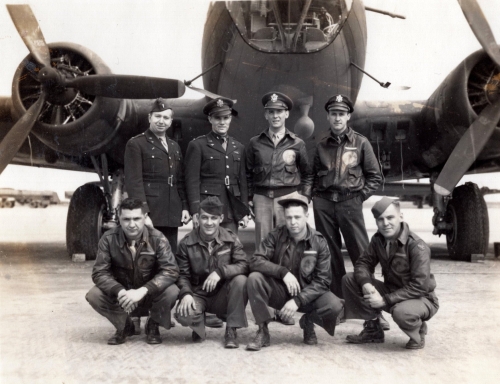
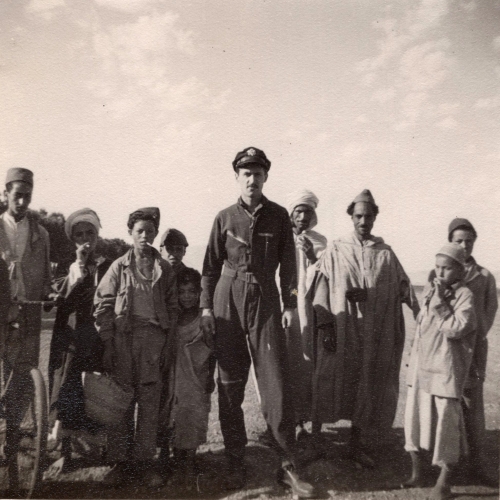
Captain James R. Douglass, 418th Squadron (from the photo collection of John Luckadoo)
Hometown During Time of Service: Lansing, MI
Army Serial Number: O-731365
Assigned to the 100th Bombardment Group
Location:
Unit: 418th Bombardment Squadron
Rank:
Position: Bombardier
Beginning Date of 100th Service: Unknown
Time of Service at Thorpe Abbotts: Unknown - Unknown
Additional 100th Service Notes
Status: CPT
Comments: GROUP BOMBARDIER, ORIGINAL 100TH - BLAKELY CREW
Awards and Commendations (in the order received)
Purple Heart
General Order #24 dated 14 August 1943
James R. Douglass, O-731365, 2nd Lieutenant, 418th Bombardment Squadron, 100th Bombardment Group (H), Army Air Forces, United States Army. For wound received in action against an enemy of the United States 24 July 1943, while serving as Bombardier on a B-17 airplane on a combat mission over enemy occupied Continental Europe. Home address: 928 West Michigan Avenue, Lansing, Michigan.
Media Articles
Use your thumb to scroll through the results box below.
| Media Item | Type | Page | Volume/Issue | Broadcast Source | Time | Description | File |
|---|---|---|---|---|---|---|---|
| Blakely, Kidd, Thornton, Douglas, Crosby Bremen mission | The Fresno Bee Oct 12 1943 | 12:00 am | |||||
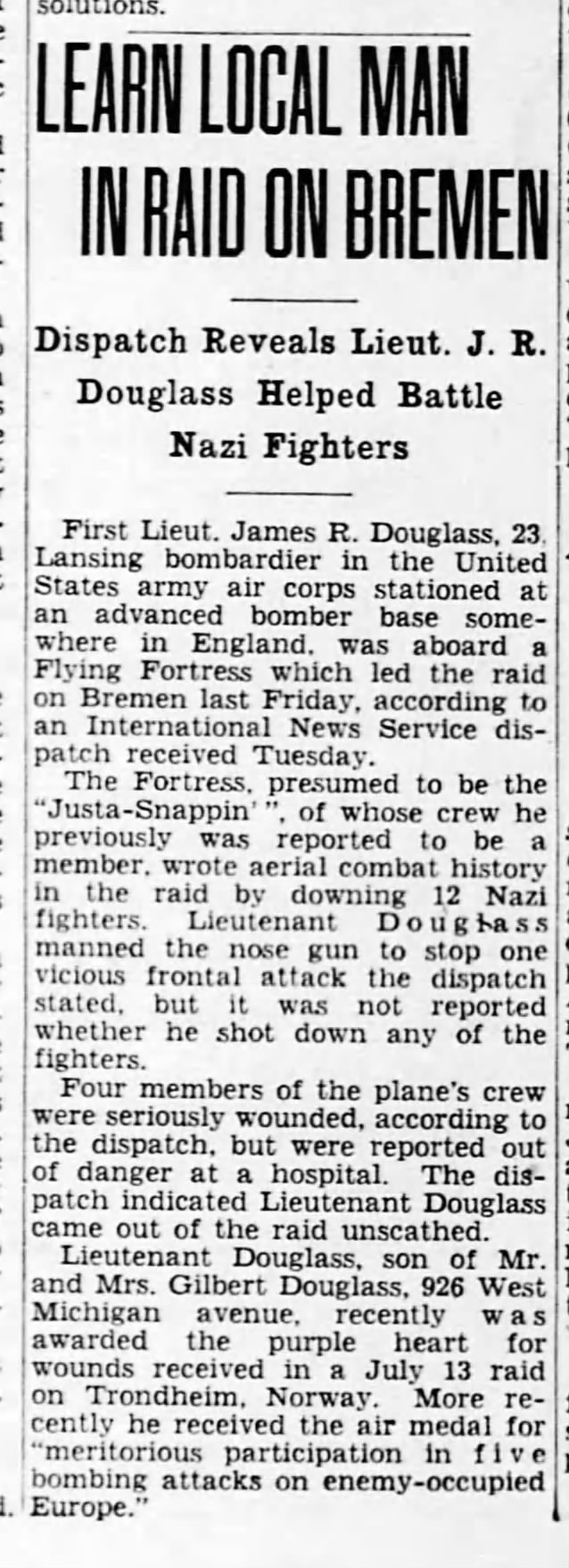
| James Douglass helped battle nazi fighters | Lansing State Journal Cot 12 1943 | 12:00 am | |||||
| James Douglas wins second medal | Lansing State Journal Oct 6 1943 | 12:00 am | |||||
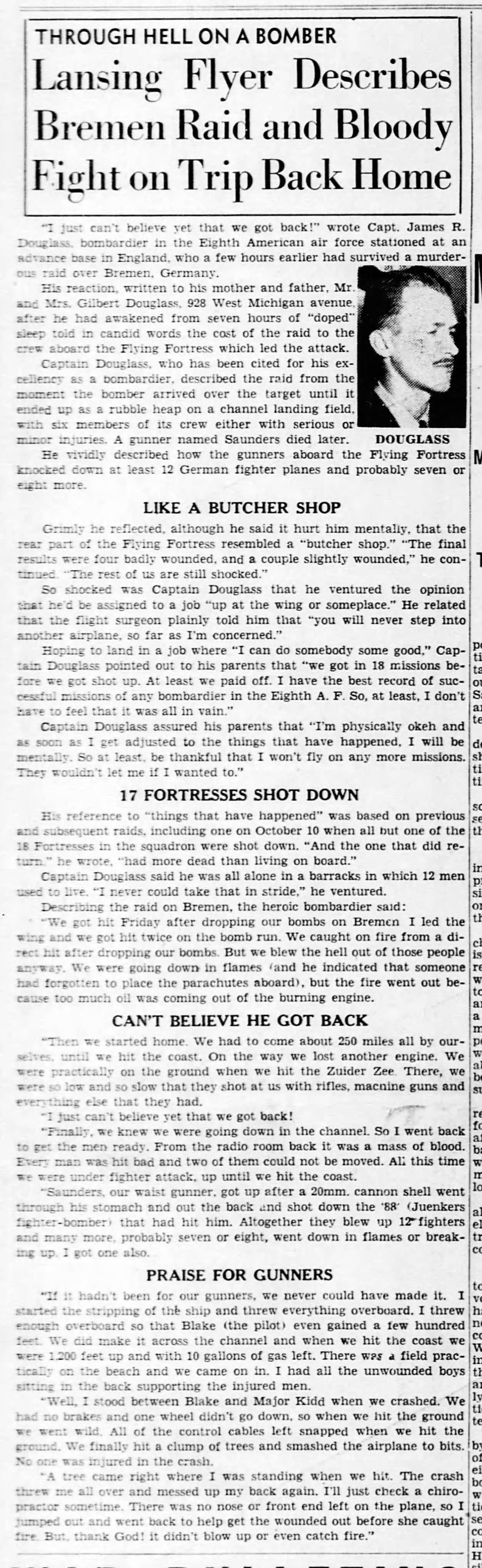
| James Douglass through hell on a bomber | Lansing State Journal Oct 31 1943 | 12:00 am | |||||
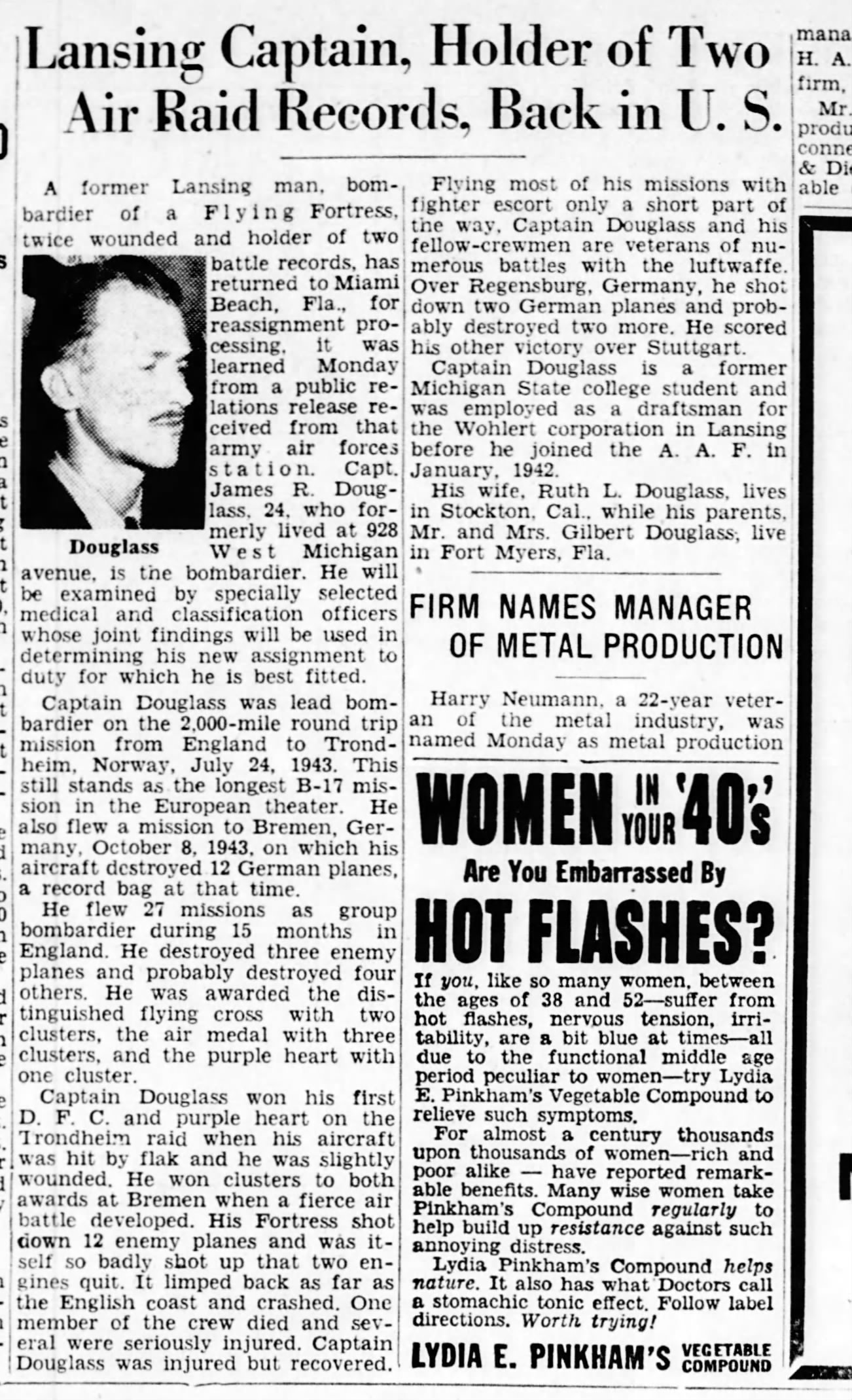
| James Douglass home | Lansing State Journal Aug 21 1944 | 12:00 am |


Comments and Notes
Memo 1:
CREW


1st Lt Everett E.Blakely                 P     CPT

 2nd Lt Charles A.Via,Jr.                CP     SWA   8/10/43  Bremen

1st Lt Joseph H." Bubbles" Payne  NAV    KIA   28/4/44 Sottevast  (With crew of W,G.Lakin - mission lead by Col. R.H. Kelly)

 2nd Lt James R.Douglass            BOM    CPT

T/Sgt Howard J.Brock                 TTE    POW  17/8/43 (With the W.R.Flesh crew)      Regensburg

T/Sgt Monroe B.Thornton            WG   CPT

T/Sgt Edmund G.Forkner            ROG    CPT

S/Sgt John L.Olson                     BTG   Transferred

S/Sgt Lyle E.Nord                         TG   KIA   29/5/44 (with crew of B.L.Williams) Leipzig, Aircraft repair depot..

S/Sgt Lester W.Saunders               WG  KIA  8/10/43  Bremen


418th Sqdn.  An ''Original" crew.  CREW #35  A/C #42-30061     "JUST-A-SNAPPIN"


NOTE: JOHN OLSON, AFTER FLYING SEVERAL MISSIONS WITH THIS CREW MAY HAVE BEEN TRANSFERRED TO ANOTHER GROUP.

LT PAYNE WAS REPLACED ON THE CREW BY HARRY CROSBY FROM THE CREW OF LT JOHN BRADY.  SGT OLSON WAS REPLACED ON THE CREW BY SGT WILLIAM MC CLELLAND/  T/SGT THORNTON BECAME THE ENGINEER AFTER AUGUST 17, 1943 AND HIS POSTION AT WG WAS FILLED BY SGT ED YEVICH.


JUST-A-SNAPPIN IS ONE OF THE BETTER KNOWN PLANES IN 100TH LORE, SHE IS REMEMBERED FOR BRINGING THIS CREW BACK FROM BREMEM ON 8 OCT 43.  BADLY DAMAGED EV BLAKELY AND JOHN KIDD, GROUP OPS OFFICER WHO LED THE MISSION FROM THE CO-PILOT'S SEAT, LANDED "JUST-A-SNAPPIN" IN A FIELD AT LUDHAM.  DAMAGE TO THE HYDRAULIC SYSTEM RENDERED THE BRAKES IN-OPERATIVE AND "JUST-A-SNAPPIN" COLLIDED WITH A LARGE TREE.  IMPACT WAS BETWEEN THE #1 AND #2 ENGINE.  THERE ARE SEVERAL PROMINENT  PHOTOGRAPHS OF HER AND THE TREE.


Much has been written about this crew. See p.49 of THE BLOODY HUNDREDTH by H.Varian and p.184/195 of FLYING PORTRESS by E.Jablomski for details of the mission of 8/10/43.


On 8/10/43, S/Sgt Edward S.Yevich LWG & S/Sgt William F.McClelland, BTG were aboard in the place of H.J.Brock & J.L.Olson. Both of these men were wounded.


See photo of this crew on p.228 of "CONTRAILS"


Lyle Nord was flying as TG on the crew of B.L.Williams on 29/5/44 and was hit in the back by a 20mm. He had flown a total of 27 missions,the last 8 of them with the Williams crew.


CREW ON OCTOBER 8, 1943 MISSION TO BREMEN:


MAJ. JOHN B. KIDD   COM PILOT

1st Lt Everett E.Blakely        P     CPT

 2nd Lt Charles A.Via,Jr.      CP   SWA   8/10/43  BREMEN (formation officer in tail)

1st Lt Harry Crosby   NAV CPT     GROUP NAVIGATOR

 2nd Lt James R.Douglass  BOM    CPT    GROUP BOMBARDIER

T/Sgt Monroe B.Thornton      TTE   CPT

T/Sgt Edmund G.Forkner   ROG    CPT

S/Sgt William F. McClelland         BTG   WIA 8/10/43 BREMEN  SN#17164959

S/Sgt Edward S. Yevich   WG WIA 8/10/43 BREMEN

S/Sgt Lyle E.Nord           TG  KIA    29/5/44 LEIPZIG (with crew of B.L.Williams), Aircraft repair depot..

S/Sgt Lester W.Saunders       WG   KIA      8/10/43 BREMEN


Nord took the 50mm gun position in the radio room on this mission.


               THIS IS WHAT HAPPENED…

                 By 1st Lt. Harry H. Crosby

(Yank, The Army Weekly, December 26, 1943, pg. 8)


On this mission, Major John B. Kidd, who had done such a creditable job leading the Group on the important Regensburg raid, was the command pilot sharing the piloting duties with Captain E. E. Blakely, now squadron commander. Our co-pilot, Lt. Charles A. Via, rode in the position of tailgunner. S/Sgt. Lyle E. Nord acted as radio gunner and assistant to T/Sgt. Edmond G. Forkner, the radio operator.

"On the approach to the I.P. it was observed that Emden, apparently remembering the two previous trips of the Eighth Air Force to that area, had sent up a dense smoke screen. Also it was noted that the FW 190s, instead of devoting all their efforts to the Fortresses, turned on our escort, long-range P47s, and engaged them in combat.

By now, much of the ground haze had cleared away. But any need to check my navigation was unnecessary. Everyone on the crew knew that the intense black cloud ahead of us marked the vicinity of our target, the town of Bremen. I have been exposed to flak before... I remember that in all of those instances each little burst of 'flieger-abwehr-kanone' was a distinct mean-looking little black ball. But now, over Bremen, each little ball had lost its individuality and the whole thing was now blended into a huge, angry cloud.

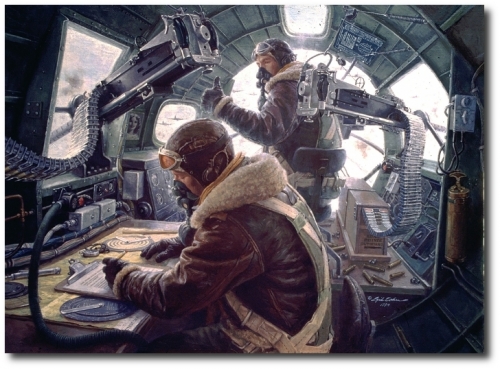
"Two minutes before we reached the target our plane was hit by the first burst of flak. Our ball turret gunner, S/Sgt. Wm. F. McClelland, announced in a calm voice that his turret had been struck, but not pierced, by a flak burst. Thirty seconds before the bombs were dropped a burst of flak hit our nose compartment, shattering the window to the right of the bombardier's head. One fragment struck the bombardier, Lt. James R. Douglass... It tore through his clothing and ripped the cloth of his flak suit but did not touch his skin... I am certain that Lt. Douglass thought he had been injured, by. the expression on his face, but he continued the manipulation of his bomb sight and bombs were away at 1525... Our own and Photo Reconnaissance photographs show that his bombs were dropped accurately and destructively.

“A mere matter of seconds later our number four engine was destroyed by flak, the control wires were shattered and the left elevator was ripped to shreds, plunging our plane into a sort of spinning dive, completely out of control. Flames were blazing from our Number Four engine. Our control surfaces were all cut and torn. (I might add that another group reported later that we were seen to fall into a flat spin, on fire, and that three chutes were observed to open from our plane.)

"The normal reaction on the part of our pilots should have been to think of their own personal safety or perhaps they should have been thinking about the other members of our crew ... Yet, in unison as we fell off into our dive, the words came over the interphone to our tailgunner: 'Signal the deputy leader to take over. ' Back in the radio compartment our young radio operator knew what was going on, but still remained at his position and radioed in that 'the target was bombed at 1525."

"For 3,000 feet Captain Blakely and Major Kidd fought to get that plane under control... and it was due to the combination of these two skilled pilots that we ever recovered from that dive, much less return to our base. Finally, we were thrown to the floor and shaken severely, but when we were able to look out of the window we were temporarily reassured to note that the ground was now in the right place.

"A hurried consultation was held over interphone to determine a plan for fighting our way back. "The following facts had to be considered: we had lost all communication back of the top turret so it was impossible to determine the extent of damage or injury. Our control wires were fraying as far back as the top turret gunner could see. least two of the crew members had reported being hit immediately after we left the target. One engine was in such bad condition that bits and finally all of the cowling were blasted away. We were losing altitude so rapidly, probably because of the condition of the elevator that any but the shortest way back was beyond contemplation... So we headed across the face of Germany direct for home.

“As we ploughed across Germany with our pilots carefully nursing the loss of each precious foot of altitude and flying at 120 miles an hour, we were subjected to innumerable attacks from enemy fighters. Ahead of us a lone B-17 was limping along … Those small planes (Me 109s) swooped in and fired for a long time at the bomber. It was with a helpless feeling that we saw our last ally turn over, spin slightly, and then burst into flame...

Now the victorious Germans turned on us. And now comes the reason that we were able to return. From that point on, there wasn't a single attack made upon us in which at least one enemy fighter was not destroyed. T/Sgt. Monroe B. Thornton got the first one. He started firing when the fighter was about 800 yards away. About 300 yards the effect of his firing began to show and the prop fell off. Lt Douglass and I saw the pilot jump. Thornton got a couple of others too, one of them an Me 110. Lt. Douglass got one.

"Back in the tail, waist and radio compartments, our gunners were paying a heavier price for their planes. Lt. Via had reported that he was hit. Lt. Via got two planes but between his first and second, a projectile passed through his hip. S/Sgt. Lyle E. Nord was pretty busy scratching flak fragments out of his face, head, neck and clothing but he still managed to bring down a fighter from a difficult position (the radio-gun).

"I've saved the waist gunners till now. They each got two but the price was enormous. S/Sgt. Edward S. Yevich has a double compound fracture in his forearm and a deep gash in his leg. S/Sgt. Lester W. Saunders fought hard but succumbed in a hospital bed one week after our return. Almost immediately after Yevich's first went down, a 20-mm. shell tore through the left waist window into, the pit of Saunders's stomach. Yet in this gravely wounded condition both of those gunners retained their positions and each one of them knocked down another fighter. After his first remark we hadn't heard much from McClelland. It wasn't till shortly before our crash-landing that I learned why. He had destroyed two aircraft despite his damaged turret before he himself was hit."

"All during this time we were crossing Germany. I remember a feeling of futility when explosions burst in and around our compartment. I was so certain that I was safe from flak areas yet here was the stuff all around us. I remember another instance when the bombardier turned around and looked at me. Two holes appeared on each side of the compartment and cotton batting sifted down as a bullet went between us. I don't remember his looking back at me again.

"I hadn't even considered the coastal batteries. But flying at 7,000 feet and making the 120 miles an hour even pop-guns would have been a menace. Whole acres of some sort of flaming stuff from guns flashed up at our ship. Tracers from machine guns laced all around us. feebly became now non-existent. Captain Blakely Our No. 4 engine revolving and Major Kidd were risking everything in some last and violent evasive action.

"After crossing the coast we were at 3.990 feet. and sinking rapidly. Ditching seemed the next answer. Lt. Douglass went back to make preparations and two minutes later returned with the news that we couldn't ditch because our wounded crew members could not possibly survive it... Moreover, our dinghy compartment had been tom to shreds and at least one of the dinghies was in ribbons. The ship was listing at such an angle that our floating compasses stuck on the side. where the sun should hit the plexiglass front of the I figured plane and called the pilot to correct him every time the sun went some place else.

"Most of us now ganged up in the radio compartment... There I saw Forkner for the first time... He has always seemed so young and perhaps excitable, but he was all there on this trip. He had completely stopped the flow of blood from all wounds, had disinfected all injuries and had calmed his patients with morphine..

"We cushioned ourselves for a landing we knew was going to be rough. And it was. Nothing could work properly at all, even the hydraulic system failed. And as we hit the ground the frayed cables to the rudder snapped.

"On the entire field there were only two big trees together. The larger one was hit while the plane was was going 50 miles an hour. We were swung around and the nose compartment destroyed completely…

"It is my understanding that this narrative will be read, edited and corrected by Major Kidd and all members of the crew before it is accepted as the true log of this, our mission to Bremen."
Memo 2:
8 December 1943 - The Distinguished Flying Cross is awarded to:


JAMES R. DOUGLASS, 0-731365, 1st Lt, AAF, USA, For extraordinary achievement while serving as Wing Bombardier on a mission over Germany:


8 October 1943. During the bombing run and just prior to releasing the bombs, his aircraft sustained a direct flak hit that shattered the plexiglass nose and caused other serious damage. In spite of that, Lt Douglass knowing that the bombing effort of the entire Wing depended on his accuracy, cooly remained at his bomb sight and scored direct hits on the target. When his aircraft received further damage and was forced to withdraw from the formation it was immediately attacked by enemy fighters. Manning the nose guns with great skill, Lt Douglass destroyed one enemy plane and fought off numerous fierce attacks, The courage and technical skill displayed by Lt Douglass on this occasion reflect highest credit upon himself and the Armed Forces of the United States. Entered military service from Michigan.
Photos
Click here to see album - 4 items
Click here to see album - 4 items
Click here to see album - 4 items

Click here to see album - 4 items
Click here to see album - 12 items

Click here to see album - 12 items
Click here to see album - 12 items

Click here to see album - 12 items
Click here to see album - 12 items

Click here to see album - 12 items
Click here to see album - 12 items

Click here to see album - 12 items

Click here to see album - 12 items
Click here to see album - 12 items

Click here to see album - 12 items

Click here to see album - 12 items
Crew List
1st Crew List
Use your thumb to scroll through the results box below.
| Rank | Name | Pos | Status |
|---|---|---|---|
| KIDD, John B. | CPT | ||
| Maj | BLAKELY, Everett E. | P | CPT |
| Lt | VIA, Charles A. | CP | SWA |
| Capt | PAYNE, Joseph H. | NAV | KIA |
| Capt | DOUGLASS, James R. | BOM | CPT |
| T/Sgt | THORNTON, Monroe B. | TTE | CPT |
| T/Sgt | FORKNER, Edmund G. | ROG | CPT |
| S/Sgt | MCCLELLAND, William | BTG | WIA |
| T/Sgt | BROCK, Howard J. | WG | POW |
| S/Sgt | SAUNDERS, Lester W. | WG | KIA |
| S/Sgt | YEVICH, Edward S. | WG | WIA |
| S/Sgt | NORD, Lyle E. | TG | KIA |
| S/SGT | OLSON, John L. | TG | XFR |